
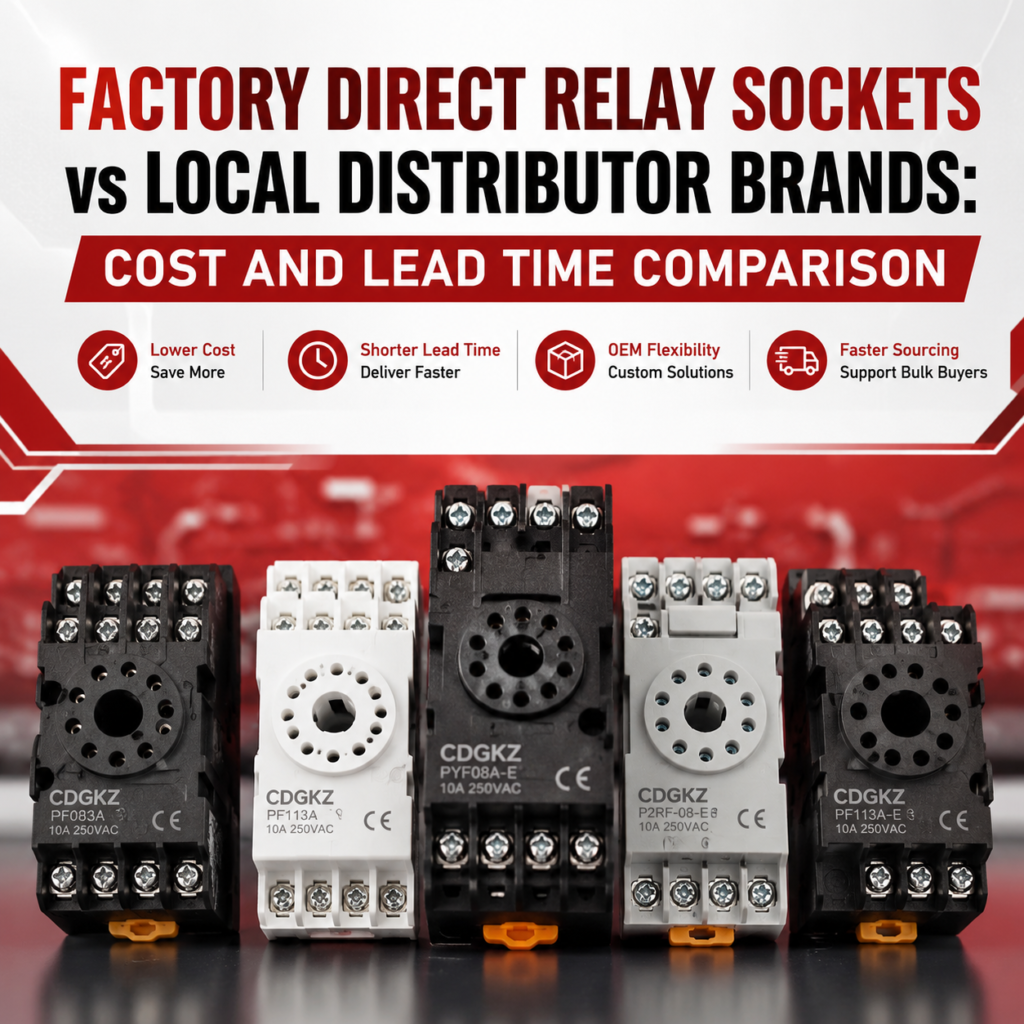
Factory Direct Relay Sockets vs Local Distributor Brands: Cost and Lead Time Comparison
When buyers compare factory direct relay sockets with distributor-stocked brands, the real pain point is not just unit price but the mix of relay socket factory price, relay socket bulk order price, and uncertain replenishment. For importers, panel builders, and partners searching for a relay socket manufacturer in China or a factory direct relay socket supplier, the goal is simple: reduce cost, shorten lead time, and speed up matching from a model, a photo, or technical specifications.
TL;DR
- For emergency replacement, local distributors can be useful because authorized channels such as DigiKey and Mouser publish live inventory and fast shipping options; however, those channels also reflect branded pricing and stock-dependent availability.
- For planned procurement, a bulk relay socket supplier or wholesale relay sockets for distributors program usually has a stronger cost structure because it removes at least one sales layer and is designed around MOQ, standardization, and longer forecasts. CDGKZ’s published socket pages explicitly position factory-direct pricing, low MOQ for custom programs, and fast turnaround as core offers.
- For compatibility-driven sourcing, the winning workflow is not “brand swap first,” but relay socket replacement by model number or relay socket matching by photo and specifications. CDGKZ’s own replacement guidance asks buyers to send the original part number, photos, coil voltage, contact form, pin map, dimensions, and expected quantity.
- For distributors and OEM buyers, CDGKZ’s strongest conversion advantage is the combination of OEM relay socket manufacturer capability, private label relay socket supplier support, and published compatibility with European, Japanese, and Korean relay formats.
Why the channel structure changes total cost
The price gap between factory-direct and distributor-channel buying is easiest to understand as a channel-structure issue. DigiKey describes itself as a global distributor focused on broad inventory and delivery speed, and Mouser likewise positions itself as a large authorized distributor with extensive component selection. That service model is valuable, but it also means the buyer is purchasing not only the socket, but warehousing, inventory carrying, channel support, and branded commercial margin.
Public examples show how that plays out. On DigiKey, an Omron P2RF-05-S relay socket is listed at $9.23 for one piece and $6.52 at 1,000 pieces; a Finder 97.01SPA socket is listed at $7.97 for one piece and $5.63 at 1,000 pieces; on Mouser, Omron P2RF-08S appears at $15.60 for one piece. By contrast, CDGKZ’s own relay socket price guide states that many manufacturer-direct relay sockets in China sell in roughly the $0.15 to $2.00 per piece range depending on specification and MOQ. This is not a like-for-like SKU comparison across every certification level or every housing style, but it is a useful directional benchmark for relay socket distributor price comparison and relay socket cost comparison.
| Brand / Supply Channel | Reference Model | Public Source | 1-Piece Price | 1,000-Piece Price | Manufacturer-Direct Benchmark | Purchasing Observation |
|---|---|---|---|---|---|---|
| Omron — Distributor | P2RF-05-S | DigiKey | US$9.23 / pc | US$6.52 / pc | US$0.15–2.00 / pc | Public volume pricing is lower than the single-piece price, but it remains considerably above the typical Chinese manufacturer-direct range. |
| Finder — Distributor | 97.01SPA | DigiKey | US$7.97 / pc | US$5.63 / pc | US$0.15–2.00 / pc | The distributor offers a quantity discount, although the listed 1,000-piece price still includes brand and distribution-channel premiums. |
| Omron — Distributor | P2RF-08S | Mouser | US$15.60 / pc | Not stated in this snapshot | US$0.15–2.00 / pc | The public single-piece price illustrates the cost difference between distributor-side branded sourcing and manufacturer-direct procurement. |
| CDGKZ — Manufacturer Direct | Multiple relay socket specifications | CDGKZ relay socket price guide | From approximately US$0.15 / pc | MOQ-based quotation | US$0.15–2.00 / pc | Pricing varies by pin count, material, terminal design, rated current, accessories, certification requirements, customization and MOQ. |
Important: This table is a directional public price benchmark rather than a strict like-for-like comparison of identical SKUs.
Different products may use different housing designs, terminal structures, mounting methods, current ratings, accessories and certification levels.
Distributor prices may also vary according to inventory, purchase quantity, delivery location, taxes and market conditions.
Key Takeaways
- Distributor channels are strongest for stocked, urgent requirements, but they usually do not win on relay socket bulk order price.
- Factory-direct sourcing becomes more compelling when specifications are stable, volume is predictable, and the buyer wants a low cost relay socket manufacturer instead of a retail-style channel.
- For conversion-focused messaging, “cost savings” works best when paired with compatibility and MOQ clarity, not as a standalone price claim.
Learn more about PCB relay socket options and relay socket specs selection guides.
Where lead time expands in distributor-brand purchasing
Lead time is where the difference between factory direct vs local distributor relay sockets becomes operational rather than theoretical. Distributor channels can be extremely fast when inventory is on the shelf, but when the exact model is not in stock, buyers move from “same-day shipping” to the much slower world of manufacturer replenishment. Public listings illustrate this clearly: DigiKey shows a 6-week manufacturer standard lead time for Finder 93.63.0.125, while DigiKey’s Omron P2RF-08-S page in another locale shows a 15-week standard lead time; Mouser’s Schneider relay socket category page shows factory lead-time around 6 weeks on listed items. For buyers running control-panel builds or distributor replenishment cycles, that variability matters as much as unit price.
CDGKZ’s factory-side positioning is built around compressing that uncertainty. Its push-in relay socket pages describe fast turnaround times, competitive factory-direct pricing, and low MOQ for custom orders. The same family of pages also states that the company supports customizable pin counts, contact types, voltages, and mounting styles, and one page says buyers can get a quote within 24 hours. In CDGKZ’s OMRON-compatible article, the company further claims that standard compatible orders ship in two to three weeks, with faster handling for urgent projects. Those are company claims rather than independent distributor listings, but they directly reflect how a short lead time relay socket supplier wants to narrow the sourcing cycle for planned B2B orders.
Lead-Time Comparison: Distributor Supply vs Factory-Direct Relay Socket Programs
Bar chart showing public distributor lead times of 6–15 weeks versus factory-direct compatible socket programs positioned at roughly 2–3 weeks.
A fair conclusion is this: distributors win urgent spot buys when stock exists; factories win forecast-driven procurement, OEM rollouts, and private-label projects when buyers need fast delivery relay sockets without re-entering a branded replenishment queue.
Key Takeaways
- The real lead-time risk in distributor buying is not the branded SKU itself; it is the switch from stocked inventory to factory replenishment.
- A factory-direct partner is most attractive when the buyer values planning stability, shorter replenishment cycles, and engineering response speed.
- Messaging around relay socket lead time comparison should emphasize fewer handoffs, not just “faster shipping.”
Read the relay model numbering guide for Schneider, Siemens, IDEC, Finder & OMRON.
Why compatibility matters more than brand labels in bulk sourcing
Bulk buyers rarely lose orders because they cannot find “a relay socket.” They lose them because they cannot confirm compatibility fast enough. That is why the most commercial long-tail terms in this topic are not broad catalog phrases, but intent-heavy phrases such as Omron Finder Schneider compatible relay sockets, relay socket replacement by model number, and relay socket matching by photo and specifications. CDGKZ’s official pages repeatedly support this positioning. Its PCB relay socket page states that the company offers socket types compliant with European, Japanese, and Korean relay formats, while its replacement guide asks buyers to send the original part number, top and bottom photos, coil voltage and frequency, contact form and load type, socket or pin map, mounting dimensions, special environmental requirements, and expected quantity.
That workflow is commercially powerful because it removes the hesitation between research and inquiry. Instead of forcing a distributor or panel builder to decode every socket family manually, CDGKZ turns the process into a sourcing shortcut: send the model, send the photo, send the parameters, and receive a matched proposal. The company’s compatibility content around OMRON MY and Schneider alternatives reinforces the same value proposition, framing CDGKZ as a relay base alternative supplier, DIN rail relay socket supplier, plug-in relay base manufacturer, and custom relay socket OEM factory for buyers who need drop-in or near-drop-in solutions.
This also aligns with the product logic of the branded families themselves. Omron’s P2RF socket family supports multiple related devices and offers DIN-track or screw mounting, while Schneider’s RXZE1M2C highlights easy installation, socket-based connection, and flexible use across relay applications. In other words, compatibility is already central in the branded world; CDGKZ’s advantage is that it packages compatibility for conversion, customization, and factory-direct pricing.
Key Takeaways
- The strongest conversion keyword is often not “cheap relay socket,” but “match my model, photo, and specs.”
- Compatibility-driven pages are especially effective for distributors, MRO buyers, and panel builders replacing mixed legacy inventories.
- CDGKZ’s edge is not only price; it is a faster path from uncertain part identification to a quote-ready, technically screened inquiry.
Why CDGKZ fits distributors, bulk buyers, and private-label programs
For distributors and large-volume buyers, the procurement question is usually broader than “Can this socket work?” It becomes: “Can this supplier support repeat orders, multi-format compatibility, OEM branding, and documentation without slowing the next shipment?” CDGKZ’s official site positions the company as a relay and socket manufacturer with decades of experience, a factory in Yueqing, ISO9001/CE/RoHS credentials on product pages, and relay socket programs spanning PCB, push-in, panel, and DIN-rail styles. Its published socket pages also mention low MOQ, factory-direct pricing, fast turnaround, customizable pin counts from 4 to 14 pins, and support for industrial, automotive, telecom, and automation applications.
This matters because it answers the usual objections from distributors. A local channel can deliver one emergency part; a factory-direct partner can support catalog building, customer-specific packaging, and margin protection. CDGKZ’s OMRON- and Schneider-focused content openly targets exactly that audience: distributors, panel builders, OEMs, and brand owners looking for lower cost, faster response, and flexible OEM/ODM service. That makes CDGKZ especially relevant for anyone searching terms like wholesale relay sockets for distributors, bulk relay socket supplier, OEM relay socket manufacturer, and private label relay socket supplier.
The standards angle supports the positioning as well. IEC 61810 is part of the recognized framework for electromechanical relay requirements and tests, including forcibly guided contact relays, while UL 508 covers industrial control equipment used for starting, stopping, regulating, controlling, or protecting electric motors. For export-minded buyers, a factory-direct source needs not only a lower quote but also a standards-aware documentation mindset.
Key Takeaways
- A distributor-friendly factory partner should support margin, customization, and documentation, not only manufacturing.
- CDGKZ’s most persuasive advantages are factory-direct pricing, broad compatibility, OEM/ODM flexibility, and inquiry-friendly technical matching.
- Standards-aware sourcing helps bulk buyers reduce downstream compliance friction in industrial markets.
View the complete relay socket catalog and push-in relay socket wholesale options.
FAQ
Is factory-direct always cheaper than buying relay sockets from a local distributor?
Not always on a one-piece emergency order. Distributor channels can be efficient when stock is available immediately. But for repeat purchasing, distributor catalogs frequently show branded socket prices in the roughly $7 to $18 range for common examples, while CDGKZ’s manufacturer-side guide places many factory-direct socket projects in a much lower range depending on specification and MOQ.
What should a buyer send to get an accurate replacement recommendation?
The best inquiry includes the original model number, full body markings, top and bottom photos, coil voltage and frequency, contact form, load type, socket or pin map, mounting dimensions, sealing or environmental requirements, and expected quantity. That is the most direct path to relay socket replacement by model number and relay socket matching by photo and specifications.
Can CDGKZ support branded compatibility and private-label projects at the same time?
CDGKZ’s published pages say yes. The company promotes compatibility with European, Japanese, and Korean relay formats, customized pin counts and mounting styles, factory-direct pricing, low MOQ for custom programs, and OEM/ODM support for distributor and brand-owner projects.
Conclusion and CTA
If your business is comparing factory direct relay sockets against local distributor brands, the evidence points to a practical split: distributor channels are useful for urgent stocked buys, while factory-direct programs are usually better for margin, repeat procurement, customization, and shorter production-side response. That is exactly where CDGKZ is trying to win—through relay socket manufacturer in China positioning, factory direct relay socket supplier economics, relay socket cost comparison clarity, and a sourcing workflow built around compatibility rather than catalog friction.
For distributors, OEMs, and panel builders, the most conversion-friendly next step is simple: send your relay model number, top and bottom photos, pin map, coil voltage, contact form, mounting dimensions, and expected quantity. CDGKZ can then evaluate Omron Finder Schneider compatible relay sockets, recommend relay socket replacement by model number, assist with relay socket matching by photo and specifications, and prepare a CDGKZ relay socket quotation for bulk, OEM, or private-label supply. Whether a buyer types CDGKZ Raley and raley socket or the correct product name, the commercial intent is the same: find a reliable, lower-cost, shorter-cycle source for relay and relay socket supply.
