
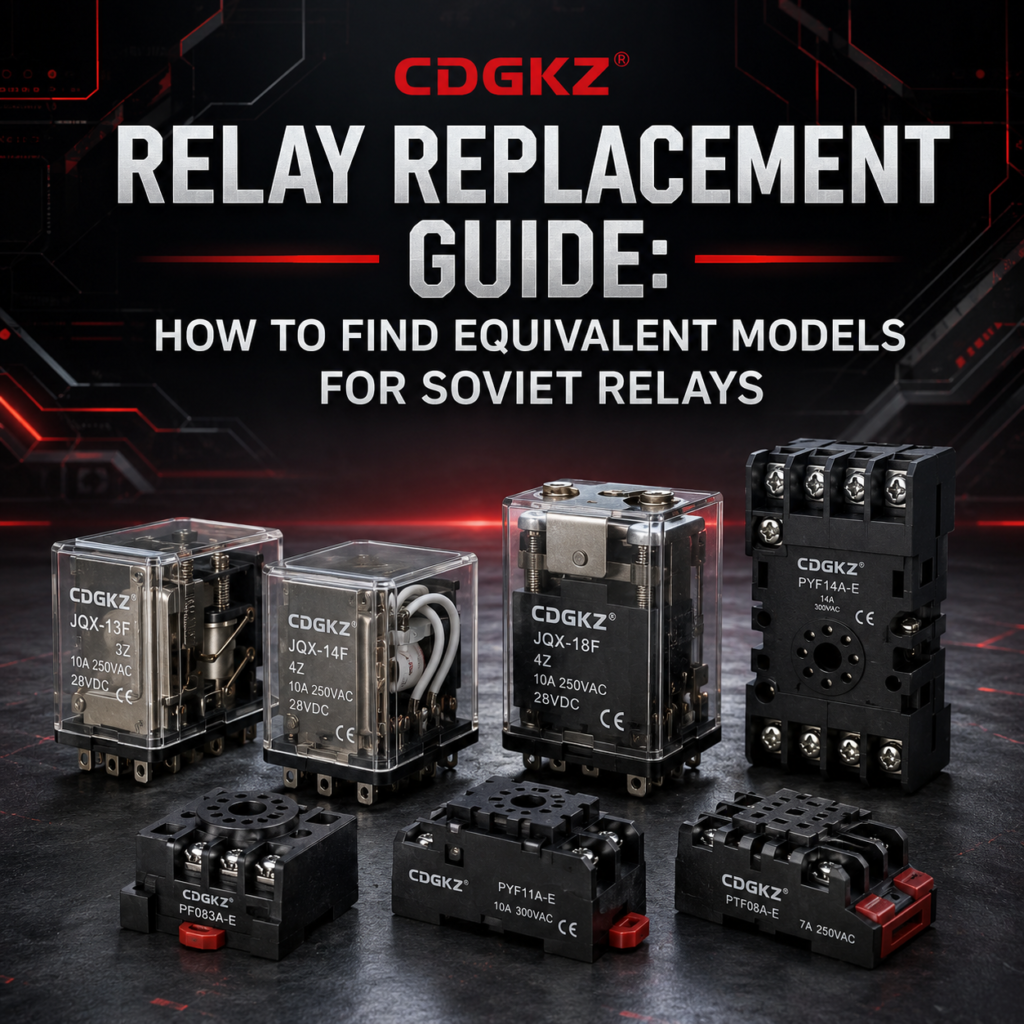
Relay Replacement Guide: How to Find Equivalent Models for Soviet Relays
If you are looking for a Soviet relay replacement, Soviet relay equivalent, Soviet relay cross reference, Soviet relay model comparison, or a Soviet relay replacement guide, the real problem is validation: legacy markings are incomplete, socket systems vary, sealing terms are often misunderstood, and a wrong substitute can fail under actual load or vibration. This page also covers Soviet electromagnetic relay replacement, Soviet plug in relay equivalent, Soviet control relay alternative, Soviet sealed relay replacement, Soviet aviation relay equivalent, Soviet military relay alternative, Soviet industrial relay replacement, Soviet relay socket replacement, Soviet relay to Chinese relay equivalent, Russian Soviet relay equivalent replacement, obsolete Soviet relay replacement, custom Soviet relay replacement solution, CDGKZ Soviet relay replacement solution, and CDGKZ OEM relay equivalent manufacturer searches, with CDGKZ Raley positioned as the inquiry path.
TL;DR
- Start with the right rulebook: IEC 61810-1 is the baseline general-and-safety standard for electromechanical elementary relays in low-voltage equipment, while MIL-PRF-6106 is the more appropriate reference when the job is really an aviation, military, or harsh-environment relay replacement.
- Never choose a Soviet relay equivalent by coil voltage alone. Panasonic and Omron both emphasize that relay selection must account for coil specification, contact specification, life, operating times, vibration, shock, mounting, size, and actual operating conditions.
- Socket compatibility matters as much as the relay body. Schneider’s plug-in systems separate 8-pin and 11-pin socket families, while CDGKZ publicly offers 4- to 14-pin socket options across DIN-rail, panel, and PCB mounting styles.
- “Wash-tight,” “sealed,” and “hermetically sealed” are not interchangeable. TE defines them as different protection classes and explicitly states that wash-tight is not the same as hermetically sealed.
- For the fastest quote on an obsolete Soviet relay replacement, send the original model number, all visible markings, top and bottom photos, coil/contact data, socket or pin map, environmental requirements, and quantity; that is the information modern relay selection guides and CDGKZ’s custom-support pages both imply is needed for a safe equivalency review.
Authority standards referenced in this article: IEC 61810-1 and MIL-PRF-6106.
Why Soviet relay replacement is a verification job, not a brand swap
For any Soviet relay replacement or Soviet relay equivalent project, the first principle is simple: a part with the “same voltage” is not automatically a safe substitute. IEC 61810-1 defines the functional and safety framework for electromechanical relays used in low-voltage equipment, but it also makes clear that when an application imposes extra demands, the relay must be assessed against the relevant application standards as well. Panasonic’s relay cautions go even further, warning that catalog data are only reference data and that relays must be tested over a practical range under real operating conditions because ambient conditions can cause unexpected failure. Omron’s technical guidance aligns with that view, noting that electrical durability depends heavily on the actual drive circuit, load type, switching frequency, switching phase, and atmosphere.
That is why a credible Soviet relay cross reference or Soviet relay model comparison is never just a name swap. It must compare the full operating envelope: coil behavior, contact behavior, life target, mechanical fit, inlet wiring, socket family, and environment. This matters even more in obsolete Soviet relay replacement work, where legacy documents may be incomplete, field wiring may have been modified, and the original relay may have spent years in heat, vibration, contamination, or intermittent overload. If your goal is a Soviet control relay alternative or Soviet industrial relay replacement, treat the project as an engineering verification exercise first and a sourcing exercise second. That mindset reduces field failures and prevents expensive false matches.
Key Takeaways
- A true Soviet relay equivalent must match the application, not just the printed rating.
- Catalog values are guidance; real installation conditions can change life and performance materially.
- For legacy parts, the safest workflow is specification review, mechanical check, and sample validation under real load.
Learn more about relay socket specs and selection parameters for panel and PCB projects.
How to build a reliable Soviet relay cross reference
A practical Soviet relay replacement guide should convert every unknown legacy part into a comparison worksheet. Panasonic’s own selection checklist is a strong template: verify coil specification, contact arrangement, contact rating, contact material, life, operate time, release time, bounce time, switching frequency, vibration resistance, shock resistance, ambient temperature, dielectric strength, mounting, size, and protection construction. Omron complements that by stressing that coil ratings must not be exceeded and that actual use conditions must be checked instead of assumed. Finder’s technical guide is especially helpful on the contact side because it separates AC1 resistive duty from AC15 inductive duty and explains that rated switching voltage is not the same thing as maximum switching voltage for insulation and design limits.
This is where many Soviet electromagnetic relay replacement projects fail. Buyers often compare only current and voltage, but not the type of load. Panasonic warns that poor suppression layouts can make contacts susceptible to welding, while TE notes that improper coil suppression can cause random tack welding on inductive or high-inrush loads. Omron similarly says that relay durability depends on the real drive circuit and actual load conditions. In other words, a Soviet relay to Chinese relay equivalent becomes credible only when coil system, contact duty, protection network, life target, and mechanical envelope all line up together. That is the difference between a cosmetic cross reference and a working replacement.
| Original Model | Coil Voltage & Frequency | Contact Form | Contact Duty Class | Pin Count | Socket Style | Sealing Level | Load Type | Vibration Requirement | Candidate Equivalent |
|---|---|---|---|---|---|---|---|---|---|
| РПС32 | 24VDC / 110VAC / 220VAC, 50Hz | DPDT / 2CO | Industrial control duty | 8-pin / 11-pin | Plug-in socket or DIN rail adapter | Standard or dust-protected | Control circuit, signal switching | Normal panel vibration | Modern plug-in electromagnetic relay + matching socket |
| РПС45 | 24VDC / 48VDC / 220VAC, 50Hz | 3CO / 4CO | Medium-duty control relay | 11-pin / 14-pin | Panel-mounted or DIN rail socket | Dust cover / optional sealed version | PLC interface, motor control signal | Medium vibration environment | 4-pole industrial relay with socket adaptation |
| РПБ5 | 12VDC / 24VDC / 110VDC | SPDT / DPDT | Signal and auxiliary duty | 8-pin / custom pin layout | Legacy plug-in base | Sealed or semi-sealed | Low-current signal, protection circuit | Higher vibration resistance required | Sealed electromagnetic relay or custom equivalent solution |
| РСМ | 27VDC / 110VDC / 220VAC | Multiple contact combinations | Heavy-duty switching | Custom pin count | Original Soviet socket or wired base | Industrial sealed type | Inductive load, control cabinet circuit | High vibration / shock requirement | Custom relay replacement after load and socket verification |
| РКН | 24VDC / 48VDC / 220VAC | NO / NC / changeover contacts | Control and protection duty | 8-pin / 11-pin / special layout | Socket replacement or adapter wiring | Standard / sealed option | Relay logic, alarm, control signal | According to cabinet or equipment condition | Chinese relay equivalent with matched coil, contacts, and socket |
Key Takeaways
- A correct Soviet relay cross reference starts with a worksheet, not a guess.
- Contact duty class and suppression method can matter as much as nominal amperage.
- If a load is inductive, motor-driven, or high-inrush, test evidence matters more than marketing labels.
When plug-in, sealed, aviation, and military relays need different paths
Socket and sealing issues are where many Soviet plug in relay equivalent requests go off course. Schneider’s Zelio plug-in documentation distinguishes socket families for 8-pin and 11-pin relays and shows that those sockets may be DIN-rail or panel mounted, which is a reminder that the relay and the socket form a system, not two separate afterthoughts. TE’s terminology guide makes an equally important distinction on protection: RT III is wash-tight, RT IV is sealed, and RT V is hermetically sealed; TE explicitly says wash-tight is not identical to hermetically sealed. For Soviet sealed relay replacement work, that difference is critical. A cabinet relay that tolerates cleaning is not automatically a valid substitute for a relay that must survive permanent exposure to contaminants, altitude, or pressure-related requirements.
The harsh-environment path is stricter still. DLA’s MIL-PRF-6106 covers electromechanical relays intended for demanding platforms such as aircraft, missile, spacecraft, shipboard, and ground-support equipment, and DLA specification sheets include both environmentally sealed and hermetically sealed variants. One DLA sheet also specifies that the gasket must provide a reliable seal between the relay and mating socket, which reinforces the point that socket replacement is part of the engineering problem. TE’s DRI portfolio likewise presents hermetically sealed relays and sockets for aerospace, military, rail, and space service. So if the request is truly a Soviet aviation relay equivalent, Soviet military relay alternative, or Russian Soviet relay equivalent replacement, the safest answer is often a qualified harsh-environment family or a custom-engineered replacement path, not a generic industrial plug-in relay.

Key Takeaways
- Socket family, mounting method, and sealing class must be checked together.
- Wash-tight, sealed, and hermetic are different protection levels, not interchangeable sales words.
- Aviation and military replacements should be screened against harsh-environment standards, not only industrial cabinet assumptions.
Explore push-in and DIN-rail relay socket options for plug-in relay replacement projects.
Why CDGKZ Raley is a practical supplier for Soviet relay to Chinese relay equivalent projects
This is where CDGKZ Raley can be positioned as a practical equivalent-model supplier instead of a blind “drop-in promise.” On its official pages, CDGKZ describes itself as a relay and relay-socket manufacturer with about 18 years of experience, more than 30 series and hundreds of models, and public compliance or certification claims across its site including RoHS, 3C, CE, UL, CAS, and ISO 9001-related credentials. Its published portfolio covers industrial relays, PCB relay sockets, push-in sockets, relay modules, and custom relay/socket work. Public product pages show 4- to 14-pin options, DIN-rail, panel, and PCB mounting styles, low-voltage DC and AC coil-voltage choices, and current ratings up to 40 A on some push-in socket lines.
For conversion-oriented sourcing, the stronger message is customization rather than overpromising universal interchangeability. CDGKZ’s service page advertises free samples, tailored relay modifications, branding and packaging changes, and after-sales support including a 5-year warranty and 48-hour failure response. Its custom-socket pages also highlight tailored pin configurations and coil-voltage accommodations. Based on those published capabilities, a reasonable inference is that many projects labeled as a Soviet relay equivalent model supplier request, custom Soviet relay replacement solution, Soviet relay socket replacement, or CDGKZ Soviet relay replacement solution are best handled as OEM engineering reviews. That positioning is more credible for procurement teams because it recognizes the reality of obsolete Soviet relay replacement work: sometimes the correct answer is an off-the-shelf socket and relay; sometimes it is a custom relay-plus-socket package that matches the legacy footprint and duty more accurately.
Key Takeaways
- CDGKZ’s public strengths are breadth of socket formats, OEM customization, and application support.
- For legacy Soviet relay projects, a custom review is often more trustworthy than claiming universal plug-and-play substitution. That is an inference from CDGKZ’s published custom-service emphasis.
- The best conversion path is to combine standards-based verification with CDGKZ’s relay, socket, and OEM support.
FAQ
Can I replace a Soviet relay with any model that has the same coil voltage?
No. Panasonic and Omron both state that safe relay selection must consider more than the coil: contact arrangement, contact rating, life, operating times, vibration, shock, size, mounting, protection construction, and actual use conditions all affect suitability.
What is the difference between wash-tight, sealed, and hermetically sealed relays?
TE defines wash-tight relays as RT III, sealed relays as RT IV, and hermetically sealed relays as RT V, and explicitly says that wash-tight is not the same as hermetically sealed. That distinction matters in Soviet sealed relay replacement and especially in aviation or military applications.
What should I send to request a Soviet relay equivalent from CDGKZ?
Send the original part number and full body markings, top and bottom photos, coil voltage and frequency, contact form and load type, socket or pin map, mounting dimensions, environmental or sealing requirements, and expected quantity. Those fields align with Panasonic’s and Omron’s selection logic, and CDGKZ’s service pages show that custom specs and sample-based support are part of its OEM workflow.
Conclusion and call to action
Finding the right Soviet relay replacement is not only about matching a model number. A reliable Soviet relay equivalent must be checked against coil voltage and frequency, contact form, load type, socket style, sealing level, vibration requirement, and the real working environment. For obsolete Soviet relays, especially sealed, aviation, military, or harsh-environment models, the safest path is not a simple brand swap, but a structured Soviet relay cross reference and sample validation process.
If you are looking for a Soviet electromagnetic relay replacement, Soviet plug in relay equivalent, Soviet sealed relay replacement, Soviet aviation relay equivalent, Soviet military relay alternative, or a Soviet relay to Chinese relay equivalent, CDGKZ Raley can help you review the model, compare the electrical and mechanical parameters, and recommend a practical replacement path.
Send us your original Soviet relay model, product photos, pin layout, coil voltage, contact rating, socket details, application environment, and expected quantity. Our team can help you check whether a standard industrial relay, sealed relay, hermetic relay, military-qualified alternative, or custom relay socket solution is the right choice.
Need help finding an equivalent model? Contact CDGKZ Raley today and send us your relay photos or part number. We will help you build a safe, practical, and cost-effective Soviet relay replacement solution.
