
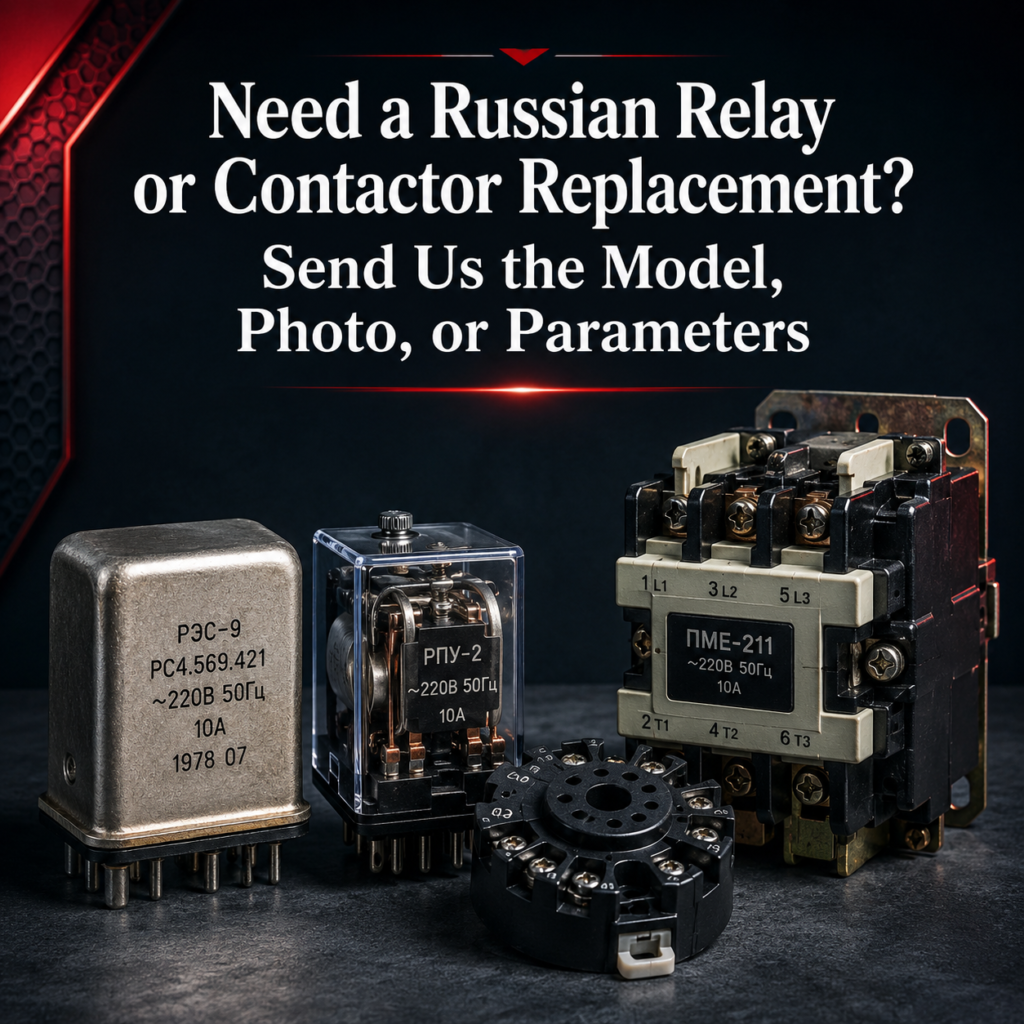
Need a Russian Relay or Contactor Replacement? Send Us the Model, Photo, or Parameters
If you are searching for a Russian relay cross reference, Russian contactor cross reference, Russian relay equivalent replacement, Soviet relay replacement, Soviet contactor replacement, Russian industrial relay replacement, Russian electromagnetic relay equivalent, Russian plug in relay equivalent, Russian relay socket replacement, Russian control relay alternative, Russian timer relay equivalent, Russian sealed relay replacement, Russian aviation relay equivalent, Russian military relay alternative, Russian relay model comparison, Russian relay replacement by model number, Russian relay replacement by photo, Russian contactor equivalent by voltage and current, Russian relay to Chinese relay equivalent, or a CDGKZ Russian relay and contactor replacement solution, the main risk is not shortage alone. The real problem is replacing legacy hardware without breaking coil compatibility, contact duty, socket fit, environmental tolerance, or standards compliance.
TL;DR
- A reliable Russian or Soviet relay replacement starts with function first, package second: coil voltage, contact form, utilization category, mounting, and environment must be checked before brand or appearance.
- For plug-in industrial relays, socket compatibility is critical. Omron explicitly warns against mixing unspecified sockets, and Finder maps exact relay series to exact socket families.
- For legacy Russian sealed, aviation, and military relays, a modern open-frame industrial cube relay is usually not a safe substitute; hermetic sealing, shock, vibration, and qualification class matter.
- For Russian contactor replacement by voltage and current, use AC-3 or the applicable IEC duty category, match coil voltage, and then verify auxiliary contacts, overload coordination, and mounting.
- According to its website, CDGKZ Contactor and relay-related product lines cover more than 30 series and hundreds of models, including relay sockets, intermediate relays, solid-state relays, and relay modules, making CDGKZ suitable as a sourcing and adaptation partner when exact legacy replacements are unavailable.
Why Russian and Soviet relay replacement projects fail
Most failed Soviet relay replacement and Russian industrial relay replacement projects come from treating all relays as interchangeable switching blocks. They are not. IEC 61810-1 applies to electromechanical elementary relays used in low-voltage equipment, while IEC 60947-4-1 applies to electromechanical contactors and motor-starters. In other words, a “relay” problem and a “contactor” problem belong to different duty classes, test expectations, and selection rules.
Legacy Russian catalogs make this even more obvious. The SKTB relay catalog lists very different device families under one broad ecosystem: non-polarized relays, polarized relays, reed relays, time relays, and static switching relays. It also shows that models such as REK 87, REK 80, and REK 81 are small hermetically sealed relays, while REP 26 is a larger slave relay and RDV11 is a contactless time-delay relay. These are not drop-in substitutes for one another, even if the housing size looks familiar in a photo.
For aviation and military relay work, the mistake is even costlier. TE explains that MIL relay selection must consider not only contact configuration and coil voltage, but also terminal style, mounting style, altitude, humidity, shock, vibration, and the governing MIL specification. DLA’s MIL-PRF-6106 covers electromagnetic relays/contactors in the 25 A and above class, while MIL-PRF-83536 covers lower-current qualified aerospace relays. That is why a Russian aviation relay equivalent or Russian military relay alternative should be chosen by qualification envelope, not by visual similarity.

Key Takeaways
- Russian relay model comparison must start by separating relay, timer relay, sealed relay, and contactor
- Russian aviation relay equivalent and Russian military relay alternative decisions require environmental and qualification checks, not only electrical checks.
- Soviet contactor replacement should be handled under contactor standards and duty categories, not relay logic.
A practical cross reference workflow by model number, photo, and nameplate
The safest Russian relay replacement by model number begins with five hard data points: model marking, coil voltage, contact arrangement, switching rating, and mechanical format. For example, IEK publishes KMI contactor model families with explicit AC-3 current, available coil voltages, and auxiliary contact versions. The SKTB catalog similarly identifies whether a relay is hermetic, plastic, monostable, bistable, time-delay, or static switching. Those clues are more useful than a reseller description.
Russian relay replacement by photo is useful, but only as a screening step. This is an inference from manufacturer guidance: Omron warns that unspecified sockets can cause abnormal heating at the mating point, Finder maps exact relay series to specific sockets, and TE highlights terminal type and mounting style as core selection attributes. Together, these sources mean that a photo can help identify package family, pin count, and mounting intent, but it cannot confirm safe interchangeability on its own.
For Russian plug in relay equivalent and Russian relay socket replacement work, verify not only pin count but also socket family, rail or panel mounting, clamp style, and wiring rating. Finder’s 94 Series shows how different sockets in the same family are assigned to specific 55 Series relay variants, including PCB sockets, panel sockets, 35 mm EN 60715 rail sockets, and push-in options. Omron’s MY family similarly emphasizes socket-supported plug-in use, while H3Y timer relays are explicitly designed to be compatible with MY relay pin configuration.
This is why the best Russian relay to Chinese relay equivalent workflow is: identify legacy family, confirm electrical function, confirm mounting and socket interface, confirm environmental class, and only then shortlist Chinese or global replacements. That sequence works for Russian relay cross reference, Russian control relay alternative, Russian timer relay equivalent, and Russian sealed relay replacement projects alike.

Key Takeaways
- Photo matching is helpful, but final approval requires pinout, socket, rating, and environment
- Russian relay socket replacement must be validated as carefully as the relay itself.
- Timer and plug-in relay replacements should be chosen by function and socket system, not case shape alone.
Starter cross reference table for common Russian and Soviet models
No source images were attached to this brief, so the table below is a public-catalog starter table rather than an exhaustive image-derived database. The legacy model facts come from SKTB and IEK published catalogs, while the “modern replacement direction” reflects current manufacturer families from TE, Omron, Finder, Schneider Electric, and Hongfa. Treat this as an engineering shortlist, not as an unconditional drop-in list.
| Legacy Russian / Soviet Model | Device Family | Public Catalog Characteristics | Key Parameters to Verify | Recommended Modern Replacement Path | Replacement Risk | Inquiry Data to Send |
|---|---|---|---|---|---|---|
| РПС32 / RPS32 | Sealed polarized relay | Low-current electromagnetic polarized bistable relay; hermetically sealed; typically used for switching DC and AC control circuits. | Coil voltage, bistable operation, contact form, terminal style, sealing level, vibration requirement. | Use a sealed latching signal relay or custom 2CO sealed relay solution. Do not replace only by pin count. | High | Send model photo, bottom pin photo, coil marking, and application environment. |
| РПС45 / RPS45 | Sealed polarized relay | Low-current electromagnetic polarized bistable sealed relay; versions may differ by terminal structure. | Rated voltage, terminal type, contact load, operate time, hermetic version, climate version. | Choose sealed bistable relay family first, then confirm terminal adaptation or custom socket conversion. | High | Send side marking, terminal photo, coil voltage, and original circuit function. |
| РП4 / RP-4 | Low-current polarized relay | Electromagnetic low-current polarized relay; commonly used in low-voltage DC circuits. | DC coil/current data, change-over contact rating, switching voltage/current, mounting style, polarity requirement. | Use a miniature polarized signal relay or custom low-current relay solution after confirming coil and contact sensitivity. | High | Send model suffix, circuit voltage, contact load, and actual switching current. |
| РСМ / RSM / PCM | Cased monostable relay | Cased monostable relay; versions may include one or two NO/NC contact arrangements. | Number of contacts, NO/NC arrangement, coil power, operating temperature, humidity requirement. | Use industrial signal relay, miniature control relay, or custom socket adapter depending on contact arrangement. | Medium | Send contact diagram, coil voltage, and front / bottom photos. |
| РКС3 / RKS3 | Low-current electromagnetic relay | Low-current DC electromagnetic relay; used for switching DC and AC circuits in automation and communication equipment. | DC coil voltage, contact material, switching frequency, contact load, temperature, vibration. | Use a low-current signal relay or sealed relay path depending on environmental and contact requirements. | Medium | Send full type code, coil data, contact load, and working environment. |
| РКМП / RKMP-1 | Neutral low-current relay | Electromagnetic low-current neutral relay family; different versions may vary by voltage, resistance, and contact structure. | Exact passport number, nominal voltage, coil resistance, contact quantity, dimensions, mounting direction. | Use compact control relay or custom relay module after checking coil sensitivity and dimensions. | Medium | Send passport number, coil voltage, wiring photo, and space limitation. |
| РВМ / RVM | Time relay | Time relay family used for delay, sequencing, and control logic applications. | Timing mode, time range, supply voltage, output contact type, reset behavior, accuracy requirement. | Use modern DIN-rail time relay or custom timer relay module. Function matching is more important than shape matching. | High | Send timing range, wiring diagram, supply voltage, and required delay function. |
| КМ / KM Series | AC contactor | Electromagnetic contactor family for AC circuits, motor control, starting, stopping, and reversing applications. | Main current, AC voltage, utilization category, coil voltage, auxiliary contacts, mounting dimensions. | Use modern IEC AC contactor replacement; select by AC-3 / AC-1 load category, motor kW, coil voltage, and auxiliary block. | Medium | Send motor power, main voltage/current, coil voltage, and front label photo. |
| КП / KP Series | Heavy-duty DC contactor | DC electromagnetic contactor family for high-power DC generator, motor, or braking circuits. | DC voltage, breaking current, duty cycle, arc suppression, coil voltage, mounting, cooling space. | Use heavy-duty DC contactor or engineered DC switching solution. Must validate DC breaking capacity and thermal margin. | Critical | Send load curve, DC voltage/current, duty cycle, and cabinet installation photo. |
| ТКД / TKD Series | Low-voltage DC contactor | Electromagnetic contactor series for DC switching; often used with inductive or motor loads. | Rated DC current, control voltage, load type, auxiliary contacts, mounting holes, shock/vibration. | Use compact DC contactor path; verify coil supply and DC load before choosing equivalent. | Critical | Send nameplate, load type, control voltage, and mounting dimension drawing. |
| ТКС / TKS Series | Low-voltage high-current DC contactor | High-current DC contactor family for demanding DC switching applications. | DC current, DC voltage range, coil voltage, pole/contact structure, mechanical mounting, aviation or transport environment. | Use high-current DC contactor or custom engineered equivalent. Sample testing is strongly recommended before mass replacement. | Critical | Send full model code, current rating, voltage, installation photo, and application scenario. |
The most important reading of this table is strategic. A Russian electromagnetic relay equivalent is often possible. A Russian plug in relay equivalent is often possible. But a Soviet relay replacement becomes dangerous when the original was sealed, qualified, or socket-specific, and a Russian contactor equivalent by voltage and current becomes incomplete if AC-3, AC-1, AC-15, or DC-13 duty is ignored.
Key Takeaways
- Use the table as a cross-reference starting point, not the final engineering release.
- Sealed, military, and timer models need family-level replacement logic, not visual matching.
- Russian relay replacement by model number is strongest when paired with coil, contact, and footprint verification.
How to replace Russian contactors by voltage, current, and utilization category
For Russian contactor cross reference work, the discipline is straightforward: do not compare only amperes on the label. IEC 60947-4-1 covers electromechanical contactors and motor-starters, and utilization categories such as AC-3 define the application context for the current rating. ABB specifically notes AC-3e relevance for premium-efficiency motor applications, which is a reminder that motor duty can change the correct frame choice even when the headline current looks familiar.
IEK’s published KMI range is a useful legacy baseline because it already groups contactors by AC-3 performance. The catalog states that KMI AC contactors cover 9 to 95 A AC-3, with operating voltage up to 660 V, and it lists multiple coil voltage options and auxiliary contact variants. For example, KMI-10910 is a 9 A AC-3 class unit, KMI-11810 is 18 A, KMI-23210 is 32 A, KMI-35012 is 50 A, and KMI-46512 is 65 A; higher-current versions include 1NO+1NC auxiliaries. That means a Russian contactor equivalent by voltage and current must also preserve the duty class and accessory logic.
Mainstream IEC families show how this replacement should be framed. Schneider’s TeSys D line includes contactors such as 9 A, 18 A, and 40 A AC-3 variants with defined coil voltages, while product pages and technical literature show that the family extends across the industrial contactor range. The correct engineering move is therefore: match AC-3 current, then coil voltage, then pole/auxiliary arrangement, then overload and mounting system.
External standard reference for contactors: IEC 60947-4-1.

Key Takeaways
- Russian contactor equivalent by voltage and current must include utilization category, especially AC-3 for motor control.
- Coil voltage, auxiliary contact layout, and overload coordination are part of the cross reference.
- Soviet contactor replacement is safest when treated as an IEC duty-class conversion, not a simple amperage swap.
Why CDGKZ Contactor and Chinese relay socket solutions are worth shortlisting
In supply-chain terms, many buyers now want a Russian relay to Chinese relay equivalent that is easier to source, easier to customize, and easier to adapt mechanically. Hongfa’s official materials show how broad Chinese relay ecosystems have become: the company offers industrial relays, relay sockets, modules, and a relay socket portfolio that covers traditional Japanese relay sockets, European relay sockets, direct plug-in relay sockets, and PCB relay sockets. That breadth matters when a legacy Russian relay socket replacement requires both the switching element and the mating base.
CDGKZ positions itself in exactly that adaptation layer. On its website, CDGKZ says it offers more than 30 series and hundreds of models, including ultra-thin relay sockets and relays, intermediate sockets and relays, solid-state sockets and relays, relay modules, and related industrial-control products, with certifications including RoHS, 3C, CE, UL, and CAS. It also presents one-stop customized service for inquiry, preliminary design, sample fabrication, testing, production, and shipment. For buyers facing non-standard Soviet relay replacement work, that product-plus-adaptation model is often more practical than searching endlessly for the original Soviet stock number.
This is where CDGKZ Contactor and socket support become commercially useful. If the legacy relay family is known but the original socket is obsolete, a supplier that can offer relay, relay base, DIN-rail options, and OEM adaptation reduces project friction. That does not remove the need for engineering validation—especially for Russian sealed relay replacement, Russian aviation relay equivalent, and Russian military relay alternative projects—but it does create a realistic path for industrial, panel, and cabinet-level modernization.
External standard reference for relays: IEC 61810-1.
Key Takeaways
- Chinese replacement success often depends on relay + socket + mounting adaptation, not the relay alone.
- According to its website, CDGKZ offers a broad catalog and customization flow that suits Russian relay and contactor replacement projects.
- Even when using a cost-effective Chinese path, sealed and qualified legacy applications still require strict engineering review.
FAQ
Can I replace a Russian relay only by matching the case size or product photo
Not safely. A photo can help identify package family and likely pin count, but Omron warns that unspecified socket combinations can create abnormal heating, Finder maps exact sockets to exact relay series, and TE treats terminal type and mounting style as formal selection parameters. In practice, Russian relay replacement by photo should be a first-pass identification method, followed by model-number, coil, contact, socket, and environmental verification.
What is the fastest way to find a Russian timer relay equivalent
Start with the timing function and electrical envelope, not the shape. The RDV11 catalog entry shows a contactless time-delay relay with up to 0.4 A output current and a very wide delay range, while Omron’s H3Y family and Schneider’s Harmony timing relays show how modern timer families separate function, supply voltage, and output specification. So the fastest safe workflow is: identify delay function, supply voltage, output form, and mounting style, then choose a modern timer family.
Is a modern Chinese relay always a valid Soviet relay replacement
No. It can be an excellent solution for control-cabinet and industrial automation applications, especially when socket adaptation and OEM redesign are acceptable. But for hermetically sealed, aviation, or military-style legacy devices, environmental and qualification demands may push you toward sealed or MIL-qualified families instead of standard cabinet relays.
Conclusion and CTA
A strong SEO page about Russian relay cross reference, Russian contactor cross reference, Russian relay equivalent replacement, Soviet relay replacement, Soviet contactor replacement, Russian industrial relay replacement, Russian electromagnetic relay equivalent, Russian plug in relay equivalent, Russian relay socket replacement, Russian control relay alternative, Russian timer relay equivalent, Russian sealed relay replacement, Russian aviation relay equivalent, Russian military relay alternative, Russian relay model comparison, Russian relay replacement by model number, Russian relay replacement by photo, Russian contactor equivalent by voltage and current, Russian relay to Chinese relay equivalent, and a CDGKZ Russian relay and contactor replacement solution should make one point clear: the best replacement is the one that preserves function, duty class, interface, and environment, not the one that merely resembles the legacy part.
If you need a sourcing path that combines relay, socket, panel adaptation, and OEM support, CDGKZ Contactor and related relay socket solutions are worth evaluating alongside mainstream IEC families. For industrial cabinet retrofits, plug-in control relays, timer relay upgrades, and Chinese-equivalent sourcing, that combination can shorten lead time and simplify redesign—provided the final cross reference is checked against the original specifications. According to its website, CDGKZ supports customized inquiry, design, testing, and production across a broad relay and socket product range.
Send us the original Russian relay or contactor model number, product photo, coil voltage, contact form, current rating, mounting size, and application environment. CDGKZ can help you check a suitable Chinese equivalent, relay socket adaptation, or OEM replacement solution.
