
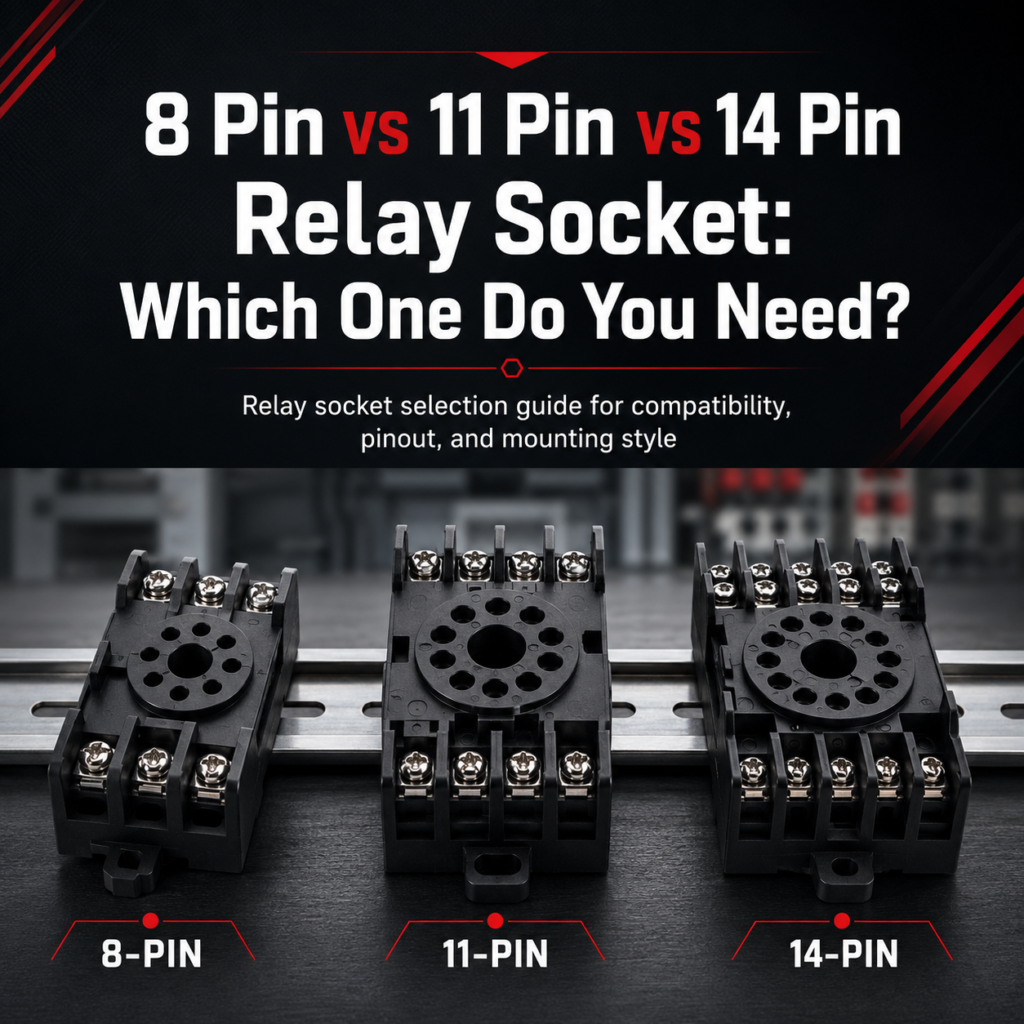
8 Pin vs 11 Pin vs 14 Pin Relay Socket:Which One Do You Need?
If you are searching for an 8 pin relay socket, 11 pin relay socket, or 14 pin relay socket, the biggest risk is choosing by pin count alone and then discovering the relay does not seat correctly, the terminal numbering is different, or the mounting style does not match your panel. This guide explains the real selection logic behind “8 pin vs 11 pin vs 14 pin relay socket” and shows how to turn compatibility questions into fast, quote-ready inquiries.
TL;DR
- Pin count is only the first filter. Real compatibility depends on the relay socket pin configuration, terminal numbering, mounting hole pattern, and the relay family the socket was designed for.
- In mainstream industrial families, 8-pin often maps to DPDT or two-changeover relays, 11-pin often maps to three-pole relays or timer relays, and 14-pin often maps to four-pole relays, but you still must verify the exact series and relay socket pinout diagram before ordering.
- DIN rail relay socket, panel mount relay socket, relay socket with screw terminals, and relay socket with LED indicator are not cosmetic differences; they change installation speed, maintenance, and cabinet layout.
- CDGKZ publicly lists 8-pin, 11-pin, and 14-pin socket options, plus DIN rail, panel, PCB, and OEM customization capabilities, which makes it easier to convert compatibility traffic into actionable inquiries.
Key Takeaways
- Start with the relay model, not just the number of pins.
- Ask for a top-view or bottom-view pinout before approving a replacement.
- Use the inquiry form to collect model, photo, voltage, current, and mounting requirements.
What Pin Count Really Means
The fastest way to explain how to choose a relay socket is this: pin count tells you the socket family, but not the socket identity. Omron’s own common socket drawings show that 8PFA, 11PFA, and 14PFA have different terminal arrangements and different mounting-hole dimensions. Even when the footprints look similar at a glance, the top-view numbering and internal connection patterns are different, which is why an installer can easily order the wrong base if they only search “8 pin relay socket” or “14 pin relay socket” without checking the diagram.
In practical industrial use, the categories usually line up with relay contact forms. Omron’s MY series associates 8-pin sockets with MY2 plug-in relays and 14-pin sockets with MY4 plug-in relays, while Omron’s LY family is offered in single-, double-, three-, and four-pole versions, and the PTF11A is an 11-pin socket used with LY3 applications. Omron’s H3CR timer documentation also shows 11-pin models paired with 11-pin sockets, which is why eleven-pin bases frequently appear in timer relay and control relay searches. Schneider’s official socket pages similarly distinguish its 8-pin RXZE1M2C from its 14-pin RXZE2M114M families.
Just as importantly, ratings vary by series.
Schneider lists the RXZE1M2C at 7 A, 250 V, Omron lists the PTF11A at 10 A, Finder lists push-in socket type 94.P3 at 10 A, 250 V, and CDGKZ lists several of its 8-pin, 11-pin, and 14-pin socket models at 10 A, 300 V. That spread is exactly why a real relay socket compatibility guide must compare the relay family, not just the number of terminals.

Key Takeaways
- Pin count is a category label, not a guaranteed interchange standard.
- The same relay socket family can still differ by current, voltage, and mounting details.
- Eleven-pin searches often overlap with timer relays and three-pole control relays.
Relay Socket Basics & Fundamentals.
Choose by Relay Model Rather Than Pin Count Alone
If your goal is relay socket matching by relay model or a replacement relay socket for industrial relay use, the safest workflow is to verify six items before quoting: relay brand and exact model, contact form, coil voltage, terminal numbering, mounting style, and required accessories. Official manufacturer pages make this pattern very clear. Finder’s 94 Series sockets are specified for particular 55 Series relays; Schneider’s RXZE1M2C is specified for RXM2 relays; Schneider’s RXZE2M114M is specified for RXM2 and RXM4 relays; and Omron’s PTF11A is specified as an 11-pin screw-terminal socket for its relay ecosystem. In other words, “Omron compatible relay socket,” “Finder compatible relay socket,” and “Schneider compatible relay socket” are useful search phrases, but they still require family-by-family verification.
This is where standards matter. IEC 61810-1 defines general and safety requirements for electromechanical elementary relays used in low-voltage equipment up to 1,000 V AC or 1,500 V DC, while IEC 60715 specifies the dimensional and functional requirements for compatible mounting on standardized rails. UL also highlights IEC/UL 61810-1 as the harmonized relay standard relevant to U.S., Canada, and international certification pathways. For buyers, the lesson is simple: the correct selection process combines standards awareness with datasheet-level checking of the specific relay/socket pair.
A good quote request should therefore ask the customer to send the relay model, the label photo, and the bottom-view or top-view pin layout. If the buyer cannot provide a datasheet, a clear relay photo and the electrical nameplate are usually enough to start screening options. This is especially important for long-tail searches like octal relay socket, plug-in relay base, industrial relay base, timer relay socket, and relay holder with screw terminals, where similar-looking products often belong to different ecosystems.
Key Takeaways
- A brand-compatible search is only the start; exact relay series matching is the real decision point.
- Standards help frame safety and mounting requirements, but the final check is still model-specific.
- Ask for the relay model, photo, and pin view before confirming any replacement.
How to Choose the Right Relay Socket for Your Relay Model
Mounting, Terminals, and Accessories That Affect the Decision
For many buyers, the deciding factor is not whether they need an 8 pin relay socket, 11 pin relay socket, or 14 pin relay socket, but whether they need a DIN rail relay socket or a panel mount relay socket. Finder’s official 94 Series pages show both 35 mm EN 60715 rail-mount types and panel-or-rail mount options such as 94.84. Omron’s PTF11A likewise specifies DIN track mounting and screw mounting, and Schneider markets its RXZ sockets around compact installation and easy relay connection. This is the difference between a fast service replacement inside a control cabinet and a labor-heavy rewiring job on a fixed panel.
Terminal style is the next filter. A relay socket with screw terminals remains the safest universal recommendation for field wiring because torque, conductor range, and repeat maintenance can all be managed predictably. For example, Omron’s PTF11A explicitly uses screw terminals, and CDGKZ’s listed 8-pin and 11-pin models publish conductor range and tightening torque data. At the same time, Finder and CDGKZ both show push-in or push-in style product paths, which are attractive when customers want faster production-line wiring or lower assembly time.
Accessories also change the buying decision. A relay socket with LED indicator is not always a native socket feature; in some ecosystems it is delivered by a suppressor or indicator module. Finder documents LED coil-indication modules for several socket families, and Schneider offers protection modules with LED indication for compatible socket systems. So when a customer says they want “the same socket as before,” you should still ask whether they also need coil indication, surge suppression, or finger-safe protection.

Key Takeaways
- Mounting style is a practical decision, not a secondary detail.
- Screw terminals are the safest default for replacement and maintenance work.
- LED indication and suppression modules should be confirmed separately in the inquiry.
Relay Socket Installation & Wiring.
How CDGKZ Can Turn Compatibility Searches Into Inquiries
From a conversion perspective, the best article strategy is to make CDGKZ visible at the moment the buyer realizes pin count alone is not enough. CDGKZ’s own site positions the company as a relay socket manufacturer in China with relay, socket, and related industrial control product lines; it also states that the brand offers more than thirty series and hundreds of models, plus resource pages for selection, standards, wiring, and technical specifications. Its push-in socket catalog states that CDGKZ supports 8-pin, 11-pin, and 14-pin configurations, with DIN rail, panel mount, and PCB mount options and OEM customization support.
The product pages also give you concrete series hooks for article inserts and product recommendations. CDGKZ publicly lists the 10F-2Z-C1 as an 8-pin socket rated 10 A, 300 V; the 13F-3Z-C3 as an 11-pin socket rated 10 A, 300 V; and the 18F-4Z-A2 as a 14-pin socket rated 10 A, 300 V. CDGKZ additionally describes custom-service steps that begin with the customer sending specifications, performance parameters, markings, and quantities, followed by preliminary design, sample fabrication, and production. That aligns well with an inquiry-first CTA.
For SEO and conversion, you can therefore place product-series blocks directly below each comparison section and use keywords such as relay socket pin configuration, relay socket pinout diagram, custom relay socket replacement solution, OEM relay socket supplier, and replacement relay socket for industrial relay. You can also capture search variations like CDGKZ relay socket, CDGKZ relay base, and even typo-driven traffic such as CDGKZ Raley and raley socket by pivoting every CTA to one action: send the relay model, photo, pin view, coil voltage, contact rating, and installation requirement for matching. That removes friction and makes the article itself function like a pre-qualification form.
Key Takeaways
- CDGKZ already has the product architecture to support model-based inquiry conversion.
- Named product examples make the article feel concrete and quote-ready.
- The strongest CTA is always: send model, photo, and parameters for compatibility checking.
FAQ
Can I replace one eight-pin socket with any other eight-pin socket
No. Even when two products are both sold as 8 pin relay socket options, terminal numbering, internal connection layout, mounting-hole dimensions, and electrical ratings can differ by family and brand. Omron’s own pinout drawings show that socket layouts are series-specific, and Schneider’s official socket pages separate 8-pin and 14-pin ecosystems by relay family.
Is an eleven-pin socket only for timer relays
No. Eleven-pin sockets are commonly used with control timers, but they also appear in multi-pole relay families. Omron documents 11-pin H3CR timer versions, and its PTF11A is an 11-pin screw-terminal socket used in the Omron relay ecosystem, including LY-family applications associated with three-pole relays.
What should a buyer send to get the right replacement recommendation
The shortest path is to send the relay brand and model, a clear label photo, a bottom-view or top-view pin image, coil voltage, contact rating, preferred mounting style, and any accessory requirements such as LED indication or suppression. CDGKZ’s custom-service flow explicitly starts with customer specifications and performance parameters, then moves to design review and sample validation.
Key Takeaways
- FAQ content should reduce fear around compatibility and replacement risk.
- The best answer to most socket questions is still model-based verification.
- A structured FAQ can also improve rich-result visibility in search.
Relay Socket Maintenance & Troubleshooting.
Closing Recommendation
If your buyer is comparing an 8 pin relay socket, 11 pin relay socket, and 14 pin relay socket, the article should keep repeating one expert message: choose by relay family, not by pin count alone. Official manufacturer data shows that pinout, mounting format, compatible relay series, and current rating all vary across socket families, while standards such as IEC 61810-1 and IEC 60715 provide the broader safety and mounting framework behind those differences.
For conversion, position CDGKZ as the practical answer to compatibility-driven searches: a relay socket manufacturer in China, an OEM relay socket supplier, and a source for custom relay socket replacement solution workflows covering DIN rail relay socket, panel mount relay socket, and model-based matching. The strongest CTA is direct and specific: Send CDGKZ your relay model, photo, pin diagram, coil voltage, contact rating, and installation requirements. We will check compatibility, recommend the right socket series, and support sample approval before bulk ordering.
Key Takeaways
- The right article educates first, then converts with a low-friction matching CTA.
- Exact inquiry inputs make replacement recommendations faster and more accurate.
- “8 pin vs 11 pin vs 14 pin relay socket” content converts best when it ends with model-photo-parameter submission.
