
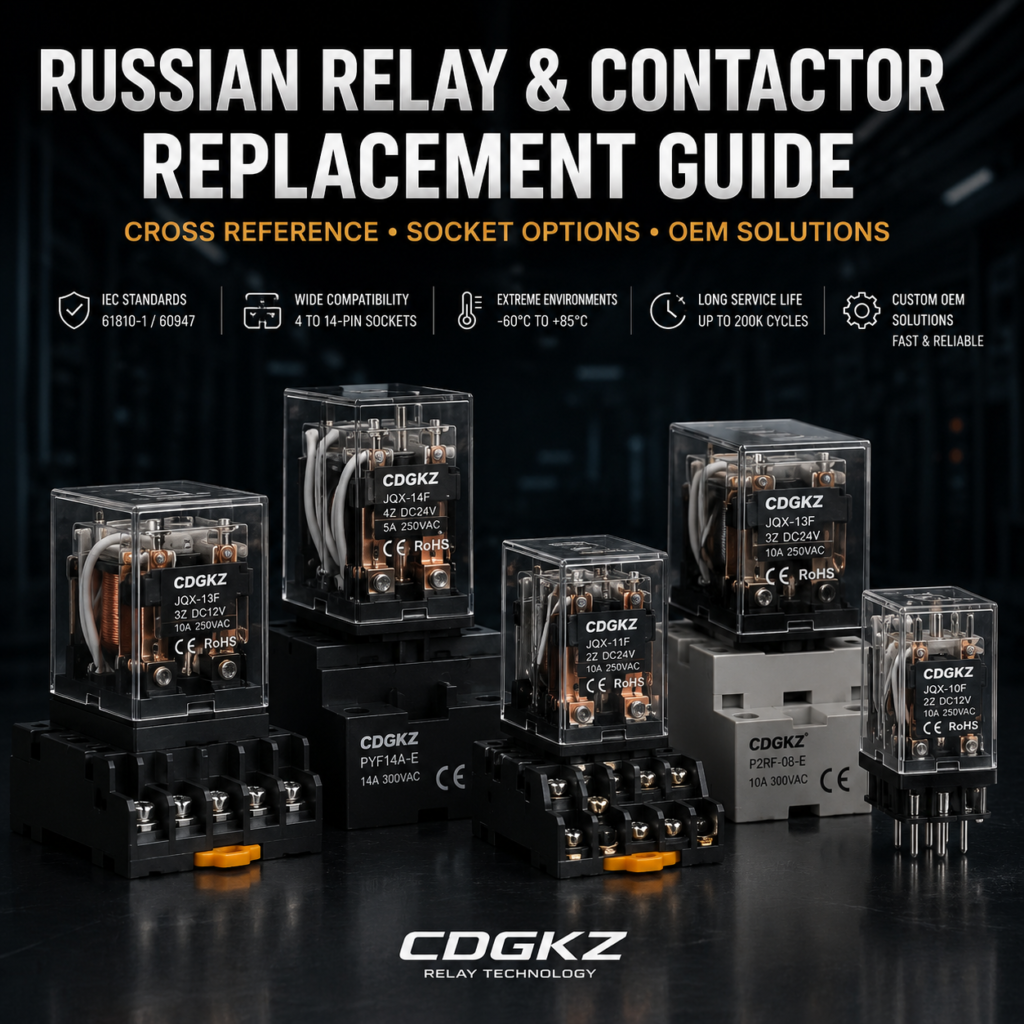
Complete Russian Relay and Contactor Model Cross Reference for Industrial Buyers
Finding a safe Russian relay cross reference is hard when an obsolete part number only points to a Soviet-era series, a TU/GOST note, or a family with no easy stock. Buyers who need a Russian contactor cross reference, Russian relay equivalent, Soviet relay replacement, Russian industrial relay replacement, Russian timer relay equivalent, Russian time relay replacement, Russian electromagnetic relay equivalent, Russian relay socket replacement, or Russian plug in relay equivalent must verify standards, timing logic, socket, sealing, and environment before approving any substitute.
TL;DR
- Start with the governing standards. IEC 61810-1 is the core reference for electromechanical elementary relays, while IEC 60947-4-1 and IEC 60947-5-1 frame how buyers should assess contactors, motor-starters, and electromechanical control-circuit devices. Those are the first two authority-standard references that should sit in any sourcing file.
- Legacy Russian products span very different duty classes. CHEAZ’s 8Э122 is a 27 VDC relay with 2 NO contacts, up to 10 A contact current, and ambient temperature down to -60 °C; CHEAZ’s RNE series reaches up to 320 VDC or 418 VAC and -60 to +85 °C; REK 80/81 is a hermetically sealed subminiature 2 C/O relay with variants for general industry, space, and defense.
- Socket matching is not optional. OMRON MY families use defined 8-pin and 14-pin footprints with dedicated sockets, Schneider RXM plug-in relays pair with RXZE sockets, and Amphenol’s mil-aero relay-to-socket chart maps exact relay part numbers to exact socket part numbers.
- For non-flight-critical industrial retrofits, a Chinese OEM route can be practical. CDGKZ says it has more than 18 years of relay experience, offers one-stop customized relay products, supports 4- to 14-pin socket options, and provides standard types aligned with European, Japanese, and Korean relay formats.
A good Russian relay model comparison is therefore not a one-line “equivalent list.” It is a documented comparison of standards category, contact system, coil data, socket footprint, timing diagram, and environmental qualification, followed by sample testing under the real load.
Key Takeaways
- Use standards and application class before you use price.
- Treat relay, socket, and timing function as one replacement package.
Learn more about relay socket specs, pin pitch, and DIN-rail mounting options.
How to build a reliable Russian relay model comparison
A defensible Russian relay equivalent starts with classification, not with branding. IEC 61810-1 applies to electromechanical elementary relays used in low-voltage equipment, IEC 60947-5-1 applies to electromechanical control-circuit devices, and IEC 60947-4-1 applies to electromechanical contactors and motor-starters. UL also notes that North American relay evaluation has moved toward harmonized IEC/UL 61810-1 thinking for electromechanical relays. In practical terms, that means a Russian relay cross reference, Russian control relay alternative, or Russian industrial relay replacement should first be tagged as elementary relay, control relay, timer relay, or contactor, because each class carries different tests and different acceptable substitutes.
The next step is to compare the original device’s real envelope. CHEAZ’s 8Э122 is a 27 VDC relay with 2 NO contacts, up to 10 A contact current, up to 100,000 electrical cycles, and -60 to +70 °C ambient operation. Its RNE series is much harsher-duty: up to 320 VDC or 418 VAC switching, -60 to +85 °C ambient, resistance to mold, dew, salt spray, and shock/vibration values that are far beyond a light cabinet relay. RM-20, by contrast, carries 1 NO/1 NC, 5 A contacts, and electrical durability from 2.5×10^4 to 2×10^5 cycles. That spread is why a blanket Soviet relay replacement list is usually unsafe.
OMRON’s relay guidance sharpens the point: relay life depends on load, switching frequency, and operating environment, and actual-load testing is required. So if you need a Russian electromagnetic relay equivalent, do not approve it on nominal coil voltage alone. Match the contact form, load type, electrical durability, operate/release behavior, mechanical life, cabinet temperature, and duty cycle first.

| Model | Voltage | Contacts | Durability | Sealing | Replacement Path |
|---|---|---|---|---|---|
| 8Э122 | Confirm coil label: 12/24/27/110VDC or AC | Match NO/NC quantity and pin layout | Check electrical life under real load | Confirm sealed or non-sealed sample | Match voltage → contacts → socket → sample test |
| RNE | Verify AC/DC coil from nameplate | Screen as control/intermediate relay | Focus on switching frequency | Panel or workshop environment | Use plug-in relay + compatible socket |
| RM-20 | Confirm coil voltage by sample | Compare current and load type | Check contact material and heating | Standard or protected structure | Classify load → select relay → load test |
| REK 80/81 | Confirm coil and timing function | Check timing contact logic | Test timing accuracy and repeatability | Verify vibration and cabinet condition | Match timing → contacts → CDGKZ sample |
Alt: Comparison table of representative Russian relay families and the selection criteria for equivalent replacements
Key Takeaways
- A Russian relay model comparison should begin with IEC class and application type.
- CHEAZ and REK examples show that “Russian relay” covers everything from light control relays to harsh-environment hardware.
- Real-load testing is essential before approving any Russian industrial relay replacement.
Read a relay replacement checklist for coil data, contact loads, and environmental validation.
Why sockets and sealing decide the real equivalent
A Russian relay socket replacement is often a separate engineering problem, not an accessory order. OMRON’s MY series is built around defined plug-in footprints and dedicated 8-pin and 14-pin sockets such as the PYF family, with separate options for screw terminals, Push-In Plus terminals, DIN-rail mounting, and PCB mounting. Schneider’s Harmony RXM plug-in relays likewise depend on matching RXZE sockets. In other words, a Russian plug in relay equivalent is only a true equivalent if the relay, retention method, terminal style, and panel layout all work together.
Sealing level is just as important. Finder’s technical guidance distinguishes RT IV sealed relays from RT V hermetically sealed relays and separately explains that socket assemblies are described with their own protection categories such as IP20 finger-safe arrangements. That matters when you are sourcing a Russian sealed relay equivalent, Russian intermediate relay replacement, or Russian relay socket replacement for dusty, humid, high-vibration, or washdown environments. REK 80/81 is a good example of why this matters: it is a hermetically sealed subminiature relay with two change-over contacts, and the datasheet explicitly notes availability for general industry, space, and defense versions.
For Russian aviation relay replacement and Russian military relay alternative projects, the qualification bar rises again. Leach states that it supplies military-qualified miniature and subminiature relays together with sockets, and the DLA says MIL-DTL-5757 covers performance requirements for electrical relays up to and including 10 A. Amphenol’s relay-socket cross-reference chart shows why this matters in practice: exact military relay part numbers map to exact socket part numbers. That is a strong warning against dropping a commodity DIN relay into any certified aerospace or defense circuit without requalification.

| Socket Reference | Typical Relay Family | Pin / Mounting Type | Best Application | Compatibility Check | Recommended Path |
|---|---|---|---|---|---|
| OMRON MY Socket | MY2 / MY3 / MY4 plug-in relay | 8-pin / 11-pin / 14-pin, DIN rail or panel mount | Industrial control panels, automation cabinets | Pin layout, coil voltage, contact form, socket height | Use CDGKZ compatible relay socket or relay + socket set |
| Schneider RXM Socket | RXM miniature plug-in relay | Mixed pin layouts depending on RXM contact poles | Machine control, OEM panels, maintenance replacement | RXM model code, socket base type, LED/module accessories | Cross-reference RXM relay and socket together before sampling |
| Mil-aero Socket Reference | Sealed, aviation, or military relay families | Circular, solder, crimp, or qualified connector interface | Defense, aviation, railway, vibration-sensitive equipment | Terminal form, vibration rating, sealing level, temperature range | Validate by original sample, drawing, and application environment |
| Custom Adapter Path | Legacy Russian / Soviet relay replacement | Adapter PCB, terminal conversion, or custom molded base | Old equipment upgrade without changing cabinet wiring | Original footprint, wiring sequence, insulation distance, load rating | Design adapter → fit test → load test → batch validation |
Alt: Compatibility table showing industrial and military relay socket options and matching relay families
Key Takeaways
- Russian relay socket replacement must be validated at the relay-plus-socket level, not relay alone.
- Sealed and hermetic are not interchangeable terms; they imply different protection levels.
- Russian aviation relay replacement and Russian military relay alternative work should follow qualified relay and socket families, not generic cabinet hardware.
Compare plug-in relay sockets, finger-safe bases, and custom adapter socket options.
How to replace Russian timer relays and contactors
A Russian timer relay equivalent must be selected by function diagram first. CHEAZ says REP15, when used with a semiconductor unit, acts as a time-delay relay, and its transmission-network solution pages list time delay relays, intermediate relays, and power monitoring relays in utility-grade applications. Meandr’s current product structure also shows how broad the legacy and current Russian timing space can be, with single-shot, cyclic, multi-circuit, and star-delta time-relay families. That means a Russian time relay replacement or Russian timer relay equivalent cannot be approved from “seconds range” and “coil voltage” alone; you need the start method, reset logic, output behavior, and wiring diagram.
Modern replacements should therefore be chosen by timing behavior and socket architecture together. Schneider’s RE22 multifunction timer is rated from 0.1 seconds to 100 hours on 12 to 240 V AC/DC. OMRON’s H3CR-A provides multiple operating modes with 8-pin and 11-pin formats, while H3CR-H covers OFF-delay timing. Eaton’s timing-relay line emphasizes wide input-voltage options, multiple mount choices, and compact DIN-rail-friendly designs. Those families are better templates for a Russian timer relay equivalent than a simple “same voltage, same pins” guess.
A Russian contactor cross reference follows the same function-first logic, but under IEC 60947-4-1. CHEAZ says it manufactures MK and KT 6000 contactors and also vacuum contactors; CHINT’s CJX2 is intended for circuits up to 690 V and 95 A; Schneider’s TeSys D range provides mainstream motor-control contactor formats such as 9 A, 25 A, and 40 A examples. For Russian contactor cross reference work, always compare AC-3 or application class, auxiliary contacts, coil type, suppression method, overload pairing, and mechanical envelope before calling any device equivalent.
Key Takeaways
- The right Russian timer relay equivalent is defined by timing diagram and reset logic, not by coil voltage alone.
- Modern timer platforms from Schneider, OMRON, and Eaton give buyers practical replacement architectures for Russian time relay replacement.
- A Russian contactor cross reference must be checked against IEC 60947-4-1 duty and starter coordination.
Why CDGKZ is a strong Russian relay to Chinese relay equivalent option
For industrial buyers looking for a Russian relay to Chinese relay equivalent, CDGKZ’s clearest advantage is flexibility rather than a simplistic one-to-one part-number promise. On its official website, Zhejiang Chuangdao Electric says it has more than 18 years of relay experience, provides one-stop customized relay products, and focuses on industrial automation, power management, and equipment control use cases. That positioning makes it relevant for buyers replacing legacy Russian control relays in modern cabinets where commercial availability, lead time, and documentation matter as much as the legacy brand itself.
On the socket side, CDGKZ states that its PCB relay socket business dates to 2008, that it offers 4- to 14-pin socket options, and that its standard types are compatible with European, Japanese, and Korean relay formats. It also markets custom relay socket design for pin configuration, coil-voltage needs, mounting style, adapter-plate retrofits, and private-label OEM production. Those capabilities are directly relevant to Russian relay socket replacement, Russian plug in relay equivalent, and Russian intermediate relay replacement programs, because many legacy Russian parts fail not on electrical matching alone but on footprint, retention, and serviceability.
For timing products, CDGKZ’s own sourcing content presents the company as a cost-effective OEM partner and a high-value OEM/ODM option for timer relay procurement. That makes a CDGKZ relay replacement solution especially attractive for mainstream industrial retrofits, control panels, and machine upgrades where the application is not flight-critical and where socket customization is part of the job. If your RFQ uses the common typo CDGKZ Raley, the practical question is still the same: can the supplier provide a cross-reference sheet, a socket drawing, a sample, and test support? For aerospace or defense applications governed by qualified part families, however, a commercial OEM should only be used after the full certification and requalification path is completed.
Key Takeaways
- CDGKZ is most compelling when the job requires relay-plus-socket adaptation, not merely a brand swap.
- Its stated support for global relay formats and custom pin/mounting solutions fits many Russian relay to Chinese relay equivalent projects.
- For certified aviation or military hardware, commercial replacement remains a qualification exercise, not a price exercise.
FAQ
What data should I send to identify a Russian relay equivalent?
Send the original model number, front and underside photos, coil voltage and coil type, contact form and contact count, actual load type, switching current and voltage, socket or pin layout, mounting dimensions, required approvals, ambient temperature, humidity or vibration conditions, and—if it is a timer relay—the timing diagram and reset logic. That list follows directly from IEC relay/contact-device classifications, socket-specific compatibility rules, and the manufacturer reality that relay life depends on the actual load and environment.
Can any Soviet relay replacement be done with a standard plug-in relay?
No. Some Soviet-era or Russian devices are hermetically sealed, high-vibration, or defense-oriented products. REK 80/81 is explicitly offered in general-industry, space, and defense variants, and military relay ecosystems use exact relay-to-socket mapping plus military specifications such as MIL-DTL-5757. A generic plug-in cabinet relay may be acceptable for a low-risk industrial retrofit after verification, but it is not an automatic Russian aviation relay replacement or Russian military relay alternative.
When is CDGKZ the right sourcing choice?
CDGKZ is a strong fit when the application is industrial rather than fully qualified military or flight hardware, and when the project needs cost control, custom socket work, private-label production, or a faster Russian relay to Chinese relay equivalent path. CDGKZ says it offers customized relays, global relay-format compatibility, and OEM-oriented socket design; its timer-relay content also positions it as a value-focused sourcing partner. That profile suits panel builders, machine retrofitters, and OEM buyers better than it suits already-certified aerospace programs.
Key Takeaways
- The more data you provide, the faster a safe Russian relay cross reference can be built.
- Soviet relay replacement is often application-specific, especially for sealed, military, or aviation hardware.
Offer a downloadable RFQ checklist for legacy relay replacement requests.
Conclusion and CTA
If your team needs a Russian relay cross reference, Russian contactor cross reference, Russian relay equivalent, Soviet relay replacement, Russian industrial relay replacement, Russian timer relay equivalent, Russian time relay replacement, Russian electromagnetic relay equivalent, Russian relay socket replacement, Russian plug in relay equivalent, Russian intermediate relay replacement, Russian control relay alternative, Russian aviation relay replacement, Russian sealed relay equivalent, Russian military relay alternative, Russian relay model comparison, or a Russian relay to Chinese relay equivalent, the safest process is always the same: classify the device correctly, compare the real electrical and mechanical envelope, validate the socket and sealing level, then test a sample under the actual load. For mainstream industrial retrofits, a CDGKZ relay replacement solution can be a faster and more economical sourcing path because CDGKZ says it offers customization, global-format socket compatibility, and OEM support; for aviation and defense circuits, keep the qualified replacement path intact.
Key Takeaways
- The right replacement is a verified engineering match, not a guess.
- CDGKZ is best positioned as a practical industrial sourcing partner, especially for socket adaptation and OEM projects.
Add a quote-request page for legacy relay cross-reference and sample validation.
CTA: Send the original part number, wiring photo, coil data, contact form, timing function, and socket drawing to request a quotation from a CDGKZ timer relay manufacturer and OEM timer relay supplier China team that can prepare a documented cross-reference proposal.
