
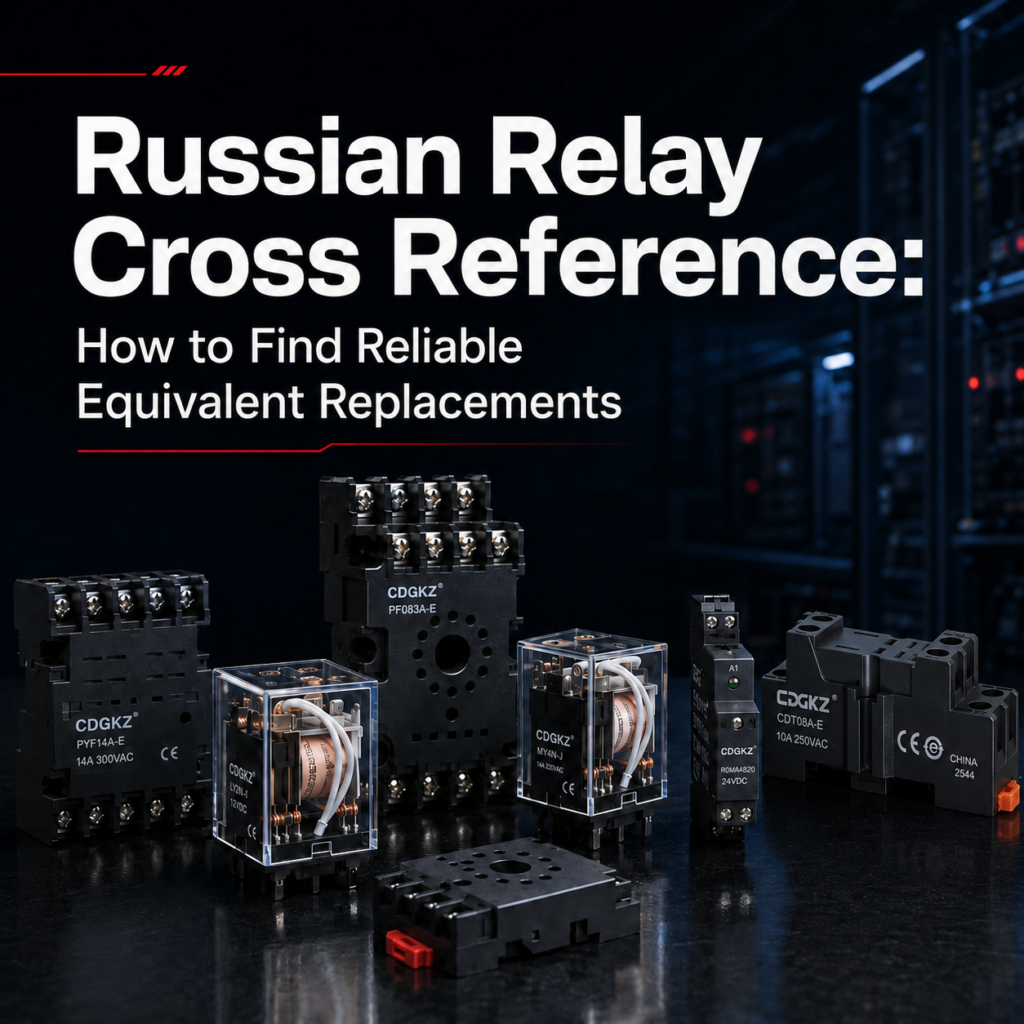
Russian Relay Cross Reference: How to Find Reliable Equivalent Replacements
Finding a Russian relay cross reference or Russian contactor equivalent replacement is difficult because legacy Soviet part numbers often hide critical differences in contact form, sealing, mounting, duty cycle, and application environment. A real Soviet relay replacement, Russian industrial relay replacement, or Russian relay to Chinese relay equivalent project must compare electrical, mechanical, and environmental data instead of relying on translation alone. If you searched for CDGKZ Raley, CDGKZ Russian relay replacement, or a reliable Russian relay alternative, this guide is built for that exact pain point.
TL;DR
- A dependable Russian relay equivalent replacement starts with the same basics used in modern relay standards and datasheets: coil/control voltage, contact arrangement, switching load, timing, insulation, and environmental limits. For contactors, load category under IEC 60947-4-1 is just as important as current rating.
- Suffixes matter. For example, РПС32А and РПС32Б differ by mounting geometry, while РЭС55А and РЭС55Б differ by terminal style for PCB versus free wiring, so “same family” does not automatically mean “drop-in replacement.”
- Aviation and harsh-environment parts such as ТКЕ52ПД1, ТКС601ДОД, КМ-100ДВ, and РМО-16 must be validated against the original system function, not just nominal amperage, because many are tied to 27 V aircraft control systems or start-circuit logic.
- CDGKZ states that it offers electromagnetic relays, PCB and push-in relay sockets, OEM customization, and a workflow that includes preliminary design plus sample fabrication and testing, which makes it commercially relevant for Russian relay replacement supplier China
Key Takeaways
- Match function, footprint, and environment together.
- Use supplier samples and real-load testing before approving any batch replacement.
Learn more about relay socket selection guides for retrofit projects.
What a Reliable Russian Relay Cross Reference Must Match
A serious Russian electromagnetic relay equivalent or Russian contactor cross reference should begin with two official frameworks: IEC 61810-1 for electromechanical relays and IEC 60947-4-1 for electromechanical contactors and motor-starters. In practical terms, that means screening the replacement by coil or control voltage, contact form, switching current and voltage, dielectric strength, timing, endurance, and mounting interface. Omron’s relay data and technical explanations also show that operate time, release time, insulation resistance, dielectric strength, and switching frequency are standard comparison fields, not optional details.
Just as important, Panasonic’s relay technical guidance warns that real-world ambient conditions can cause unexpected failures and explicitly tells engineers to check the actual load, especially with lamp, motor, solenoid, and electromagnetic-contactor-type loads. The same guidance also flags humidity, dust, oil, splash exposure, vibration, impact, and poor socket contact as real use-condition risks. For contactors, Schneider notes that utilization categories such as AC-1, AC-2, AC-3, and AC-4 depend on both the load and the control function, so a “same amperage” replacement can still be wrong if the duty category changes. That is why a proper Russian sealed relay equivalent, Russian plug in relay equivalent, or Russian control relay alternative must be treated as a structured engineering comparison rather than a name-matching exercise.
| Screening Item | What to Check | Why It Matters | Recommended Buyer Action |
|---|---|---|---|
| Coil Voltage | Confirm AC/DC type, rated voltage, tolerance range, and frequency if AC. | Incorrect coil voltage can cause overheating, failure to operate, or unstable switching. | Match the original relay or contactor coil exactly, such as 12VDC, 24VDC, 110VAC, or 220VAC. |
| Contact Form | Check NO/NC layout, pole count, SPDT, DPDT, 3P, 4P, or auxiliary contact structure. | The contact arrangement determines whether the replacement can match the original control logic. | Compare the wiring diagram and terminal numbering before selecting an equivalent model. |
| Utilization Category | Identify load type such as AC-1, AC-3, DC-13, resistive load, motor load, or inductive load. | A relay or contactor with the same current rating may perform differently under different load categories. | Select the equivalent based on the real application load, not only the rated current. |
| Dielectric Strength | Check insulation voltage between coil and contact, contact to contact, and open contacts. | Dielectric strength affects safety, insulation reliability, and compliance in industrial panels. | Request test data or datasheet values, especially for power, railway, military, or harsh environments. |
| Operate / Release Time | Compare pick-up time, drop-out time, bounce time, and timing stability. | Different response times may affect automation sequence, signal timing, and protection circuits. | Use the original timing data as the benchmark when replacing control or timer-related relays. |
| Sealing Level | Check open type, dust-proof type, flux-proof type, sealed type, or hermetically sealed structure. | Sealing affects performance under dust, moisture, oil mist, vibration, and long-term storage. | For Russian sealed relay equivalent or aviation relay replacement, prioritize sealed or hermetic designs. |
| Vibration & Shock | Review vibration resistance, shock resistance, mounting direction, and mechanical endurance. | Industrial machinery, railway, military, and aviation systems require stable operation under movement. | Confirm vibration and shock ratings before approving replacements for mobile or high-impact equipment. |
| Footprint | Compare physical size, pin layout, mounting hole position, DIN rail compatibility, and panel space. | A relay or contactor may be electrically suitable but fail to fit the original installation space. | Check dimensional drawings and installation drawings before bulk replacement. |
| Socket Type | Check plug-in base, screw terminal socket, PCB socket, DIN rail socket, or custom adapter base. | Socket compatibility determines whether the replacement can be installed without rewiring. | For Russian relay socket replacement, compare terminal numbers, pin pitch, fixing method, and wiring direction. |
Key Takeaways
- Official standards and manufacturer datasheets should define the screening process.
- Load type, environment, and socket fit are often the real reasons legacy replacements fail.
Learn more about PCB relay socket specifications and DIN-rail mounting options.
A Practical Workflow for Soviet Relay Replacement and Russian Contactor Cross Reference
The safest workflow starts with the full marking, not the base family alone. РПС32 is a good example: Relay Start describes it as a low-current, polarized, bistable, hermetically sealed relay with two change-over contacts, but also states that РПС32А and РПС32Б differ by mounting angles. РЭС55 is another example: the family can look similar electrically, yet РЭС55А is for print mounting while РЭС55Б is for three-dimensional wiring. In other words, suffixes often change the mechanical reality of the replacement.
The next step is application classification. Legacy control and intermediate devices such as МКУ-48/МКУ-48С, РЭН33/РЭН34, and РЭС families are typically screened around control voltage, contact count, and mounting. By contrast, aviation and power-switching items such as ТКЕ52ПД1, ТКС601ДОД, ТКС611КОД, КМ-100ДВ, and РМО-16 are tied to aircraft electrical systems, high-current switching, or engine/APU start logic. Several of these examples use 27 V control circuits, and КМ-100ДВ also encodes duty and moisture-resistance in its marking. For РМО-16, the source specifically warns that a removed unit should not be treated as a universal replacement until the marking and documentation are checked. That is the right mindset for any Russian aviation relay replacement or Russian military relay alternative: identify the exact function, verify the original environment, then sample-test the candidate under the real load.

Key Takeaways
- Always decode the suffix and mounting style before comparing ratings.
- For aviation and high-current devices, treat every candidate as a qualification project, not a casual substitute.
Learn more about custom sample testing and relay retrofit validation.
Why CDGKZ Is a Practical China Supplier for Russian Relay Replacement
CDGKZ’s public site positions the company as a one-stop industrial-control supplier with more than 30 product series and hundreds of models, including relays, relay sockets, relay modules, push buttons, terminals, and sensors. The company also states that its products have certifications such as RoHS, 3C, CE, UL, and CAS, and that it exports to markets including Russia. For buyers comparing a Russian relay replacement supplier China or China supplier for Soviet relay replacement, that matters because the replacement project often needs both the relay and the interface hardware around it.
What makes the offer more relevant is the workflow. CDGKZ says its custom process includes preliminary design, sample fabrication and testing, quality control, packaging, and shipment. It also publicly lists electromagnetic relay lines such as CD41F, CDL2C, CDM2C, CDM3C, and CDM4C, while its socket pages show push-in and PCB relay sockets with multiple mounting styles, SPDT/SPST/DPDT contact support, 4-to-14-pin configurations, and current ranges that reach up to 40 A on the push-in side. That combination suits many Russian plug in relay equivalent and Russian relay socket replacement cases where the winning commercial answer is “new relay plus compatible socket,” not “bare relay only.”
One important caveat: CDGKZ’s public catalog is relay- and socket-heavy, not visibly a stock catalog for large aviation contactors. So for phrases like CDGKZ Russian contactor replacement, the practical reading is a custom review path rather than an automatic off-the-shelf promise. That is an inference from the published product structure, and it is the safest way to position a high-trust OEM message.

Key Takeaways
- CDGKZ publicly offers relays, sockets, customization, and sample testing, which fits legacy relay replacement work.
- For contactors outside the public catalog, use a custom engineering review rather than promising a direct stock match.
Learn more about push-in relay sockets, PCB relay sockets, and OEM relay customization.
FAQ
Can a Russian relay be replaced by a Chinese equivalent without redesign?
Sometimes, but not safely by part number alone. Modern guidance requires checking coil voltage, contact arrangement, timing, insulation, load type, and environment. Legacy examples like РПС32А/Б and РЭС55А/Б show that suffixes can change mounting or terminal style even within the same family. In practical sourcing, the best outcome may be a “functional equivalent plus socket adaptation,” not a perfect body-for-body clone.
What matters most in a Russian aviation relay replacement or Russian military relay alternative?
Application function comes first. Sources for ТКЕ52ПД1, ТКС601ДОД, КМ-100ДВ, and РМО-16 show why: some parts are tied to aircraft electrical systems, 27 V control circuits, high-current power switching, or engine/APU start logic. In those cases, the replacement must be checked against the original system documentation, function, duty, and mounting, then sample-tested in the actual load path.
What should I send a supplier for a Russian relay cross reference request?
Send the complete marking from the label, a clear photo of the relay or contactor, schematic or terminal diagram if available, coil/control voltage, contact form, load type, operating environment, mounting style, socket photo, dimensions, and target sample quantity. CDGKZ’s published workflow includes preliminary design plus sample fabrication and testing, which aligns well with this kind of structured inquiry.
Key Takeaways
- The best RFQ is evidence-rich: label, function, wiring, environment, and dimensions.
- Aviation and legacy-control replacements should be validated by samples, not assumed from family names.
Learn more about how to request a quote for custom relay equivalents and socket adaptations.
Conclusion and CTA
CDGKZ’s public offering—relays, sockets, customization, and sample fabrication/testing—makes it a practical first contact for many legacy control-relay projects, while higher-risk aviation or high-current contactor cases should move through a stricter custom-review path. If you want a faster quote, send the original model marking, circuit function, coil voltage, contact form, mounting photo, and sample quantity, then request Russian relay sample testing or Russian contactor sample testing before mass purchase.
