

Beginner’s Guide: What Is a Timer Relay and How to Choose the Right One
If you need a timer relay for beginners, keep asking what is a timer relay, or need a timer relay selection guide that explains how to choose a timer relay, the hard part is selecting the right industrial timer relay, multifunction timer relay, on-delay timer relay, off-delay timer relay, cycle timer relay, or star-delta timer relay in the right voltage and mount format. This guide helps buyers searching CDGKZ Timer Raley avoid mismatch, rewiring, and downtime.
TL;DR
- A timer relay is a control device that changes output after a preset time, so it is fundamentally a timing-control component rather than just a basic switch.
- The safest buying path is function first, then supply voltage, then output rating, then mounting style, then compliance and environment.
- A 24V timer relay often fits PLC and DC control circuits, while a 220V timer relay search often maps to products rated around 200–230 VAC or wide-range 24–240 VAC/DC.
- DIN rail timer relay, panel mount timer relay, timer relay with socket base, compact timer relay, and easy wiring timer relay are not interchangeable decisions; each affects installation speed, maintenance cost, and cabinet space.
- Based on its public materials, CDGKZ presents itself as a cost-effective OEM/ODM option with broad relay and socket coverage, customization support, and one-stop sourcing advantages.
How to Select the Right Timer Relay: CDGKZ Timer Relay Selection Guide.
What a Timer Relay Actually Does
According to OMRON, a timer is a control device that outputs a signal at a preset time after an input is received. The current product standard from the International Electrotechnical Commission, IEC 61812-1:2023, applies to time relays and coupling relays for industrial and residential use, and it explicitly covers requirements, tests, and definitions for different relay types. In plain language, a timer relay adds controlled time logic to a switching circuit: it decides not only whether a contact changes state, but also when that change happens.
That is why a timer relay is common in motor starting, sequence control, interlocking, delayed shutdown, repetitive cycling, and simple automation tasks. In product catalogs and RFQs, you will also see close variants such as time-delay relay, delay timer relay, electronic time relay, analog timer relay, and plug-in timing relay. Those names usually point to the same buying question: you need a device that applies a defined time function to an output circuit. Omron’s timer overview also shows that the market spans analog timers, digital timers, and time switches, so beginners should not confuse “timer relay” with “time switch” or assume every model is multifunction.
A practical way to think about it is this: a standard relay answers “switch or do not switch,” while a timer relay answers “switch now, later, for a defined period, or in a repeated pattern.” That difference is what makes the timer relay a foundation component in low-cost control panels where a PLC may be unnecessary or overkill.
Key Takeaways
- A timer relay is a timing-control device that changes output after a preset delay or sequence.
- IEC 61812-1 is the key product standard reference for time relays and their tests.
- Terms like time-delay relay and electronic time relay usually describe the same core buying category.
What Is a Timer Relay? Definition, Types, and Uses.
The Timer Relay Types Beginners Should Know
The first split is between on-delay timer relay and off-delay timer relay. In signal ON-delay operation, timing starts when the input is received while the timer is already powered; in power ON-delay operation, timing starts when supply voltage is applied. Omron notes that signal-start designs are generally more accurate because the timing section is already energized before counting begins. By contrast, OFF-delay operation turns the output on immediately with the input and delays turn-off after the input is removed. In other words, on-delay waits before energizing; off-delay waits before de-energizing.
Beginners should also know interval and cycle behavior. Omron defines interval operation as input and output turning on at the same time, with output turning off after the set time. It defines flicker operation as repeated output ON/OFF once an input is received. In buying language, a cycle timer relay is often the model customers mean when they ask for repeated ON/OFF operation, even if catalogs label it “flicker,” “recycler,” or “cyclic.” A multifunction timer relay is valuable when one SKU must cover several modes, because it reduces SKU count and gives more field flexibility. Omron’s H3CR-A offers multiple operating modes, while Phoenix Contact lists multifunction timer relays with selectable ranges and functions.
Star-delta timer relay models are more specialized. Omron’s H3DT-G and H3DK-G are built specifically for star-delta timing, with separate star and delta outputs, while Schneider Electric also offers dedicated star-delta timing relays in 24…240 V AC/DC versions. If your load is a motor starter sequence, choose star-delta directly; if your task is general delay control, a multifunction timer relay or dedicated on-delay/off-delay unit is usually the cleaner choice.
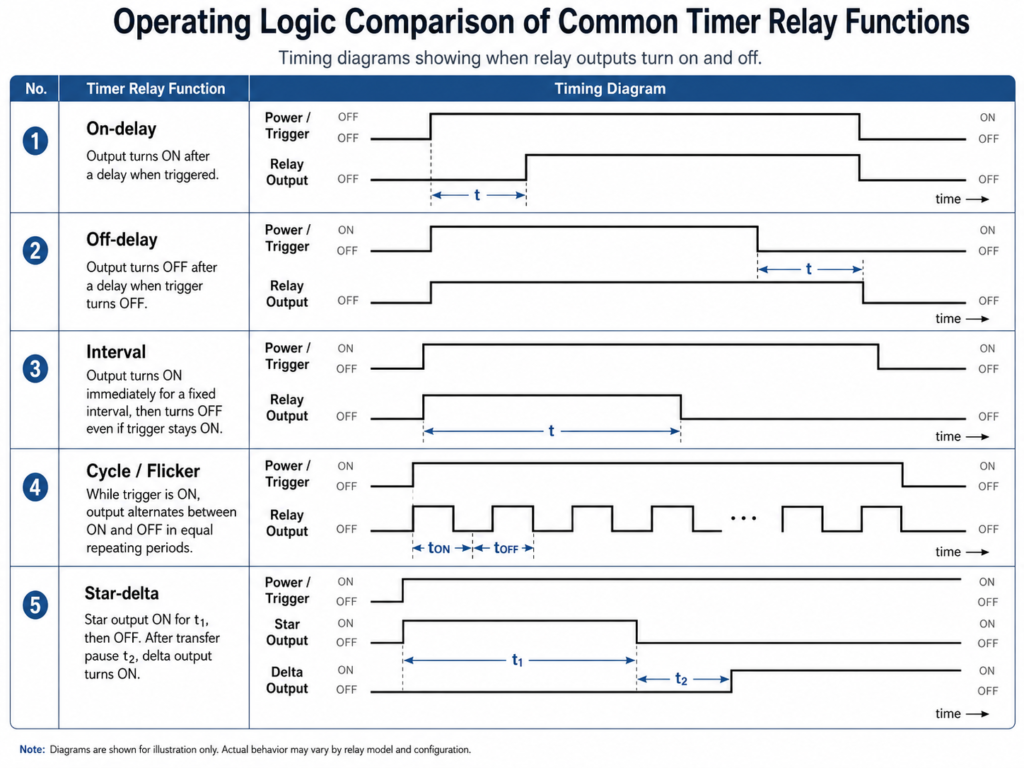
Key Takeaways
- On-delay waits before switching on; off-delay waits before switching off.
- A cycle timer relay request often maps to flicker or repeated ON/OFF operation in manufacturer terminology.
- Star-delta timer relay models are best for motor starter transitions, not for general-purpose delay tasks.
Timer Relay Types: What Relay Types Are Available?
How Voltage, Mounting, and Wiring Change the Choice
For most entry-level buying decisions, supply voltage is the next filter after function. A 24V timer relay is popular because many PLC panels and machine control circuits already distribute 24 VDC. Omron’s H3Y-2 DC24 example is a power ON-delay, 8-pin round-socket timer with DPDT output, while its H3CR-H8L AC/DC24 shows a 24 VAC/VDC power OFF-delay format. By contrast, what many buyers call a 220V timer relay is often specified by manufacturers as 200 to 230 VAC, 200/220/240 VAC, or as a wide-range 24…240 V AC/DC model. Omron’s H3Y-2 AC200-230 and Phoenix Contact’s MACX-TR-1T-MUL are good examples of how catalog language translates into real purchase options. That means “220V” is usually a market shorthand, not the full engineering specification.
Mounting style matters just as much. A DIN rail timer relay usually targets standard 35 mm DIN rail layouts; Phoenix Contact’s DIN rail data explicitly references EN 60715 and gives a 35 mm profile width. An Omron H3DK-G star-delta timer is DIN-track mounted and 22.5 mm wide, while the H3CR-A can be panel-mounted with a socket and still keep length at 75 mm or less. If you want a panel mount timer relay for legacy cabinets, a front-panel or socket-assisted cube format can be easier. If you want a timer relay with socket base, Omron’s model selection guide highlights that plug-in sockets let you replace the timer without rewiring, which is a major maintenance advantage.
This is also where compact timer relay and easy wiring timer relay claims become meaningful instead of decorative. Phoenix Contact describes 6.2 mm narrow timer relays, compact installation-housing timer relays, and push-in connection technology for tool-free wiring. For buyers under cabinet-space pressure or labor-cost pressure, those details directly affect installation time, replacement time, and panel density.
| Timer Relay Option | Common Function | Supply Voltage | Mounting Style | Typical Application | Best Fit Buyer | Selection Notes |
|---|---|---|---|---|---|---|
| DIN Rail Timer Relay | On-delay, off-delay, interval, cycle/flicker, multifunction timing | 24V DC / AC, 220V AC, or wide voltage input | Direct DIN rail mounting | Control cabinets, PLC panels, motor control circuits, automation systems | Panel builders, OEM equipment factories, industrial automation integrators | Recommended when cabinet space, clean wiring, and fast installation are important. |
| Panel Mount Timer Relay | Digital timing, cycle control, delay control, process timing | 24V DC, 110V AC, 220V AC, or universal voltage versions | Front panel / machine panel mounting | Machine operation panels, packaging equipment, temperature control systems, production equipment | Machine manufacturers, equipment OEMs, maintenance teams | Best when operators need visible settings, display access, or direct adjustment from the panel surface. |
| Timer Relay with Socket Base | On-delay, off-delay, interval, star-delta, multifunction timing | 24V DC / AC, 220V AC, or model-specific coil voltage | Plug-in relay with 8-pin, 11-pin, or 14-pin socket base | Control panels, relay replacement circuits, maintenance-friendly electrical systems | Distributors, wholesalers, repair teams, panel builders | Ideal when fast replacement, socket compatibility, and easy maintenance are required. |
| 24V Control System Timer Relay | Signal delay, PLC output delay, sensor-triggered timing, automation sequence control | 24V DC or 24V AC | DIN rail, panel mount, or socket base | PLC cabinets, low-voltage control circuits, automation machines, sensor control systems | Automation engineers, OEM factories, control cabinet manufacturers | Choose 24V versions for safer low-voltage control systems and PLC-compatible applications. |
| 220V Control System Timer Relay | Motor delay, lighting delay, pump control, fan control, star-delta starting | 220V AC | DIN rail, panel mount, or socket base | Industrial control panels, motor starters, HVAC systems, pump panels, electrical distribution cabinets | Electrical contractors, panel builders, distributors, maintenance users | Choose 220V versions when the control circuit is powered directly from AC mains control voltage. |
| CDGKZ Timer Relay Solution | On-delay, off-delay, interval, cycle/flicker, star-delta, multifunction options | 24V, 220V, and customized voltage options available | DIN rail, panel mount, and socket-base compatible options | Control cabinets, OEM equipment, distributor replacement markets, industrial automation projects | OEMs, distributors, wholesalers, panel builders | Suitable for buyers needing flexible model selection, socket matching, OEM branding, and cost-effective supply from China. |
Key Takeaways
- Choose voltage after function: 24V timer relay for common DC control systems, and “220V timer relay” only after checking the manufacturer’s exact AC rating.
- DIN rail, panel mount, and socket-base designs change maintenance cost and panel layout.
- Compact timer relay and easy wiring timer relay features pay off when cabinet space and labor time are limited.
Timer Relay Installation Guide: Tips for Beginners.
The Selection Checklist That Prevents Costly Mistakes
A beginner-friendly timer relay selection guide should always start with five checks: operating mode, supply voltage, output contact type, load rating, and mounting method. After that, confirm timing range, accuracy, environment, and compliance. Omron’s timer cautions are blunt on the most expensive mistake: use a load current below the rated output current and test under real operating conditions, because contact life changes greatly with switching conditions. Phoenix Contact’s multifunction MACX-TR example shows why datasheet details matter: it gives wide-range input voltage, adjustable timing from 10 ms to 999 h 59 min, repeat accuracy, switching capacity, and dielectric strength references. Those are not marketing extras; they are the core purchasing data.
Installation discipline matters too. CDGKZ’s own relay socket installation guide recommends matching the socket or base to the relay’s pin configuration, verifying voltage and current ratings, de-energizing before wiring, using correct wire gauges, and securing the assembly firmly to reduce vibration-related failures. Omron also warns against applying the wrong rated voltage, miswiring, DC polarity reversal, or undersized power supplies that cannot handle inrush. In other words, a cheap timer relay becomes an expensive timer relay the moment wiring or rating discipline is ignored.
For compliance-minded buyers, two external authority references are worth bookmarking: IEC 61812-1 for time relays and IEC 60947-5-1 for electromechanical control circuit devices and switching elements. For North American projects, UL Solutions notes that industrial control equipment standards are being harmonized and that UL 60947 replaces UL 508 for several categories of industrial control equipment, which matters when you plan export or multi-market panel builds.
Key Takeaways
- Check function, voltage, output type, load rating, and mounting before price.
- Miswiring, wrong voltage, and overloaded contacts destroy timer relay life faster than brand differences do.
- Keep IEC 61812-1 and IEC 60947-5-1 as your two main standards references during selection.
Why CDGKZ Is a Strong OEM Option
According to Zhejiang Chuangdao Electric, the company behind CDGKZ, it has more than 18 years of relay manufacturing and sales experience, provides one-stop service, and offers customized relay products for industrial control and power management applications. Its relay page also presents a broad product family that includes relay sockets, relays, relay modules, terminal blocks, and related control components, while search snippets from its homepage say the catalog extends to more than 30 series and hundreds of models. For an OEM buyer, that matters because timer relays are rarely purchased in isolation; sockets, mounting accessories, and adjacent control hardware often affect the total project cost more than the relay alone.
CDGKZ’s timer-relay-related pages position the company as a cost-effective OEM partner and a high-value OEM/ODM option for industrial control buyers. Elsewhere on its site, CDGKZ says its relay socket range covers everything from small PCB sockets to robust 30 A DIN-rail-mounted bases and that products meet IEC and UL standards. Another CDGKZ page says OEM manufacturing uses automated molding, metal stamping, assembly stations, and 100% functional testing, including contact resistance, dielectric strength, coil resistance, and mechanical endurance. These are self-published claims, but taken together they form the value proposition many procurement teams want from an OEM timer relay manufacturer: breadth, compatibility, customization, and process control.
That is why CDGKZ is a practical name to evaluate if you are searching for a reliable timer relay supplier China or need supporting socket hardware along with the relay. The same relay page also advertises customized solutions, competitive pricing, fast turnaround, and no MOQ, which can be especially useful during pilot runs, sampling, or mixed-model projects. For buyers trying to balance price, quality, and service, CDGKZ’s strongest conversion angle is not one single timer feature; it is the ability to source the timer relay and the matching interface ecosystem from one supplier in China.

Key Takeaways
- CDGKZ presents itself as an experienced relay manufacturer with one-stop sourcing and customization support.
- Its published positioning emphasizes cost-effectiveness, OEM/ODM support, broad model coverage, and supporting socket hardware.
- For procurement teams, the biggest advantage is lower sourcing friction across relays, sockets, and related panel accessories.
How to Select the Right Timer Relay: CDGKZ Timer Relay Selection Guide.
FAQ
What is the difference between an on-delay timer relay and an off-delay timer relay?
An on-delay timer relay waits for the preset time before it switches the output on. An off-delay timer relay switches on immediately and delays the turn-off after the input or power is removed. If your process needs delayed startup, choose on-delay; if it needs delayed shutdown or run-on, choose off-delay.
Should I choose a 24V timer relay or a 220V timer relay?
Choose the voltage that matches your control supply first. A 24V timer relay usually fits PLC, sensor, and DC control panels, while a “220V timer relay” request usually maps to models specified as 200–230 VAC, 200/220/240 VAC, or wide-range AC/DC products depending on the brand. Always buy against the exact datasheet voltage, not the search term alone.
When does a timer relay with socket base make more sense than fixed wiring?
A timer relay with socket base makes more sense when you want faster replacement, simpler maintenance, or field changes without rewiring. Omron’s selection guide explicitly notes that plug-in sockets let you replace timers without rewiring, and manufacturers such as Phoenix Contact also promote push-in and tool-free wiring features for faster installation. That is especially valuable in production lines where downtime is expensive.
Conclusion and CTA
Choosing the right timer relay is not only about price. For industrial control panels, the better decision starts with the correct timing function, supply voltage, contact rating, mounting style, wiring convenience, and long-term maintenance needs. Whether you need an on-delay timer relay, off-delay timer relay, cycle timer relay, star-delta timer relay, DIN rail timer relay, panel mount timer relay, or timer relay with socket base, the goal is the same: stable timing control, easier installation, faster replacement, and lower total sourcing cost.
For buyers, distributors, OEM factories, and control panel builders, CDGKZ provides a practical timer relay sourcing solution from China. With broad relay and socket product coverage, OEM/ODM customization support, competitive pricing, and matching socket-base options, CDGKZ helps customers simplify model selection, reduce procurement friction, and build more reliable control cabinet systems. This is especially valuable when your project needs flexible voltage options, compact installation, easy wiring, fast delivery, and cost-effective alternatives for industrial automation applications.
If you are looking for a reliable timer relay manufacturer, an industrial timer relay supplier in China, or a customized timer relay solution for your next control panel project, CDGKZ can help you select the right model and compatible socket base. Contact CDGKZ today to request a product catalog, technical support, sample evaluation, or OEM/ODM quotation for your timer relay application.
