
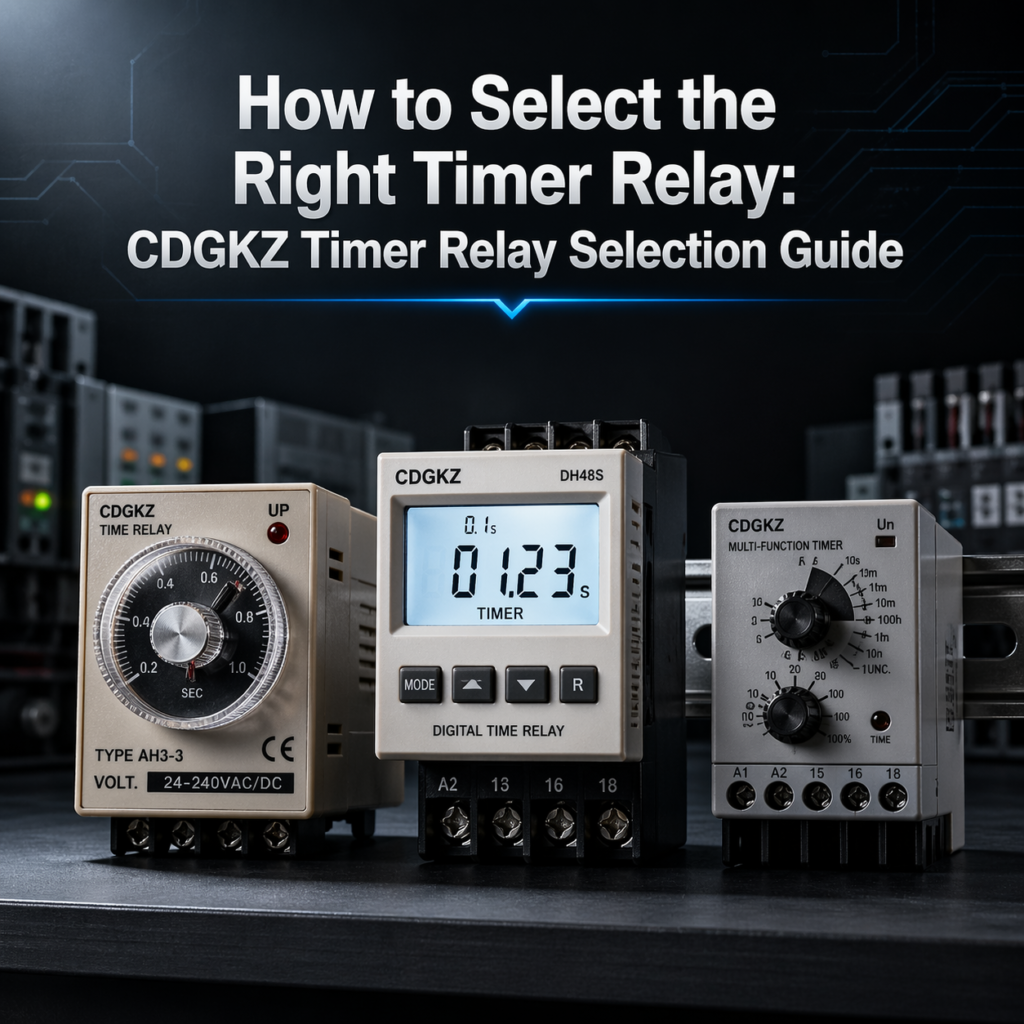
How to Select the Right Timer Relay: CDGKZ Timer Relay Selection Guide
If you are asking how to select the right timer relay, start with sequence logic, not price. Buyers searching for the best timer relay for industrial automation, how to choose a timer relay for control panel use, or a timer relay for PLC control systems often compare model numbers before checking function, voltage, contacts, and mounting. This CDGKZ timer relay selection guide is written for that exact sourcing problem, including buyers who search CDGKZ Timer Raley or need an industrial timer relay supplier China buyers can trust.
TL;DR
A timer relay is a control component that changes contact status after a preset time. In practical selection, the right choice usually depends on five things: the timing function, the way timing starts, the supply voltage, the output contact rating, and the mounting format that fits the panel. Official references from current vendor documentation and the applicable standards show that this is not a one-variable purchase; it is an application-matching decision.
- Define the timing behavior first. On-delay, off-delay, interval, cycle/flasher, and star-delta are the common operating modes, and multifunction timer relays combine several of them in one device.
- Separate control power from load power. You must match the relay’s rated supply voltage to the control circuit, then confirm that the contact type and current rating can actually switch the load safely.
- Choose the right housing for the panel. DIN rail, plug-in, panel-mount, ultra-slim, and multifunction formats all solve different wiring and maintenance problems in control cabinets and PLC systems.
- Commercially, the best supplier is not always the most famous one. CDGKZ’s official site says it offers one-stop customization, 18 years of experience, 30+ product series, international certifications, an automated factory, fast turnaround, and on-demand relay production from prototypes to volume orders.
Key Takeaways
- Function fit matters more than brand familiarity.
- The best cost effective timer relay solution is the one that avoids rework, downtime, and unnecessary inventory.
Below are the timer relay formats most engineers compare when designing cabinets, machines, and modular control panels.
Start with the timing function and trigger logic
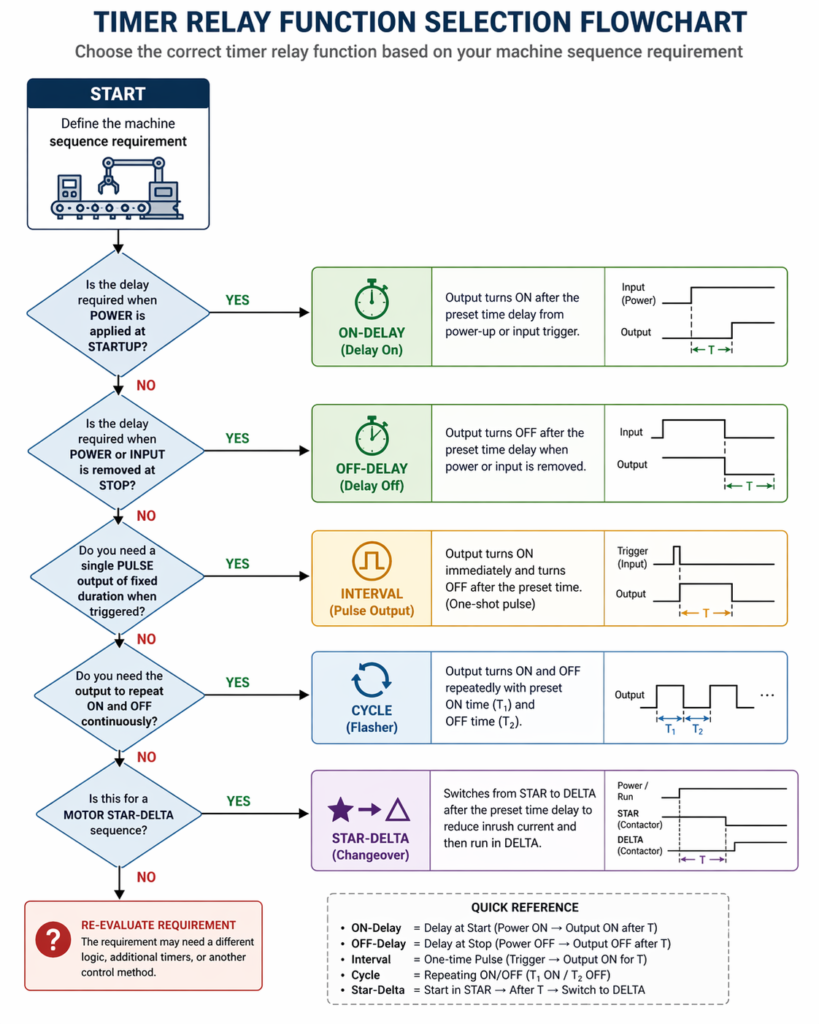
The first real decision is not voltage or price. It is timing behavior. Official selection guidance shows that timer relays are used to output a signal after a preset time, and that two common starting methods exist: power ON/OFF start and signal ON/OFF start. In other words, some relays begin counting when supply power is applied, while others wait for a separate trigger input. That distinction matters immediately in conveyors, fan overrun circuits, batching systems, pump sequencing, filling machines, and interlocked machine starts.
From there, define the required operating mode. In practical industrial use, the most common functions are on-delay relay, off-delay relay, interval, cycle/flasher, one-shot, and star-delta. CDGKZ’s own timer relay guide uses essentially the same selection logic and recommends defining the timing function before comparing anything else. Official product families from Omron also show why multifunction models are popular: one relay can cover several operating modes and reduce the number of spare models a buyer must keep in stock.
A useful buying rule is simple: if the machine sequence is fixed and never changes, a single-function timer can be the cleanest choice. If maintenance teams support multiple machine types, or if the same cabinet may need a future logic change, a multifunction timer relay supplier is usually the safer commercial path because it reduces SKU fragmentation and simplifies service backup. That is one reason the phrase best timer relay for industrial automation often points to flexibility rather than just a low ex-factory price.
Key Takeaways
- Decide the timing mode before you compare brands or quotations.
- Confirm whether timing starts from supply power or from a separate control signal.
- Multifunction models are often the better inventory decision for mixed equipment fleets.
Match voltage, contact rating, and time range to the real load
The second decision is electrical fit. Many sourcing mistakes happen because buyers mix up the relay’s control voltage with the load voltage and load current. CDGKZ’s selection checklist explicitly separates voltage and power supply, contact configuration, and timing range and accuracy; that is exactly how professional selection should be done. In practice, you must verify the control supply first, then the output contact structure, then the required timing window and precision.
Current vendor specifications show how broad these ranges can be. A current timer relay from Phoenix Contact lists a 24 to 240 V AC/DC input range, adjustable timing from milliseconds to hundreds of hours, repeat accuracy figures, two changeover contacts, and an 8 A switching limit for ohmic loads. Current slim and modular products from Schneider Electric also show 24 to 240 V AC/DC supply variants in compact industrial timing relays. That matters for buyers searching phrases like 24V 220V timer relay supplier: sometimes the right answer is not two different SKUs, but one wide-range model that simplifies inventory and replacement.
At the standards level, use the official requirement pages from IEC and UL as external compliance anchors. IEC 61812-1:2023 applies specifically to time relays and coupling relays and defines requirements and tests, while UL 508 covers industrial control equipment, explicitly including time-delay relays and switches. These official pages are the two external authority standard references your article should point readers toward before finalizing a BOM or import decision.
TIMER RELAY SELECTION MATRIX
Compare control voltage, contact type, time range, accuracy, and recommended industrial use cases
| Model Type | Control Voltage | Contact Type | Time Range | Accuracy | Best For |
|---|---|---|---|---|---|
| Basic Analog Timer Relay | 24 V DC / 220 V AC | SPDT | 0.1 sec – 30 min | ±5% | Simple conveyor delay start, fan delay stop |
| Industrial Digital Timer | 24 V DC / 24-240 V AC/DC | SPDT / DPDT | 0.01 sec – 999 hr | ±0.5% | Packaging lines, PLC panels, precision timing |
| On-Delay Timer | 24 V DC / 110-240 V AC | SPDT | 1 sec – 60 min | ±1% | Motor delayed startup |
| Off-Delay Timer | 24 V DC / 220 V AC | SPDT | 0.5 sec – 30 min | ±2% | Cooling fan run-on control |
| Cycle / Flasher Timer | 24 V DC / 220 V AC | SPDT / DPDT | 0.5 sec – 24 hr | ±1% | Warning lights, pump cycles |
| Star-Delta Timer | 220 V AC / 380 V AC | DPDT | 1 sec – 30 sec | ±1% | Motor starter panels |
| CDGKZ Multifunction Timer Relay | 12-240 V AC/DC Universal | SPDT / DPDT | 0.01 sec – 999 hr | ±0.3% | One model replaces multiple timer types |
Quick Buying Advice
- 24 V DC = ideal for PLC and automation cabinets.
- 220 V AC = common for industrial machinery.
- SPDT = standard single output switching.
- DPDT = dual output or interlock control.
- CDGKZ multifunction timers reduce inventory and sourcing cost.
Key Takeaways
- Always separate control voltage, output contact form, and actual switched load.
- Wide-range supply models can reduce stock pressure for OEMs and distributors.
- For compliance reference, link to IEC 61812-1 and UL 508, not to generic blog summaries.
Learn more about relay contact ratings, SPDT vs DPDT, and voltage matching.
Choose the right form factor for control panels and PLC systems
Once function and electrical fit are correct, the next question is installation. CDGKZ’s timer relay guidance breaks mounting into DIN rail, panel, and plug-in formats, and that is a useful structure because each form factor changes the maintenance workflow. A DIN rail timer relay manufacturer is attractive when the customer builds modular control cabinets; a plug-in format is stronger when field replacement speed matters; and a panel-mount timing relay suits front-door operator access or legacy cabinet layouts.
For control cabinet density, compactness matters more than people think. Current product families show how narrow timing relays can now be. Phoenix Contact lists ultra-narrow PLC-interface timer relays and 6.2 mm narrow timer models for simple time-control applications, while its higher-end multifunction models support dry contacts plus PNP and NPN proximity switch inputs. That matters directly for timer relay for PLC control systems and for buyers looking for a compact timer relay for panel builders: not every timer relay integrates equally well into crowded I/O rows, bridge systems, or mixed signal environments.
Wiring clarity matters too. CDGKZ’s guide notes the common terminal logic many engineers expect: A1/A2 for supply power, B1 for optional control input, and COM/NO/NC for the load path. In real projects, that makes relay replacement faster and troubleshooting cleaner. It also helps explain how to choose a timer relay for control panel projects: you are not only buying timing logic, you are buying serviceability, terminal accessibility, replacement speed, and panel readability. For machinery builders, that is why a reliable timer relay for machinery is often one that is easy to identify, easy to wire, and easy to replace under pressure.
Key Takeaways
- DIN rail, panel-mount, and plug-in timer relays solve different maintenance problems.
- PLC and compact cabinet designs benefit from slim modules and flexible control-input options.
- Wiring labels such as A1/A2, B1, COM, NO, and NC improve speed and reduce service errors.
See our guide to DIN rail relay sockets, PLC interface modules, and timer relay wiring terminals.
Decide between analog, digital, and multifunction timer relays
The fourth decision is interface style. That is where digital and analog timer relay factory positioning becomes commercially relevant. Official catalog categories from Omron show a straightforward distinction: analog timers emphasize simple dial-knob setting, while digital timers emphasize high-precision time settings, digital preset entry, and visible elapsed-time information. In plain English, analog timers are fast and familiar, while digital timers are more exact and easier to standardize when setpoints must be reproduced consistently across multiple shifts or sites.
The analog case still matters. Omron’s H3Y analog timer family highlights easy knob adjustment, visible status indication, and compatibility with familiar relay formats. For replacements in existing cabinets, that can be a big advantage. At the same time, current digital timer pages emphasize readability, easier programming, better maintenance feedback, and modern user interfaces. If the machine changes products frequently, or if the timer value must be recorded or checked precisely during maintenance, a digital timer relay often wins. If the job is fixed, repetitive, and maintenance teams prefer visual dials, an analog timer relay can still be the better choice.
Multifunction timing relays sit between those worlds. Omron’s multifunction H3CR-A emphasizes multiple operating modes and wide AC/DC supply coverage, and current Phoenix Contact multifunction families extend that idea further with wide-range supply, large timing windows, and configurable functions. For OEMs, distributors, and export buyers, that translates into a useful commercial message: fewer SKUs, better spare-part coverage, and less inventory waste. That is exactly why a high quality timer relay alternative is not merely about copying a famous brand’s footprint; it is about giving the buyer more usable flexibility at a lower lifecycle cost.
Key Takeaways
- Analog timers favor simplicity and quick local adjustment.
- Digital timers favor precision, visibility, and repeatable settings.
- Multifunction timers are often the smartest stock and service choice for mixed applications.
Explore digital vs analog timer relay differences and multifunction replacement strategies.
Evaluate the supplier, not just the timer relay
A technically correct relay can still become a bad purchase if the supplier cannot support samples, documentation, production consistency, or urgent delivery. This is where buyer-intent keywords like affordable timer relay manufacturer, OEM timer relay factory, custom timer relay manufacturer, industrial timer relay OEM ODM, and timer relay with fast delivery become commercially meaningful. The right factory should support drawing review, voltage confirmation, sample validation, quality control, standards documentation, packaging requirements, and shipment follow-up, not just quotation speed.
On its official website, CDGKZ says it has more than 30 product series and hundreds of models, nearly 18 years of experience, one-stop customized service, and products that have passed certifications including RoHS, 3C, CE, UL, and CAS. The company also describes a custom workflow that moves from inquiry to preliminary design, sample fabrication and testing, production, quality control, packaging, and shipment tracking. For buyers that want a functional industrial timer relay supplier China partner rather than just a catalog exporter in China, that process depth matters.
CDGKZ further states that it operates a 4,000 m² automated facility, supports on-demand production from standard to customized relays, offers fast turnaround, and in some relay business scenarios has no minimum order quantity. It also markets itself as a cost effective timer relay solution and a high quality timer relay alternative, claiming 30%+ lower cost than Western brands in OEM partnerships. Taken together, that is the strongest conversion message for a buyer who needs a CDGKZ industrial timer relay supplier, a multifunction timer relay supplier, or a reliable timer relay for machinery without paying premium-brand pricing for every project.
Key Takeaways
- The right factory should support engineering, samples, QC, and logistics—not only quotation.
- CDGKZ officially presents itself as a one-stop, customization-capable, cost-focused industrial relay manufacturer.
- For conversion, combine technical fit with OEM/ODM support, documentation, and delivery responsiveness.
Learn more about CDGKZ OEM/ODM relay manufacturing, certifications, and sample development.
FAQ
What is the best timer relay for industrial automation?
The best timer relay for industrial automation is the one that matches the machine sequence, trigger method, supply voltage, load rating, and mounting layout. Multifunction models can reduce spare-part complexity, but fixed-function models may be better for single-purpose equipment. Start with timing behavior, then confirm voltage, contacts, accuracy, and form factor.
Should I choose a digital or analog timer relay?
Choose an analog timer when the customer values simple local setting, familiar dials, and fast replacement in conventional panels. Choose a digital timer when precision, visibility, repeatable presets, elapsed-time display, or better maintenance feedback matter more. If one timer may serve several applications, a multifunction digital style often improves standardization and reduces inventory pressure.
What should I ask an OEM timer relay factory before ordering?
Ask for the exact timing function, start method, supply voltage, contact configuration, current rating, time range, mounting style, compliance documents, and datasheet terminal map. Then ask about sample making, lead time, packaging, customization, and shipment tracking. CDGKZ’s published custom-service flow is a good example of the process serious OEM buyers should expect from a factory partner.
Key Takeaways
- FAQ content should answer selection intent, not just product promotion.
- Strong FAQ schema helps capture long-tail searches linked to timer relay selection and OEM sourcing.
Read more about timer relay FAQs, quotation checklists, and cross-reference selection.
Conclusion and CTA
If you want to rank for how to select the right timer relay, you should guide the reader through function, trigger logic, voltage, contacts, time range, mounting style, and supplier capability in that order. That structure solves real buyer intent for phrases such as best timer relay for industrial automation, how to choose a timer relay for control panel, timer relay for PLC control systems, custom timer relay manufacturer, 24V 220V timer relay supplier, and compact timer relay for panel builders. More importantly, it naturally positions CDGKZ Timer Raley and CDGKZ timer relay selection guide content as a practical, conversion-ready answer instead of a keyword page.
For buyers who need a cost effective timer relay solution, a high quality timer relay alternative, or an industrial timer relay OEM ODM partner, CDGKZ’s published strengths—customization workflow, certifications, automated production, fast turnaround, and broad relay manufacturing experience—make it easier to argue that CDGKZ is the better commercial choice. The next conversion step is simple: request the catalog, confirm the timing function and voltage, ask for the datasheet and sample, and move the conversation to quotation.
Key Takeaways
- Selection content converts best when it solves engineering and sourcing questions together.
- CDGKZ can be positioned as an affordable, professional, and customization-capable supplier for industrial timer relay buyers.
Request the latest CDGKZ timer relay catalog, sample, or OEM inquiry support.
