
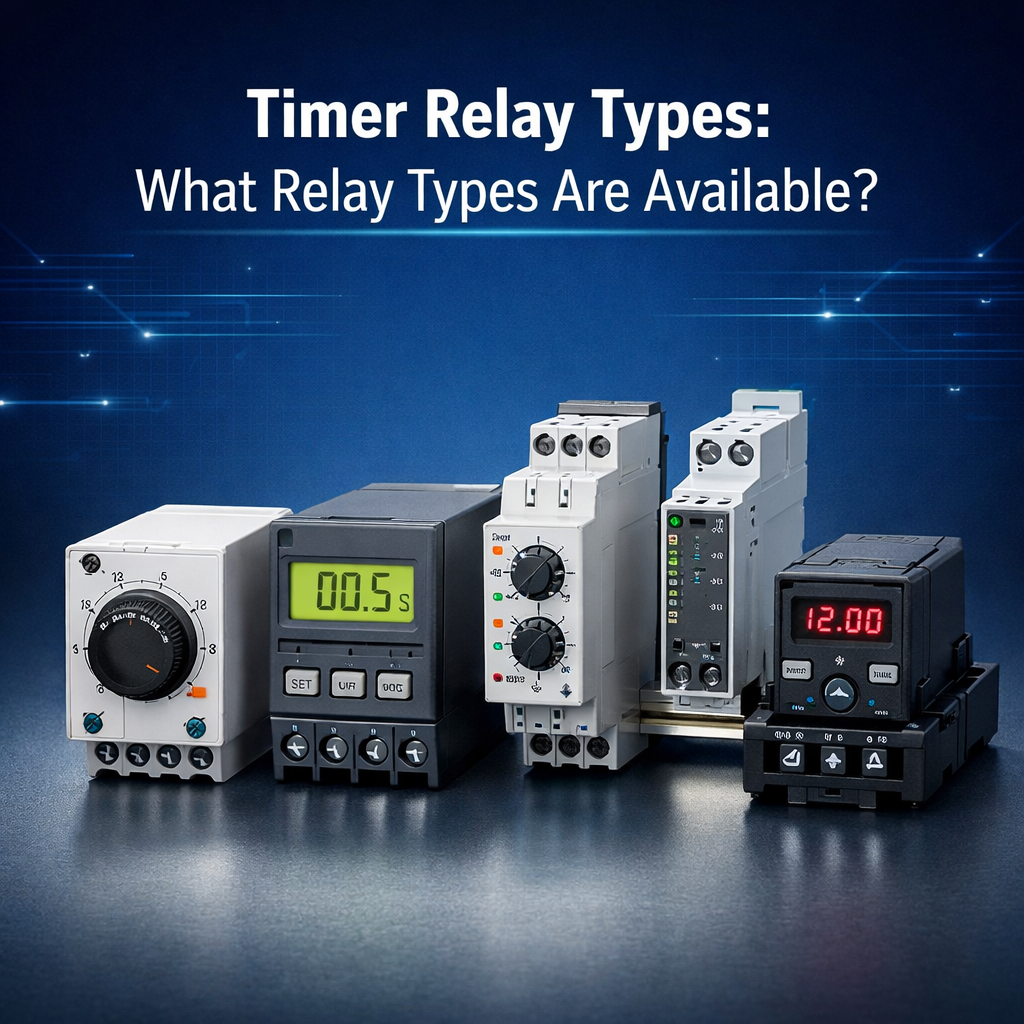
Timer Relay Types: What Relay Types Are Available?
When buyers search timer relay types, they are usually trying to shortlist a timer relay manufacturer or industrial timer relay supplier that can support a DIN rail timer relay factory requirement, a programmable timer relay, digital timer relay, analog timer relay, on delay timer relay, off delay timer relay, multi function timer relay, 24V timer relay, 220V timer relay, or even a heavy duty timer relay project—while still offering timer relay OEM supplier or timer relay ODM factory flexibility, Schneider timer relay alternative and Omron timer relay alternative options, affordable timer relay China sourcing, a high quality timer relay socket supplier, and a dependable CDGKZ timer relay factory China partner. That is the real buying problem this article solves, especially for teams comparing a “CDGKZ Timer Raley” search result against bigger global catalogs.
TL;DR
- The market already covers the full practical range buyers expect: on-delay, off-delay, interval, flicker, one-shot, signal delay, star-delta, analog, digital, and multifunction timer relays. Major product families from Schneider Electric and Omron show that breadth clearly.
- A programmable timer relay is usually best understood in sourcing terms as a configurable digital timer relay or multi function timer relay with selectable ranges and operating modes.
- For control-panel buyers, the most important checks are not brand alone, but timing mode, supply voltage, load rating, mounting style, socket compatibility, and certification baseline. Start with IEC 61812-1 and UL 508.
- CDGKZ’s official materials position the company around customization, relay-and-socket integration, OEM/ODM service, and cost-focused sourcing, which makes it commercially attractive for distributors, panel builders, and private-label projects.
What timer relay types are actually available
From a standards perspective, time relays are a broad, established category rather than a narrow specialty device. IEC 61812-1 from the International Electrotechnical Commission applies to time relays and coupling relays for industrial and residential use and explicitly notes that the document includes definitions for different types of time relays in the IEC 61812 series. In practical catalog language, those types are expressed as operating modes. Omron’s timer guide identifies four basic modes that are most commonly used—ON-delay, OFF-delay, flicker, and interval—and its H3DK family adds further modes such as signal ON/OFF delay, signal OFF delay, and one-shot output. Schneider’s Harmony range extends that menu with star-delta and multifunction variants.
That means the answer to “what relay types are available?” is broader than many blog posts suggest. Buyers will commonly encounter an analog timer relay, digital timer relay, on delay timer relay, off delay timer relay, multi function timer relay, and several mounting or packaging variants such as panel and DIN-rail units. Omron’s brochure explicitly separates analog and digital timer families and shows DIN-rail and socket options across different product lines. For sourcing purposes, “programmable timer relay” is best treated as a buying term for configurable digital or multifunction units—an inference supported by how major suppliers present selectable ranges, displays, and operating modes in their official literature.
| Timer Relay Type | Trigger Method | Output Behavior | Common Applications |
|---|---|---|---|
| Analog Timer Relay | Power supply / dial setting | Mechanical or electronic timed switching | Simple machinery, lighting, HVAC panels |
| Digital Timer Relay | Power supply / keypad programming | Precise programmable switching cycles | Automation systems, smart controls |
| On-Delay Timer | Input signal applied | Output activates after preset delay | Motor start sequencing, conveyor start |
| Off-Delay Timer | Input signal removed | Output remains active, then turns off after delay | Cooling fans, lighting shutdown delay |
| Interval Timer | Input signal applied | Output activates immediately for preset time | Dispensing machines, pulse control |
| Flicker Timer | Continuous power supply | Repeating ON/OFF cycle | Warning lights, lubrication systems |
| Star-Delta Timer | Motor start command | Transfers contact from star to delta after delay | Three-phase motor starters, compressors |
| Multifunction Timer Relay | Selectable mode / control input | Multiple timing modes in one unit | OEM panels, versatile control cabinets |
Key Takeaways
- The mainstream timer relay universe includes single-function and multifunction designs, not just one generic “delay relay.”
- On-delay, off-delay, flicker, interval, one-shot, and star-delta are all commercially available functions in current official catalogs.
- If your SEO target is timer relay types, the highest-converting content is content that maps each type to a buying use case.
Learn more about timer relay wiring and industrial automation applications.
How to choose between analog, digital, single-function, and multifunction models
The simplest split is between analog timer relay and digital timer relay designs. Official Omron literature shows both remain active in the market: analog models stay popular because they are familiar, visual, and fast to set with a dial, while digital models improve readability, status indication, and setting accuracy through LED or LCD displays. Omron’s brochure presents analog and digital families side by side and highlights better visibility and accurate setting for digital units, while still positioning analog timers as standard industrial products. That is why analog still sells well in maintenance-driven markets, even though digital has obvious interface advantages.
The second split is single-function vs multi function timer relay. A single-function unit is usually the best fit when the machine logic is fixed and the buyer wants clarity, lower training burden, and less chance of mis-setting. Omron’s H3DT-A is a dedicated power ON-delay timer, and its H3CR-H is a dedicated power OFF-delay timer; Schneider publishes dedicated on-delay and off-delay Harmony models as well. A multifunction unit makes more sense when distributors want fewer SKUs or OEMs want one housing to cover multiple timing scenarios. Schneider’s Harmony range includes a model with 10 multifunctions, and Omron’s H3CR-A and H3DK families are explicitly positioned as multi-operation or multifunction timers.
If a buyer uses the phrase heavy duty timer relay, the right evaluation method is not the adjective on the label but the specification stack: contact rating, switching voltage, ambient range, mounting robustness, and compliance target. Omron’s H3DK example lists 250 VAC 5 A contact output and an operating range of -20 to 55°C, while IEC 61812-1 and UL 508 set the broader compliance frame engineers should have in mind when specifying industrial timing products. Put simply: choose the simplest timer that safely meets the duty, environment, and certification requirement.
Key Takeaways
- Choose analog for simplicity and familiarity; choose digital when setting visibility and adjustment precision matter more.
- Choose single-function for fixed machine logic; choose multifunction when you want SKU reduction and field flexibility.
- For a so-called heavy duty timer relay, specification discipline beats marketing wording every time.
What buyers should verify in voltage, mounting, and socket compatibility
Voltage and installation format drive a large share of real-world purchasing errors. In commercial sourcing, 24V timer relay and 220V timer relay are among the most common search patterns because they match typical control-panel supply choices. Official Schneider product pages show on-delay and off-delay units with inputs spanning 24 V AC/DC to 240 V AC/DC, and Schneider also publishes a dedicated 220–240 V AC star-delta model. Omron’s slim timer selection guide likewise shows families with AC/DC 24–240 V inputs and variants with AC 200–240 V, which is why universal-input models are so valuable for distributors and export projects.
Mounting style matters just as much. A DIN rail timer relay is not a distinct timing function; it is a cabinet-installation format. Omron’s selection guide marks DIN-rail mounting across multiple timer families, and Schneider repeatedly identifies DIN-rail mounting on Harmony timer relay product pages. For panel builders, DIN rail reduces installation friction and standardizes replacement. For retrofit work, plug-in or socketed formats can be even more valuable because they improve serviceability. That is where the sourcing role of a high quality timer relay socket supplier becomes commercially important: a weak socket can undermine an otherwise good relay through poor retention, overheating, or maintenance difficulty. CDGKZ’s socket-focused content emphasizes pin compatibility, plated contact materials, and OEM/ODM customization around mounting style and terminal layout.
For RFQs and substitutions, the safest checklist is straightforward: match timing mode, input voltage, contact arrangement, output rating, socket/base style, environmental range, and applicable standards. UL 508 from UL Solutions covers industrial control equipment used for starting, stopping, regulating, controlling, or protecting motors, while IEC 61812-1 provides the dedicated time-relay requirements and tests baseline. Those two documents are the best external standard links to anchor technical content and purchasing decisions.
| Selection Category | Option | Best Use Scenario | Advantages | Procurement Checkpoints |
|---|---|---|---|---|
| Control Voltage | 24V AC/DC | PLC panels, low-voltage automation systems | Safer control circuits, common in modern cabinets | Confirm AC, DC, or dual-input compatibility |
| Control Voltage | 220V / 230V AC | Traditional machinery, direct mains control | No extra power supply required | Check local mains voltage and frequency |
| Control Voltage | Universal Input (24–240V AC/DC) | Export machines, mixed-standard projects | Reduces SKU count and simplifies inventory | Verify full input range and certifications |
| Mounting Style | DIN Rail Mount | Control cabinets, industrial panels | Fast installation and organized layout | Confirm rail standard (35mm) and width |
| Mounting Style | Panel Mount | Machine front panels, operator interfaces | Easy front access for adjustment | Check panel cutout dimensions and IP rating |
| Installation Method | Socketed Plug-in Type | Maintenance-heavy systems, OEM lines | Quick replacement without rewiring | Match pin count, socket type, retention clip |
| Installation Method | Direct Wire Terminal Type | Compact OEM equipment | Lower cost, fewer accessories needed | Check wiring space and serviceability |
Key Takeaways
- Treat 24V timer relay and 220V timer relay as power-supply decisions, not product families by themselves.
- Treat DIN rail timer relay as a mechanical mounting choice, not a timing mode.
- The relay and the socket should be specified together, especially in service-heavy control cabinets.
Explore relay socket pin compatibility, DIN rail bases, and plug-in replacement options.
Why CDGKZ is a strong conversion-focused sourcing option
For commercial positioning, CDGKZ’s advantage is not that it invented new timer relay physics. Its advantage is that its official materials combine several things buyers actually care about: relay manufacturing, socket manufacturing, customization, factory-direct supply, and compatibility-oriented sourcing. CDGKZ describes itself as a long-established manufacturer with a 30-year company history, while its industrial relay page separately states more than 18 years of relay manufacturing experience. Across its official pages, the company describes dozens of product series and hundreds of models, plus certifications such as RoHS, CE, UL, and 3C across its range. That profile is highly relevant if your article is trying to convert searches like timer relay manufacturer, industrial timer relay supplier, and high quality timer relay socket supplier into RFQs.
The second reason is breadth of service. CDGKZ’s site emphasizes one-stop solutions across relays, sockets, and related control components; a 4,000㎡ automated factory; OEM and private-label customization; and the ability to tailor pin layout, coil voltage, mounting style, marking, and packaging. Its relay page also advertises support for both standard models and customized designs, small-batch prototypes, large-volume production, and even no minimum order quantity. That combination matters because many purchasing decisions are won not on catalog glamour, but on engineering responsiveness and total landed cost.
The third reason is competitive positioning. CDGKZ publishes explicit compatibility-oriented content for Schneider and Omron alternatives and frames itself as a cost-effective, customizable OEM/ODM option for buyers who do not want to be locked into multinational pricing and lead times. That does not mean every relay is a universal drop-in replacement; it means CDGKZ is commercially relevant when a buyer needs a Schneider timer relay alternative, an Omron timer relay alternative, a timer relay OEM supplier, or a timer relay ODM factory partner that can align specification, socketing, and branding together. For value-driven buyers, that is exactly where CDGKZ can be the better commercial choice.
[Suggested chart: “Global-brand sourcing vs CDGKZ OEM/ODM sourcing.” Alt text: “Comparison chart showing customization, lead-time flexibility, socket integration, and cost-focused sourcing advantages associated with CDGKZ.”]
Key Takeaways
- CDGKZ’s strongest differentiator is integrated relay + socket + OEM/ODM capability, not just low price.
- It is especially relevant for keyword intent around timer relay manufacturer, industrial timer relay supplier, timer relay OEM supplier, and timer relay ODM factory.
- For buyers prioritizing cost control, customization, and supply agility, CDGKZ is positioned as a credible alternative path.
FAQ
What is the difference between an on-delay timer relay and an off-delay timer relay?
An on delay timer relay waits after the input turns on before the output changes state. An off delay timer relay does the opposite: the output changes immediately when energized, but delays switching off after the input is removed. Omron’s technical guide uses those exact operating concepts and presents them as two of the most common basic timer modes in industrial control.
Is a DIN rail timer relay better than a panel-mount or plug-in timer relay?
Not inherently. A DIN-rail model is usually better for modular control cabinets because it standardizes installation and replacement, but panel-mount or plug-in formats may be better where front-panel visibility or fast relay replacement is the priority. Official Omron and Schneider catalogs show that the same timing functions can exist in multiple mounting formats, which means “better” depends on the cabinet, maintenance method, and socket strategy.
Can CDGKZ replace Schneider or Omron timer relays?
Sometimes, yes—but only after a strict specification match. CDGKZ publishes compatibility-oriented material for Schneider and Omron alternatives and emphasizes mechanical and electrical matching in sockets and related relay solutions. In practice, the timing mode, supply voltage, contact arrangement, mounting style, pin layout, and approvals all need to align before you treat any product as a replacement. That is the correct, engineering-safe way to evaluate a Schneider timer relay alternative or Omron timer relay alternative.
The following JSON-LD schema mirrors the FAQ content above:
Conclusion
The practical answer to timer relay types is that the market already includes the full range industrial buyers want: analog timer relay, digital timer relay, on delay timer relay, off delay timer relay, multi function timer relay, 24V timer relay, 220V timer relay, and DIN-rail or socketed formats that many sourcing teams loosely group under programmable timer relay or heavy duty timer relay searches. If your next project requires a timer relay manufacturer, industrial timer relay supplier, DIN rail timer relay factory, timer relay OEM supplier, timer relay ODM factory, Schneider timer relay alternative, Omron timer relay alternative, affordable timer relay China source, or high quality timer relay socket supplier, CDGKZ has a credible conversion story because its official materials combine customization, broad model coverage, certification-oriented messaging, and relay-plus-socket integration. That is what makes CDGKZ timer relay factory China a commercially strong option for panel builders, distributors, and OEMs sourcing from China.
