
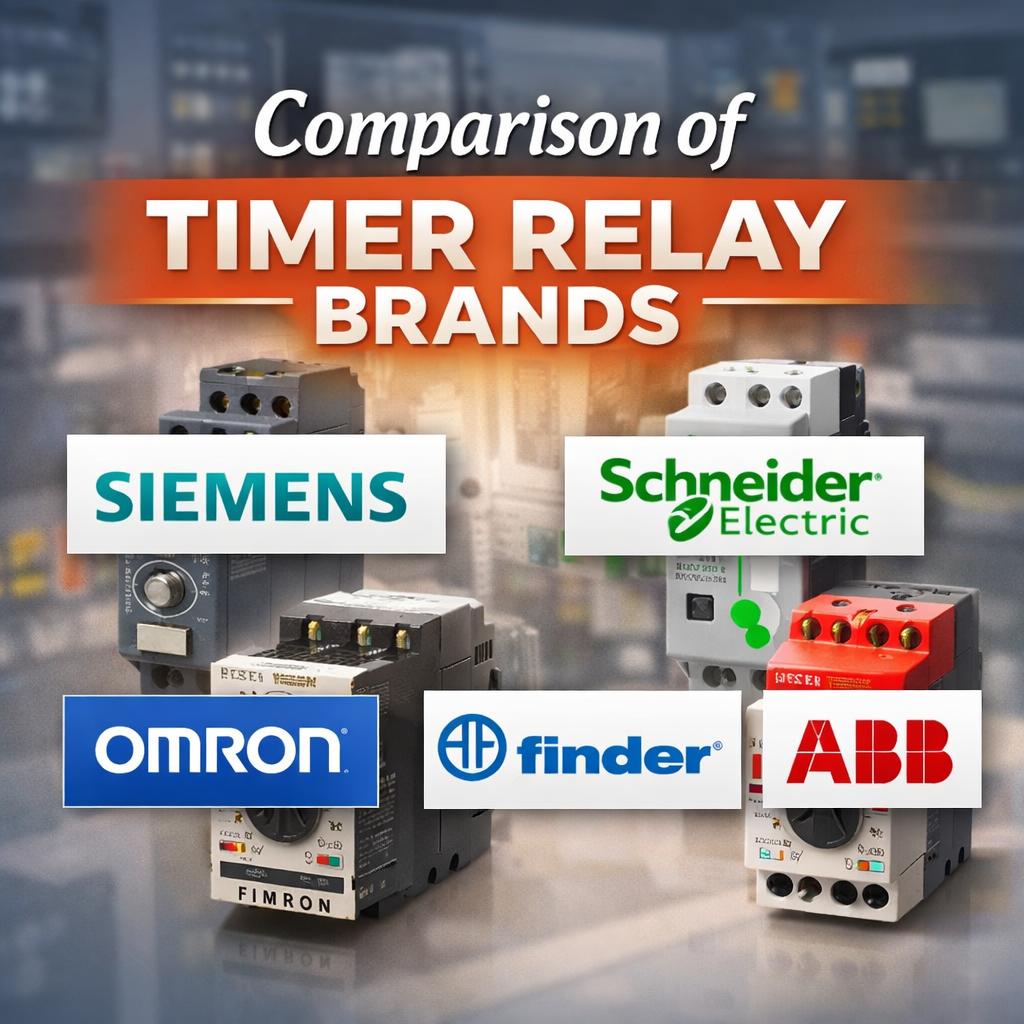
Global Timer Relay Brands and Types Explained: Siemens, Schneider, Omron, Finder Alternatives Guide
Industrial control systems depend on timer relays (also called time relays, time delay relays or industrial timer relays) to sequence operations, protect equipment and ensure smooth start‑ups and shutdowns. Engineers and purchasers often default to a familiar brand name, but selecting the right timer relay type matters more than the logo on the case. This guide explains how different types—on‑delay, off‑delay, cycle, interval and star‑delta—work and compares major manufacturers like Siemens, Schneider Electric, Omron, Finder and ABB. Whether you’re specifying a DIN‑rail timer relay for a motor control panel or searching for timer relay alternatives, this article helps you choose the best product for your application.
TL;DR (Summary)
Understand functions first: On‑delay, off‑delay, interval and cycle timers each serve specific control logic; star‑delta timers simplify motor starting. Multifunction units combine these modes.
Compare brands thoughtfully: Siemens offers compact 3RP timers with high accuracy and reliability. Schneider’s Harmony series focuses on simple integration and NFC configuration. Omron’s H3CR series provides industry‑leading precision (±0.2 % full‑scale accuracy). Finder specializes in modular timers with European design logic, and ABB’s CT series is rugged for harsh environments.
Look beyond the label: Many time relay suppliers offer compatible alternatives with similar functions, voltage ranges and DIN‑rail mounting, often at lower cost.
Selection factors matter: Consider timing range, accuracy, contact configuration, coil voltage, mounting style and environmental ratings when choosing a timer relay.
CTA: Explore our product line of multi‑function timer relays compatible with major brands and request a quotation tailored to your panel requirements.
Types of Timer Relays: Functions, Principles and Applications
Timer relays introduce programmable delays into control circuits. Understanding the operating principle of each type is essential when planning a system or selecting an alternative.
On‑delay timer relay (delay‑on make)
An on‑delay timer relay keeps its output inactive until a preset delay has elapsed after the control signal arrives. According to industrial guides, the output contacts close only after the set time and reset instantly when power is removed. Typical applications include motor soft‑start sequences, conveyor start‑up sequencing and HVAC fan start delays.
Off‑delay timer relay (delay‑on break)
An off‑delay timer relay energizes its output immediately after power is applied, then opens the contacts only after the set delay once power is removed. Off‑delay timers keep cooling fans running after motors shut down or provide lamp‐fade delays in lighting circuits.
Interval timer relay (one‑shot)
Interval or one‑shot timer relays produce a fixed‑length output pulse when triggered. The GEYA technical guide notes that an interval timer activates its output instantly and de‑energizes after the preset time. Interval timers are used for momentary motor control, access control (door unlocking) or testing sequences.
Cycle (repeat) timer relay
A cycle timer relay alternates between ON and OFF states repeatedly. When power is applied, the contacts switch on for a preset time and off for another preset time, creating continuous cycles. Cycle timers automate pumps, irrigation systems and flashing lights.
Star‑delta (motor starting) timer relay
Star‑delta timers control the transition from a star connection to a delta connection during motor start‑up. They provide the star connection for a preset delay, then automatically switch to delta, reducing inrush current and mechanical stress. This type of timer is common in large‑motor starters and industrial compressors. Some multifunction relays integrate star‑delta modes alongside other functions.
Multifunction timer relay
Modern multifunction relays combine several timing modes in one unit. For example, Siemens’ 3RP15 electronic timers can perform on‑delay, off‑delay, cycle and star‑delta functions, and the catalogue notes they deliver high accuracy (<±1 % repeat accuracy and <±5 % setting accuracy) with high mechanical endurance. Multifunction relays reduce inventory, simplify wiring and adapt to varying applications.
Key Takeaways
Function determines selection: Choose a timer relay based on the required delay logic rather than brand or price.
Time range matters: On‑delay and off‑delay timers often cover from milliseconds to hours; interval and cycle timers suit pulse or repetitive tasks; star‑delta timers feature short transfer delays for motor starting.
Multifunction saves space: Combining multiple modes reduces inventory and simplifies panel design.
Internal link suggestion: Learn more about timer relay functions and wiring diagrams
Comparing Major Timer Relay Brands: Siemens, Schneider, Omron, Finder & ABB
When selecting a timer relay or evaluating an alternative, understanding each manufacturer’s strengths helps you balance performance, cost and integration.
Siemens – precision and reliability
Siemens’ SIRIUS 3RP time relays are designed for high‑end automation and integrate seamlessly with other Siemens components. The electronic timer catalogue lists features such as universal voltage ranges (24–240 V AC/DC) and multiple time ranges (0.05 s to 100 h). Benefits include high repeat accuracy (<±1 %), high mechanical endurance (30 × 10⁶ operations) and integral surge suppression. The modular design allows snap mounting on standard DIN rails and reduces panel depth.
Positioning: Siemens sits at the top of the market, offering robust relays for complete system integration.
Star product: 3RP25 multifunction timers with up to 27 timing functions.
Strengths: Reliability, modularity and compatibility with the SIRIUS ecosystem.
Schneider Electric – integration and smart configuration
Schneider’s Harmony timer relays (formerly Telemecanique) target panel builders looking for easy installation and digital configuration. Retail descriptions highlight their slim form factor and ability to mount on DIN rails using the same space as a single‑pole modular device. They are described as “straightforward and easy to use, ideal for simple integration in hard‑wired logic schematics”. The Harmony NFC range allows settings to be duplicated via a smartphone app, reducing set‑up errors and enabling remote adjustments.
Positioning: Mid‑range with smart integration and IoT‑ready features.
Star product: Harmony RE22/RE48 series with NFC configuration.
Strengths: Slim design, easy DIN‑rail mounting, digital programming and simple integration into existing logic.
Omron – precision and longevity
Japanese manufacturer Omron is renowned for its H3CR series solid‑state timers. The official datasheet notes that the H3CR‑A offers ±0.2 % full‑scale operating time accuracy and ±5 % setting error. It also specifies a mechanical life of 20 million operations and electrical life of at least 100 000 operations. The series complies with EN 61812‑1 and other international standards, making it a global benchmark.
Positioning: General‑purpose timers for industrial automation.
Star product: H3CR‑A multifunction timer.
Strengths: High precision, broad supply voltage range and long service life.
Finder – specialist with European design
Italian manufacturer Finder focuses almost exclusively on relays and timers. A global market review notes that this specialization results in high‑quality contacts and distinctively European design logic. The Finder 80 Series includes modular timers 17.5 mm wide with multiple time scales, high input/output isolation and DIN‑rail mounting. Finder offers specialized timers like staircase timers and astronomical switches, making the brand popular in building automation.
Positioning: Specialist brand for European building automation and custom relay functions.
Star product: 80 Series modular timers.
Strengths: Wide range of specialized timers, high‑quality contacts and distinct European design.
ABB – robustness for harsh environments
Swiss manufacturer ABB targets heavy industry, marine and oil & gas sectors. According to a global review, ABB’s CT‑E and CT‑S electronic timers are built to withstand harsh industrial environments and work seamlessly with ABB contactors and soft starters. Their key advantage is robustness, with vibration resistance and wide temperature operating ranges.
Positioning: High‑end relays for extreme conditions.
Star product: CT‑E and CT‑S series.
Strengths: Durability, compatibility with ABB starters, and extended environmental tolerance.
Siemens
Precision and Reliability
Siemens’ SIRIUS 3RP time relays are built for high-end automation, offering universal voltage ranges, wide timing options, strong repeat accuracy, high mechanical endurance, and seamless DIN rail integration.
Positioning: High-end automation and full system integration
Star Product: 3RP25 Multifunction Timer
Strengths: Reliability, modularity, SIRIUS ecosystem compatibility
Schneider Electric
Integration and Smart Configuration
Schneider’s Harmony timer relays focus on slim DIN rail installation, simple hard-wired logic integration, and digital setup. NFC-enabled models allow smartphone-based duplication and remote parameter adjustment.
Positioning: Mid-range with smart integration and IoT-ready features
Star Product: Harmony RE22 / RE48
Strengths: Slim design, digital programming, easy wiring, simple integration
Omron
Precision and Longevity
Omron’s H3CR series is widely recognized as a benchmark for solid-state timer relays, offering excellent timing precision, broad voltage options, long mechanical life, and strong compliance with international standards.
Positioning: General-purpose industrial timing solutions
Star Product: H3CR-A Multifunction Timer
Strengths: High precision, broad voltage range, long service life
Finder
Specialist with European Design
Finder specializes in relays and timers, with the 80 Series offering slim 17.5 mm modular designs, multiple timing scales, strong isolation, and DIN rail mounting for European-style building automation.
Positioning: Specialist brand for European applications and custom timing logic
Star Product: 80 Series Modular Timers
Strengths: Specialized range, quality contacts, distinctive European logic
ABB
Robustness for Harsh Environments
ABB’s CT-E and CT-S electronic timers are designed for demanding applications in heavy industry, marine, oil and gas. They are valued for durability, vibration resistance and strong compatibility with ABB starters and contactors.
Positioning: High-end relays for extreme industrial environments
Star Product: CT-E / CT-S Series
Strengths: Durability, harsh-environment performance, ABB ecosystem compatibility
Key Takeaways
Different brands suit different needs: Choose Siemens for high‑end modular systems, Schneider for easy integration and NFC programming, Omron for precision and long life, Finder for specialized building automation, and ABB for rugged environments.
Standards compliance matters: Look for IEC 61812‑1 or UL approvals to ensure safety and global acceptance.
Price vs. performance: Cheaper brands may offer similar functions; evaluate based on accuracy, life expectancy and environmental rating.
Internal link suggestion: Read our in‑depth review of Siemens 3RP vs. Schneider Harmony timers
Choosing the Right Timer Relay: Selection Criteria & Alternatives
Selecting a timer relay involves more than picking a brand. Engineers must match the relay’s performance to the application’s requirements, and sometimes an industrial timer relay supplier can offer cost‑effective alternatives with the same functionality.
Define the timing function
Identify whether your application requires on‑delay, off‑delay, interval, cycle, star‑delta or a combination. Multifunction relays allow the function to be changed via dials or digital settings, which can reduce inventory and simplify maintenance.
Match the time range and accuracy
Ensure the relay’s programmable range covers your required delay. For motor soft starts you may need 0.1 s–180 s; for cooling fans you may need 30 s–300 s. High‑precision applications may demand ±0.1 % accuracy. Siemens’ 3RP series offers <±1 % repeat accuracy and high mechanical endurance, while Omron’s H3CR delivers ±0.2 % full‑scale accuracy. Choose accuracy appropriate for your process but avoid paying for unnecessary precision.
Select the contact configuration
Determine how many circuits you need to control. SPDT (single‑pole double‑throw) relays control one circuit with changeover contacts, DPDT (double‑pole double‑throw) control two independent circuits, and 3PDT handle three circuits. Some manufacturers offer 4‑pole or multi‑pole versions for complex systems. Ensure the contacts can switch the required currents (AC‑15, DC‑13 ratings) and provide adequate isolation for safety.
Check coil voltage and load ratings
Timer relays are available with DC coils (e.g., 12 V or 24 V for PLC systems) and AC coils (120 V, 230 V for standalone panels). Many modern units support universal ranges (24–240 V AC/DC), reducing stock variations. Always verify that the control supply voltage and the contact ratings match your system’s requirements.
Consider mounting method and space
Most industrial time relays are designed for DIN‑rail mounting, which saves space and simplifies installation. Models like Schneider’s Harmony series feature one of the slimmest form factors and use the same space as a single‑pole DIN device. Panel‑mount relays may suit retrofit projects but require cut‑outs in the enclosure.
Evaluate environmental tolerance
Industrial environments vary widely. Check operating temperature range, humidity tolerance, vibration resistance and IP rating. ABB’s CT series is known for withstanding harsh conditions, while Siemens 3RP timers feature integrated surge suppression.
Explore compatible alternatives
If brand name units strain your budget or lead‑times are long, consider timer relay alternatives from reputable OEM suppliers. The VIOX FCT18 series, for example, offers cost‑effective industrial performance with wide voltage support. Chinese manufacturers like VIOX specialize in high cost‑performance and OEM customization, allowing panel builders to source equivalents for Siemens, Schneider or Omron relays.
Key Takeaways
Specification matters more than logo: Define function, time range, voltage and mounting before selecting a brand.
Alternatives exist: Compatible timer relays can deliver the same functions and standards compliance at lower cost.
Verify ratings: Check contact ratings, environmental tolerances and certifications to ensure safety and reliability.
Internal link suggestion: How to choose the best timer relay for your control panel
OEM Supply & Industry Trends
Industrial automation is evolving, and so is the timer relay market. Here’s what procurement teams and engineers need to know.
OEM and private‑label manufacturing
Many distributors and manufacturers offer OEM or private‑label timer relays that are electrically compatible with well‑known brands. These units match the form factor and wiring of Siemens, Schneider or Omron relays but are produced by specialized factories. As highlighted in the global review, Chinese manufacturers provide rapid iteration and high cost‑performance ratio. By working directly with an industrial timer relay supplier, panel builders can customize functions, logos and packaging while meeting international standards like IEC 61812‑1.
Smart features and IoT integration
Timer relays are no longer purely electromechanical devices. Schneider’s NFC timers enable smartphone configuration and diagnostics. Some units integrate with PLCs via Modbus or other communication protocols, providing remote monitoring and adjustment. Engineers should plan for connectivity features when designing modern control panels.
Sustainability and compliance
Manufacturers are emphasizing eco‑design and regulatory compliance. Omron’s H3CR and Siemens’ 3RP series carry CE marking and comply with EMC directives and UL/CSA approvals. Schneider’s Green Premium label indicates reduced environmental impact. When sourcing alternatives, ensure they meet the same safety and environmental standards.
Key Takeaways
OEM partnerships reduce costs: Private‑label relays can deliver branded performance with flexible customization.
Smart features improve productivity: Look for NFC, programmable or network‑enabled timers to simplify configuration and diagnostics.
Ensure compliance: Verify that any alternative meets IEC 61812‑1, UL and CE requirements.
Internal link suggestion: Learn how OEM timer relays work and how to source them
FAQ
Below are common questions about timer relays. For structured data, a JSON‑LD schema is provided after the answers.
Why are timer relay functions more important than brand names?
Functions such as on‑delay, off‑delay, interval and cycle determine how a relay behaves in the circuit. Choosing the wrong function can cause motors to start abruptly, fans to stop too early or control sequences to malfunction. Brands differ in reliability and features, but function should always come first.
How can I replace a branded timer relay with a compatible alternative?
Identify the timing function, supply voltage, contact configuration and mounting style of the existing relay. Then look for an alternative with the same specifications and standards certifications. Many OEM manufacturers produce equivalents to major brands. For example, an on‑delay Siemens 3RP can be replaced with an equivalent universal time relay that offers the same timing ranges and DIN‑rail mounting.
What certifications should a timer relay have?
Industrial timer relays should conform to standards such as IEC 61812‑1 for time relays and relevant EMC directives. UL and CSA approvals are essential for North American markets, and CE marking indicates compliance with EU safety requirements. Omron’s H3CR series and Siemens’ 3RP series meet these standards
Conclusion & Call to Action
Timer relays are fundamental building blocks of industrial automation. By understanding the difference between on‑delay, off‑delay, interval, cycle and star‑delta modes and comparing manufacturers’ strengths, engineers can design more reliable and cost‑effective systems. Siemens excels at precision and modularity, Schneider leads in integration and NFC programming, Omron offers unmatched accuracy and longevity, Finder provides specialized European timers, and ABB delivers robustness for harsh environments. Meanwhile, OEM alternatives from emerging manufacturers deliver similar functions with attractive pricing.
Ready to select your next timer relay? Explore our range of multifunction and single‑function relays compatible with major brands. Our industrial timer relay supplier team can recommend the right device for your application or design a private‑label solution tailored to your panel requirements. Contact us today for technical support, samples and quotations.
