
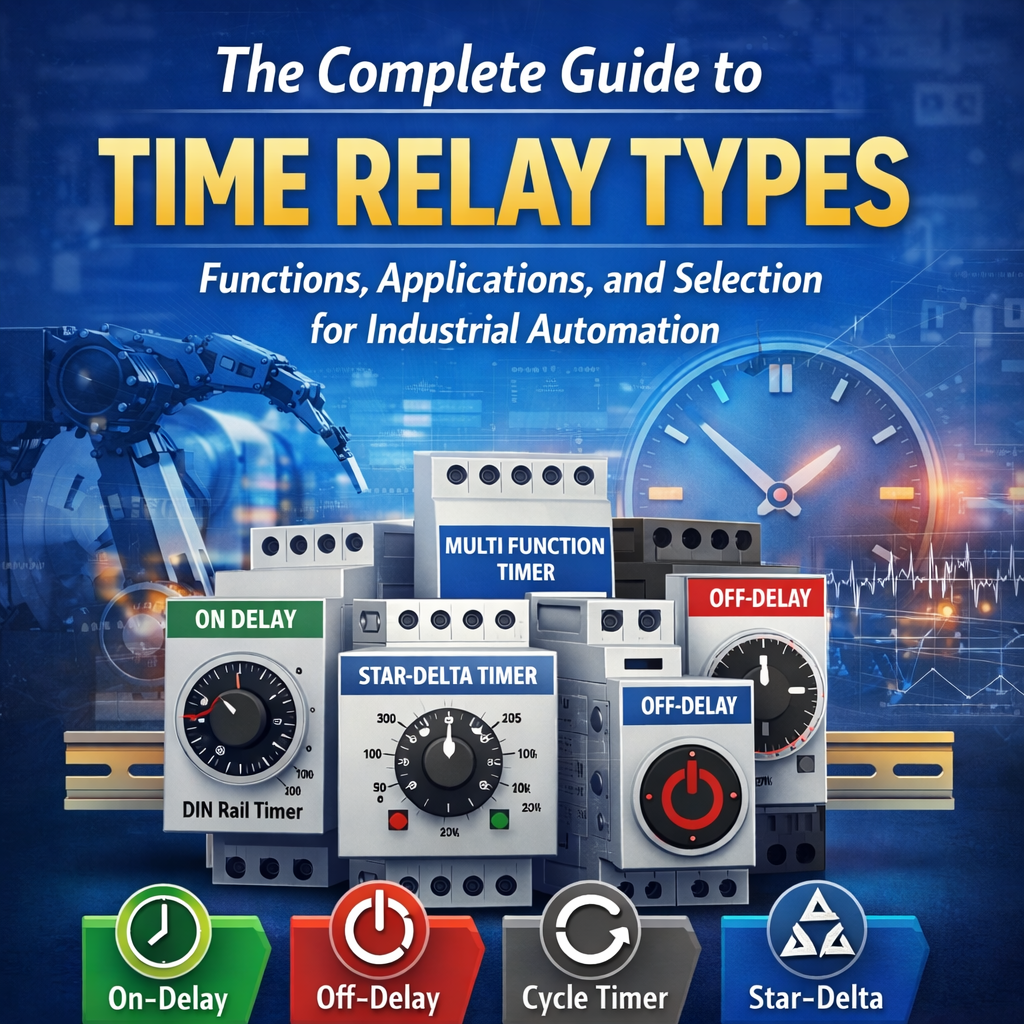
Time Relay Types Explained: Industrial Timer Relay Guide for Automated Systems
In industrial automation, precise timing determines whether motors start smoothly, conveyors synchronize or safety interlocks trigger correctly. Time relays, also known as timer relays or time delay relays, provide this precision. Engineers often face confusion about the different types—on‑delay, off‑delay, interval, cycle, and star‑delta—and which one suits their application. This article addresses those pain points by explaining how each timer relay type works, highlighting real‑world uses and offering a structured selection guide.
TL;DR
Time relays (timer relays) are devices that delay or control switching in electrical circuits. They are essential for motor control, lighting, safety systems and process automation.
The main types include on‑delay, off‑delay, interval/one‑shot, cycle (flasher), star‑delta and multifunction timer relays.
Selecting an industrial timer relay requires evaluating the timing function, range, contact configuration, installation method (DIN‑rail vs panel) and environmental ratings.
DIN‑rail timer relays simplify installation in control panels and are widely used in motor control and industrial automation systems.
Reliable suppliers and manufacturers like CDGKZ offer industrial timer relays with on‑delay, off‑delay and multifunction modes suitable for OEM and OEM‑style projects.
On‑Delay and Off‑Delay Timer Relays
Operating principles
An on‑delay (delay‑on‑make) timer relay waits a preset time after the control signal is applied before energising its output. The timing sequence typically proceeds as follows: the input signal energises the coil, the internal timing circuit counts down and only after the preset time do the output contacts change state. This delay prevents immediate start‑up and is valuable for soft‑starting motors, staggering equipment startup sequences or preheating ovens.
Conversely, an off‑delay (delay‑on‑break) timer relay operates the contacts immediately when the input is energised, then begins timing only after the control signal is removed. The contacts remain in their switched state during the delay period, then return to normal when the preset time elapses. Off‑delay timing keeps equipment running briefly after power is removed—ideal for cooling fans, elevator lights or pump run‑on.
Applications and benefits
Motor soft starts and sequential startup: On‑delay relays prevent inrush current by delaying activation until motors reach speed. They are used in conveyors, crushers and compressors.
Cooling and safety hold: Off‑delay relays keep fans or pumps running after shutdown, ensuring safe temperature and pressure decay.
Lighting and access control: Stairwell or restroom lights can stay on for a preset period using off‑delay or interval timers, saving energy.
Key Takeaways
On‑delay timers delay activation after coil energisation, reducing mechanical stress and current surges.
Off‑delay timers maintain output for a set time after input removal, perfect for run‑on functions.
Both types are available as DIN‑rail timer relays or panel‑mount devices and support SPDT, DPDT or 3PDT contact configurations.
Internal link suggestion: Understand how DIN‑rail mounting simplifies timer relay installation.
Interval (One‑Shot) and Cycle Timer Relays
Interval / One‑Shot timers
An interval timer (also called a one‑shot timer) energises its output immediately upon receiving the control signal and then de‑energises after the preset delay, regardless of whether the input signal remains present. It outputs a single pulse of defined length. This mode is used for actions that must occur once and for a defined duration, such as sealing in packaging machines, timed ventilation or temporary motor activation.
Cycle / repeat‑cycle (flasher) timers
Cycle timers alternate between on and off states for specified durations, repeating this pattern as long as the input signal is present. Known as repeat‑cycle or flasher timers, they allow control of periodic operations such as irrigation systems that water at set intervals or flashing warning lights and beacons. The cycle typically has independent on‑time and off‑time settings, enabling asymmetrical duty cycles.
Typical uses
Process control: In mixing or chemical processes, interval timers regulate the duration of mixing or heating phases.
Safety and access: Interval timers control electric locks—unlocking doors for a few seconds when a key card is presented.
Agriculture and environmental control: Cycle timers manage greenhouse irrigation, periodic ventilation fans and flashing hazard lights.
Key Takeaways
Interval (one‑shot) timers provide a single timed output pulse after activation.
Cycle timers repeatedly switch on and off for preset durations, enabling periodic control of pumps, lights or alarms.
Adjustable on‑time and off‑time make cycle timers versatile for symmetrical or asymmetrical duty cycles.
Internal link suggestion: Explore repeat‑cycle timer applications in process automation.
Star‑Delta and Multifunction Timer Relays
Star‑Delta timers for motor starting
Star‑delta timer relays control the transition of three‑phase motors from a star (wye) configuration to a delta configuration. They limit the starting current by initially energising the motor windings in star (reducing voltage per phase) and, after a preset time, switching to delta connection for full power. This reduces the mechanical and electrical stress during startup and is widely used for large motors in industrial plants. Typical delay settings range from 2–10 s for the star stage and are adjustable based on motor size and load.
Multifunction timers
Multifunction timer relays incorporate multiple timing modes—on‑delay, off‑delay, interval, repeat‑cycle and sometimes more—within a single unit. Mode selection is often via dip switches or a selector knob. Multifunction timers are ideal for applications where timing requirements may change, such as small production lines or experimental automation systems. They simplify inventory and reduce panel space because a single relay can be configured for various functions.
Use cases
Large motor starters: Star‑delta timers reduce initial current draw and mechanical shock on pumps, compressors and fans.
Flexible automation: Multifunction timers enable process sequences that change over time without hardware replacement.
Backup spares: Maintenance teams keep multifunction timers as universal spares to minimise downtime.
Key Takeaways
Star‑delta timer relays switch motors from star to delta configuration after a preset delay, ensuring smoother starts.
Multifunction timers combine multiple timing functions in one device, allowing flexible adaptation to diverse applications.
These timers often support DIN‑rail mounting and universal voltage ranges, making them convenient for OEM panels.
Internal link suggestion: Learn how star‑delta starters protect motors.
Selecting the Right Timer Relay for Your Application
Choosing the correct timer relay is critical for safety and efficiency. Consider these criteria:
Timing function requirements: Decide whether you need on‑delay, off‑delay, interval, repeat cycle or multiple functions. Determine if a multifunction relay could simplify your design.
Time range and accuracy: Match the relay’s time range to the application (e.g., 0.1 s–180 s for motor soft start or 30 s–300 s for cooling fans). Electronic or microprocessor‑based timers offer ±0.1 % accuracy.
Contact configuration: Choose SPDT, DPDT or 3PDT contacts based on how many circuits you must control.
Electrical specifications: Ensure the coil voltage and contact ratings match your control circuit and load (e.g., 24 V DC, 120 V AC or 230 V AC). Low‑voltage DC relays suit PLC‑controlled systems while AC coils suit simpler control panels.
Installation method: DIN‑rail timer relays snap onto DIN rails and save space in modern control cabinets; panel‑mount relays may be better for retrofits. Check the physical dimensions (height, width, depth) to fit your cabinet.
Environmental tolerance: Evaluate operating temperature, humidity and vibration ratings for industrial environments; for harsh conditions, choose relays with IP ratings or sealed enclosures.
| Relay Type | Function | Typical Delay Range | Example Application |
|---|---|---|---|
| On-Delay Timer Relay | Delays output activation after the control signal is applied. | 0.1 s – 180 s | Motor soft start, conveyor startup sequencing, industrial oven preheating |
| Off-Delay Timer Relay | Keeps output active for a preset time after the control signal is removed. | 30 s – 300 s | Cooling fan run-on, pump post-operation delay, lighting delay-off |
| Interval Timer Relay | Activates output immediately, then turns it off after a preset interval. | 0.1 s – 60 s | Timed ventilation, door unlocking pulse, temporary machine startup |
| Cycle Timer Relay | Alternates ON and OFF states repeatedly according to preset cycle times. | 1 s – 24 h | Pump periodic operation, flashing warning lights, greenhouse irrigation control |
| Star-Delta Timer Relay | Controls transition from star connection to delta connection during motor startup. | 2 s – 10 s | Large motor startup, compressor systems, industrial fan drives |
| Multifunction Timer Relay | Supports multiple timing modes such as on-delay, off-delay, interval and cycle in one unit. | Depends on selected mode, typically 0.1 s – 24 h | Flexible automation panels, OEM equipment, multi-purpose control cabinets |
Key Takeaways
Define the required timing function and range before selecting a relay.
Verify coil voltage, contact ratings and environmental specifications for safe operation.
DIN‑rail and multifunction timer relays offer flexibility and simplify control panel layouts.
Internal link suggestion: Review our timer relay product range and specifications
Applications and Benefits of Industrial Timer Relays
Timer relays play vital roles across industries:
Industrial automation: Time delay relays manage sequencing of conveyors and machines, preventing jams and damage. They also coordinate start‑up and shutdown sequences to protect equipment.
HVAC systems: Relays control compressors and fans in heating and cooling systems, preventing short cycling and extending equipment life.
Lighting control: In both industrial and commercial settings, timers automate lighting schedules for energy savings and safety. Off‑delay or interval timers keep lights on for a set period after a switch is pressed.
Motor control: On‑delay and star‑delta timers minimise inrush current and mechanical stress during motor start‑up. Off‑delay relays run cooling fans after shutdown to prevent overheating.
Safety and security: Timers delay alarm activation in fire systems to confirm signals, and control the duration doors remain unlocked in access control.
Process control: Interval and cycle timers regulate mixing, heating and irrigation tasks in factories and agriculture.
Key Takeaways
Timer relays enhance safety, energy efficiency and equipment longevity across automation, HVAC, lighting and motor control.
Each relay type suits specific applications—on‑delay for soft starts, off‑delay for run‑on, interval for single pulses, cycle for periodic actions and star‑delta for large motors.
Integrating time relays into PLC systems or control panels improves reliability and process consistency.
Internal link suggestion: Find out how to integrate timer relays with PLCs.
FAQ
What is the difference between on‑delay and off‑delay timer relays?
An on‑delay timer delays the activation of its output after the control signal is applied. An off‑delay timer energises its output immediately but keeps it active for a preset time after the control signal is removed. On‑delay relays are used for soft starts and sequencing, while off‑delay relays provide run‑on functions such as cooling fans or lights.
Can a PLC timer replace a separate timer relay?
Programmable logic controllers (PLCs) have built‑in software timers. However, standalone time delay relays can offload simple timing tasks from the PLC and reduce programming complexity. They also provide isolation between control and power circuits and can continue timing functions during PLC faults. For critical safety functions (e.g., maintaining outputs after power loss), dedicated off‑delay relays are preferable.
How do I mount a DIN‑rail timer relay?
DIN‑rail timer relays have clip mechanisms that snap onto standard 35 mm DIN rails. To install, hook the top of the relay onto the rail and press down until it clicks. Ensure adequate clearance for wiring and ventilation. Panel‑mounted time relays require a cut‑out and are secured with screws or clamps. Always de‑energise circuits before installation.
Conclusion & Call to Action
Time relays—whether on‑delay, off‑delay, interval, cycle or star‑delta—are indispensable building blocks of industrial timer control circuits. They provide precise timing control, improve safety and efficiency, and simplify automation design. When choosing a timer relay, consider the timing function, range, contact configuration, installation method and environmental factors. For engineers seeking reliable solutions, CDGKZ’s industrial timer relays combine DIN‑rail convenience with multi‑function options and robust contact ratings. Explore our timer relay catalogue or contact our timer relay specialists today to find a time relay that matches your motor control or automation needs.
