
Industrial Terminal Block Technical Specifications Explained
Introduction: Engineers and procurement specialists often struggle to find clear, authoritative information on terminal block technical specifications when selecting components. Too many resources read like product catalogs without explaining what the specs actually mean. This guide provides an in-depth look at industrial terminal block specifications – terminal block technical specifications explained in plain language – so you can confidently determine if a given terminal block suits your project. We’ll cover key electrical ratings (current, voltage, wire size), material properties, safety standards compliance, environmental durability, and how to read spec sheets to choose the right terminal block for your needs. By the end, you’ll know exactly what each parameter means and why it matters.
TL;DR
- Core Specs: Terminal blocks (aka terminal connectors or terminal strips) have critical ratings like rated current and voltage, supported wire size range, and tightening torque. These determine if a block can safely carry the required electrical load.
- Materials Matter: High-quality blocks use flame-retardant insulation materials (often UL94 V-0 thermoplastics) and conductive metal parts (tinned copper alloys) to ensure low contact resistance and reliable connections.
- Standards Compliance: Reputable industrial terminal blocks meet standards such as IEC 60947-7-1 and UL 1059, confirming they passed rigorous electrical, mechanical, and fire safety tests. Insulation class and flammability ratings (e.g. UL94 V-0) are key safety specs.
- Environmental Durability: Check the block’s operating temperature range (e.g. -40°C to +105°C), vibration resistance, corrosion protection (platings, etc.), and IP rating (ingress protection). These specs indicate reliability in harsh or industrial environments.
- Spec Sheet Know-how: Always match a terminal block’s specs to your application. Learn how to read terminal block specifications on datasheets—especially current, voltage, and approvals—to choose the right terminal block that meets your project’s requirements and safety codes.
Electrical Specifications: Rated Voltage, Current & Wire Capacity
Understanding the electrical ratings of a terminal block is crucial to ensure it can handle your application’s power requirements. The key electrical specs include rated voltage, rated current, and wire size (capacity), which are often interrelated.
| Specification | Typical Range | What It Means in Practice |
|---|---|---|
| Rated Voltage | 300 V / 600 V / 1000 V | Maximum system voltage the terminal block can safely withstand |
| Rated Current | 10 A-50 A+ | Maximum continuous current without overheating |
| Wire Size Range | 0.2 -10 mm² (24-8 AWG) | Minimum and maximum conductor size allowed |
| Dielectric Strength | 2.5-6 kV | Insulation resistance against electrical breakdown |
Rated Voltage & Dielectric Strength: This is the maximum voltage the terminal block is designed to handle safely. For example, common industrial terminal blocks might be rated for 300 V, 600 V, or higher. The voltage rating is largely determined by the block’s design (pitch/spacing between terminals) and the insulation’s dielectric strength. A higher dielectric strength means the insulating material can withstand higher voltages without breakdown, which in turn allows a higher voltage rating. Always choose a block with a voltage rating above your system’s operating voltage (with a safety margin). For instance, if your circuit is 240 V, a 300 V-rated terminal block would be appropriate, whereas a 110 V block would not. Manufacturers often test terminal blocks with overvoltage or impulse withstand tests to verify this spec.
Rated Current: This specification indicates the maximum continuous current (in Amps) that each circuit of the terminal block can carry safely. It depends on the conductor material cross-section, contact design, and heat dissipation. Essentially, a larger or better-cooled terminal can carry more current without overheating. For example, a small PCB terminal block might be rated for 10 A, while a heavier duty feed-through block might handle 50 A or more. It’s important to never exceed the rated current; doing so risks overheating the terminal and the connected wires. Notably, UL 1059 (the UL terminal block standard) tests for heat rise at rated current to ensure safety. Always select a terminal block with a current rating comfortably above your circuit’s maximum normal operating current. If there are potential surges or inrush currents, consider derating (using a higher-capacity block) for extra safety.
Wire Size Range: Terminal blocks support a range of wire sizes (gauges) specified by the manufacturer (e.g. 26–12 AWG or 0.5–4 mm²). This indicates the smallest and largest conductor that can be properly inserted and secured. The wire size range must accommodate the wires in your project. For instance, if a block accepts up to 12 AWG and you need to connect a 10 AWG wire, that block is not suitable. Using a wire outside the specified range can lead to poor connections or damage. In general, larger wire sizes correlate with higher current capacity, so wire range and current rating often go hand-in-hand. Ensure both are adequate for your needs. If you require bridging multiple wires in one terminal, also check if the terminal allows two conductors per clamp (some do, but at reduced gauge).
Key Takeaways:
– Rated voltage tells you the maximum system voltage the block can safely handle – choose a block rated above your operating voltage (e.g. 600 V block for a 480 V system).
– Rated current is the maximum amps per circuit; exceed it and the terminal will overheat. Select a block with current rating higher than your circuit’s peak current.
– Wire size/gauge range must match your wiring. Use only wires within the specified AWG or mm² range for a secure connection and to meet the block’s amperage rating.
Learn more about our range of industrial terminal blocks and their electrical ratings.
Material & Mechanical Specifications: Insulation, Conductor, and Torque
Beyond electrical ratings, a terminal block’s construction materials and mechanical design greatly affect performance and durability. Key specs here include the insulation material, the conductor (terminal) material, and the recommended tightening torque for screw clamps.
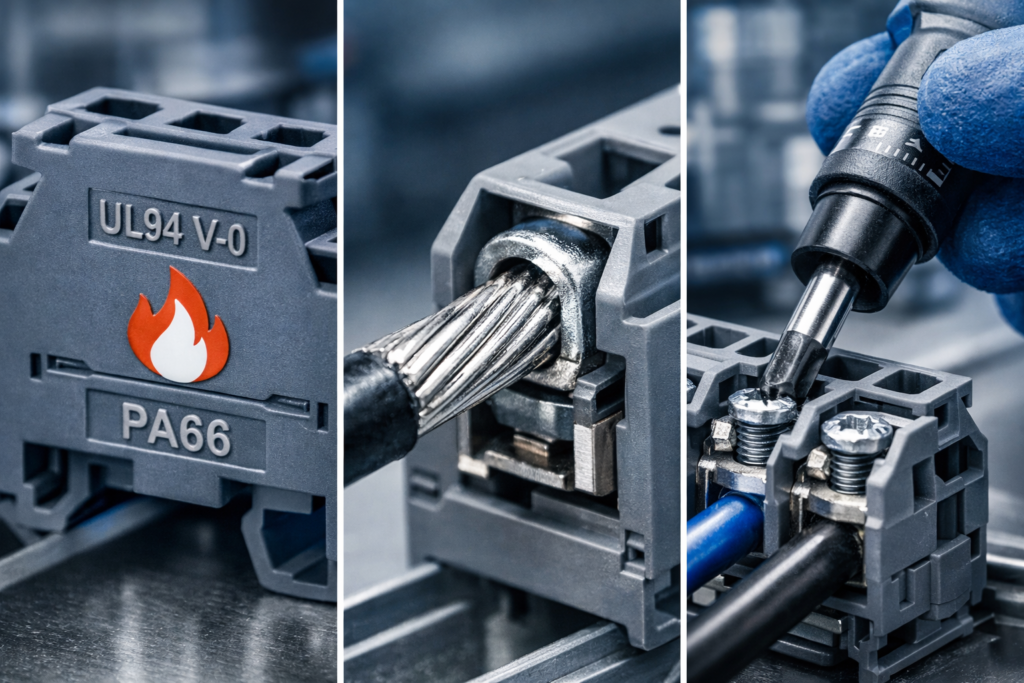
Insulation Material: The housing or body of the terminal block is typically made of an insulating plastic (thermoplastic or thermoset). Common materials include polyamide (nylon PA6.6), which offers a good balance of electrical insulation, heat resistance, and toughness. High-quality terminal blocks use fire-resistant, UL94 V-0 rated plastics that self-extinguish if ignited, ensuring safety in case of electrical faults. The insulation material also determines the temperature range of the block (e.g. nylon blocks often handle about -40°C to +105°C). In fact, some industrial terminal blocks are rated for operation from -40°C up to 120°C. The material’s Comparative Tracking Index (CTI) is another indicator (higher CTI means better resistance to electrical tracking in humid/dirty conditions). When evaluating a terminal block, check the datasheet for the insulation’s flammability rating (look for UL94 V-0 or similar) and its maximum operating temperature. A good insulation material will not deform under heat and will maintain dielectric strength over the product’s life.
Conductor & Contact Material: The current-carrying parts of the terminal block – the metal terminal inserts, clamps, and screws – are usually made of copper-based alloys for conductivity, often plated to resist corrosion. Many screw terminal blocks use brass or phosphor bronze metal bodies (for the clamp or cage) with a tin or nickel plating to prevent oxidation. The screws or clamp actuators might be steel (for strength) with plating (zinc or nickel) to avoid rust. The choice of conductor material affects the contact resistance and long-term reliability: copper alloys provide low resistance and good spring properties (for clamp contacts) but must be protected from corrosion. Tin-plated terminals are common for general use terminal blocks, while high-end or high-current blocks might have silver-plated or even gold-plated contacts to ensure excellent conductivity over time. When reading specs, note if the manufacturer specifies the metal – e.g. “tin-plated copper alloy contacts” – as this is a sign of a quality design. Avoid unknown or cheap materials that could corrode or loosen (leading to higher resistance and heating).
Tightening Torque: For screw-type terminal blocks (the most common type, using a screw to clamp the wire), the manufacturer will specify a recommended tightening torque (in N·m or lbf·in). This is the torque that should be applied to the screw to ensure the wire is securely clamped without damaging the terminal. Proper torque is critical: under-tightening can lead to a loose connection that overheats or fails (especially under vibration), while over-tightening can strip the screw or deform the conductor, also causing failure. For example, a typical IEC terminal block might specify 0.5–0.6 N·m (around 4–5 lbf·in) for a small screw. Always use a calibrated screwdriver or torque tool to meet these specs, especially in safety-critical applications. Many standards (including IEC and UL) have tests for screw tightness and conductor pull-out to ensure terminals won’t loosen under stress. If you’re using spring-clamp or push-in terminal blocks, there is no user-applied torque, but the manufacturer may specify an equivalent test force. In any case, follow the manufacturer’s guidelines for installation to get the mechanical performance the specs promise.
| Component | Material | Benefit |
|---|---|---|
| Housing | PA66 (UL94 V-0) | Flame-retardant, heat resistant, high dielectric strength |
| Conductor | Tin-plated copper alloy | Low resistance, corrosion protection |
| Clamp / Spring | Phosphor bronze / stainless steel | High mechanical strength and vibration resistance |
| Screw | Zinc-plated steel | High torque endurance, anti-rust |
Key Takeaways:
– Housing material should be a high-quality insulator (often PA66 nylon) with a UL94 V-0 flammability rating for safety. This ensures the terminal block can withstand heat and will not propagate flames.
– Terminal metals are typically copper alloys (brass, phosphor bronze) plated with tin or nickel to resist corrosion. Quality metal construction means lower contact resistance and a longer-lasting connection.
– For screw terminals, always tighten to the specified torque. The torque spec guarantees the screw is neither too loose (risking overheating) nor too tight (risking damage). Proper installation ensures the mechanical integrity of the connection.
Learn more about terminal block construction and materials on our blog.
Standards & Compliance for Terminal Blocks
| Standard | Region | Scope |
|---|---|---|
| IEC 60947-7-1 | International (IEC) | Low-voltage terminal blocks for industrial applications |
| UL 1059 | USA (UL) | Safety standard for terminal blocks used in equipment |
| UL 94 V-0 | Global | Flammability rating for terminal block insulation materials |
| CE Marking | Europe | Compliance with EU Low Voltage and EMC Directives |
When deploying terminal blocks in commercial or industrial projects, safety and compliance certifications are paramount. Customers and regulatory bodies want to know that the product meets relevant international standards. Key terms and specs in this realm include IEC 60947-7-1, UL 1059, UL 94 V-0, insulation category/class, and other safety marks. Let’s break down what these mean:
IEC 60947-7-1 (and related IEC standards): IEC 60947 is a family of international standards for low-voltage switchgear; Part 7-1 specifically covers terminal blocks for copper conductors. A terminal block built to IEC 60947-7-1 has passed a battery of design tests for things like dielectric withstand, temperature rise, short-circuit, mechanical durability, and more. For example, this standard ensures a terminal block can handle its rated current without excessive heat (temperature-rise test) and that its insulation can withstand transient overvoltages (surge voltage test) and a power-frequency withstand test. It also defines creepage and clearance distance requirements based on pollution degree (industrial environments are typically Pollution Degree 3 in IEC terms). A compliant block will have an IEC certification or declaration from the manufacturer. Notably, IEC 60947-7-1 covers screw and spring clamp terminal blocks intended for up to 1000 V AC or 1500 V DC applications, across a wide range of conductor sizes (0.2 mm² up to 300 mm²). This tells you that an IEC-rated terminal block is suitable for heavy-duty industrial use when installed properly.
UL 1059: UL 1059 is the Underwriters Laboratories standard for terminal blocks (in North America). If a terminal block is UL Recognized under UL1059, it means it has been tested for use in equipment and meets specific safety criteria. UL1059 classifies terminal blocks into “Use Groups” (typically Group C or D for industrial devices) that define the voltage and environmental application. For instance, Use Group C in UL 1059 might correspond to industrial control equipment at up to 600 V with certain spacing requirements. UL tests include things like dielectric voltage-withstand, current overload (heat rise), pull-out tests for wires, and flame tests. A key aspect is spacing: UL 1059 has minimum creepage/clearance distances that the terminal block must maintain for a given voltage (to prevent arc tracking or flashover). In practical terms, if a block is UL approved for 600 V in a certain Use Group, you can use it in UL-listed industrial panels (UL508A) up to that rating, provided you follow any conditions of acceptability noted. Always check if the terminal block carries a UL Recognized (Component) mark and for which voltage/current it is rated by UL – this information is often in the datasheet or UL’s online directory. Using UL-recognized terminal blocks can simplify getting UL approval for your overall equipment.
Other Certifications and Ratings:
– Insulation Class / Category: Sometimes a datasheet will mention insulation category (for example, “IEC insulation coordination: III / 3 / 600 V” etc.). This relates to how the terminal block’s insulation system is rated for overvoltage categories and pollution degrees. It ensures the block can handle certain transient voltages. While a deep design topic, as a user you just need to ensure the block’s ratings align with your environment (e.g. industrial power distribution usually demands Overvoltage Category III).
– UL94 Flammability (UL 94 V-0, V-1, etc.): We touched on this in materials, but it’s often listed under safety specs. UL94 V-0 is the most stringent commonly used rating for plastics in terminal blocks – indicating the plastic stops burning within 10 seconds after two applications of flame and does not drip flaming particles. Always prefer V-0 rated terminal blocks for industrial applications, as they will self-extinguish if there’s a fire risk. Lower ratings like V-2 or HB indicate less flame resistance.
– CE Mark and RoHS: If you’re in regions that require CE marking (Europe), terminal blocks should carry the CE mark, indicating conformity to applicable EU directives (often by adhering to EN IEC 60947-7-1 and low-voltage directive, etc.). RoHS compliance indicates the product is free of certain hazardous substances – most modern terminal blocks are RoHS compliant (no lead in the alloy, etc.).
– Other standards: There are additional standards for specific uses (e.g. IEC 60947-7-2 is for protective earth (ground) terminal blocks, which have a green/yellow marking and connect to ground bars; IEC 60947-7-3 for fuse terminal blocks). If your project requires these special terminal types, ensure compliance with those parts. Some terminal blocks also carry CSA certification (Canadian Standards) or ATEX/IECEx if used in explosive atmospheres, etc., depending on the application.
In summary, compliance specs give you confidence that the terminal block has been tested for safety. Always verify what standards a terminal block meets. For critical projects, specify blocks that are IEC certified and UL recognized, so you know they have been independently evaluated.
Key Takeaways:
– IEC 60947-7-1 compliance means the terminal block passed international tests for electrical, mechanical, and thermal performance on copper conductors up to its rated limits. It’s a mark of globally recognized safety and quality.
– UL 1059 recognition indicates the terminal block meets UL’s safety requirements for use in equipment (appropriate spacings, flame resistance, etc.). In industrial control panels, using UL-approved terminal blocks helps satisfy UL508A panel standards.
– Check for insulation class and flammability ratings: High-quality blocks use UL94 V-0 materials and have creepage/clearance distances for the intended voltage and pollution degree. These specs reassure you that the block will not fail under environmental stress or fault conditions.
Read more about Terminal Block safety certifications and standards compliance in our guide.
Environmental & Reliability Specifications
Industrial terminal blocks are often used in harsh environments – from high-temperature factory floors to vibration-prone automotive or railway systems, to corrosive outdoor installations in solar or marine applications. Therefore, it’s important to understand the environmental and reliability specs of a terminal block. Key factors include operating temperature range, vibration/shock resistance, corrosion resistance, and sometimes an IP rating.
Operating Temperature Range: This spec tells you the ambient temperature limits within which the terminal block can operate safely while carrying its rated current. A typical range for standard terminal blocks is around -40°C to +105°C (which corresponds to -40°F to +221°F). Some specialized or high-temp blocks go higher (125°C or more), whereas economy products might only be rated to 85°C. The lower end (e.g. -40) is important for cold environments or outdoor use in winter. The upper end must accommodate both ambient heat and the self-heating from current load. As mentioned, the material (plastic) largely dictates this range – nylon PA66 often tops out around 105°C continuous. If your equipment will run hot or see temperature extremes, choose a terminal block with ample temperature margin. Also note that at elevated temperatures, the current capacity might be derated (some manufacturers provide derating curves). Always consult if there are any de-rating factors above a certain temp. For instance, a block might handle 20 A at 20°C but only 15 A at 60°C due to heat rise. Manufacturers who test per IEC or UL include such considerations in their ratings.
Vibration and Shock Resistance: Applications like railway, aerospace, automotive, or heavy machinery will subject terminal connections to constant vibration and occasional shocks. A good terminal block for such environments will specify compliance with vibration tests (often per IEC 61373 for railway or MIL-STD-202 for general vibration) and shock tests. Screw terminals can loosen under vibration if not properly tightened (hence the torque importance), but many industrial screw clamp designs include features to resist loosening (like lock washers or cage clamp designs). Spring-cage terminals inherently perform well under vibration because the spring maintains constant pressure. When reviewing specs, look for any stated vibration resistance (e.g. “5g vibration for 12 hours, no loosening” or similar) or mention that the terminal is “vibration-proof”. Some terminal blocks are advertised as “railway grade” or “anti-vibration design”. For shock, standards might specify testing to e.g. 30g shock pulses without electrical discontinuity. If none of this is mentioned, assume the block is for stationary use in low-vibration settings. In critical uses, ask the manufacturer for vibration test data or choose spring-type blocks.
Corrosion Resistance: Terminal blocks involve metal parts, so corrosion can be a concern especially in humid, salty, or chemically exposed environments (e.g. coastal installations, water treatment plants, or factories with chemical fumes). To address this, manufacturers use plated metals (tin-plated copper, zinc-plated steel screws, etc.) and sometimes stainless steel hardware. One common test for corrosion resistance is the salt spray test (IEC 60068-2-11 or similar), where the terminal is exposed to a saline mist for a period (often 48 or 96 hours) and then inspected. A quality terminal block will pass 48h salt spray with no significant corrosion. When comparing products, check if they mention compliance to any corrosion or humidity tests. Additionally, moisture resistance might be noted – some terminals have anti-condensation designs or use materials that resist moisture absorption (which can lower insulation performance if not addressed). If your environment is corrosive, consider terminal blocks specifically marketed as “corrosion-resistant” or look for materials like stainless steel screws and high-quality plating. Regular maintenance (tightening and inspections) is also advisable in those conditions.
Ingress Protection (IP) Rating: Most individual terminal blocks are open-style and meant to be mounted inside an enclosure, so they don’t usually carry an IP rating themselves (aside from a basic IP20 “finger-safe” designation for some, meaning the design prevents accidental finger contact with live parts). IP20 is inherently provided by many modern terminal blocks via their shape (recessed screws, etc.). However, if terminal blocks are used in a situation without an enclosure, you might encounter terminal block assemblies with higher IP ratings. For example, some manufacturers offer terminal blocks in protective housings or with covers that achieve IP54 or IP65 to resist dust and water spray. Generally, though, in control panels the enclosure provides the needed IP rating (e.g. a NEMA or IP-rated box), and the terminal blocks inside are IP20 touch-safe. Always ensure any live terminals are at least finger-proof (IP20) to avoid electrical shock hazards – this is often a requirement in standards. If you do need exposed terminal blocks outdoors, use ones with appropriate enclosures or choose specialized connectors instead.
Other Reliability Factors: Some specs or tests that indicate reliability include electrical endurance (making/breaking capacity if the terminal has any switch or fuse function), maximum screw tightening cycles (how many times you can rewire it before threads wear out), and maintenance requirements. In critical systems, consider whether the terminal design is maintenance-free (spring clamps require no re-tightening, whereas screws might need periodic re-tightening in high-vibration settings). Also, look at any certifications like ATEX/IECEx if using in explosive atmospheres (some terminals for intrinsic safety circuits are certified for that).

Key Takeaways:
– Temperature range: Choose terminal blocks rated for the full temperature span of your application (e.g. -40 to +105 °C is a common industrial range). This ensures the block won’t fail or degrade in extreme cold or heat.
– Vibration resistance: In high-vibration environments, use terminal blocks designed and tested to resist loosening (spring-clamp types or screw clamps with vibration certifications). They should maintain electrical continuity under shock and vibration.
– Corrosion protection: Look for plated or stainless steel hardware and references to salt spray or humidity testing. Quality terminal blocks withstand corrosive atmospheres (48+ hours salt spray) without significant oxidation, preserving low contact resistance over time.
– Enclosures/IP: Unless specifically rated with an IP65+ housing, assume terminal blocks need to be mounted in a protected enclosure. Standard blocks are typically finger-safe (IP20) but rely on external housing for environmental sealing.
Discover how our terminal blocks are tested for extreme environments and long-term reliability.
How to Read Terminal Block Specifications & Choose the Right Terminal Block
Choosing the correct terminal block for your needs involves understanding the spec sheet and knowing which parameters are most critical for your application. Here’s a simple selection guide on how to read terminal block specifications and use them to make an informed choice:
- Identify the Key Specs on the Datasheet: When you look at a terminal block’s datasheet or product page, locate the sections for Electrical Specifications, Mechanical/Material Specifications, and Standards/Certifications. Typically, the electrical section will list rated voltage, rated current, and wire size range as discussed. Make sure these align with your requirements: for example, if you need to connect a 4 mm² wire and carry 30 A, ensure the block’s wire range includes 4 mm² (or AWG 12) and the current rating is >= 30 A. Check the torque spec (usually under mechanical specs) if you’ll be tightening screws – you’ll want to use a torque screwdriver set to that value when installing. In the standards section, see if it lists UL, IEC, CE, etc., which can be crucial for project compliance. Essentially, read through each spec and ask, “Does this meet or exceed my project’s needs or regulatory requirements?” If not, you may need a different product.
- Prioritize Compatibility and Safety: The most important factors are those that, if mismatched, could cause failure or safety issues. That means voltage and current are top priority – never use a terminal block with a lower voltage or current rating than your application demands (ideally have a safety margin). For instance, for a 600 V system, don’t use 300 V-rated terminals; for a 50 A motor circuit, don’t use a 30 A block. Next, ensure the standards compliance fits: if your panel must be UL approved, using UL Recognized terminal blocks (and wiring them according to UL guidelines) will be necessary. If the project is in the EU, ensure the terminal has a CE mark and an IEC standard reference. Also consider the environment: if it’s an outdoor or high-temp installation, pay attention to those environmental specs (temperature, IP, UV resistance if plastic is exposed to sunlight, etc.). Terminal block specifications explained on paper need to match the reality of your use case. For example, if a spec sheet note says “Current rating 30 A (22°C ambient)”, and you know your enclosure could be 50°C inside, you might need to derate or choose a block with a higher nominal rating.
- Evaluate the Connection Type and Convenience: Specifications aren’t just numbers – also consider the type of terminal block that best suits your application and how easy it is to use. There are screw clamp, spring clamp, plug-in modular terminals, etc. A spec sheet may indicate the type (e.g. “screw terminal, slotted head” or “push-in spring terminal, requires ferrules for fine-strand wire”). If you have an application with frequent rewiring or vibration, a spring clamp terminal might be a better choice (even if the specs are similar) because it’s maintenance-free. On the other hand, if cost is a big factor and the environment is stable, screw types might suffice. The spec sheet might also specify if tools are needed (screwdriver type, wire stripping length, etc.). These practical aspects should influence your choice beyond just the raw numbers.
- Use a Selection Guide or Checklist: Many manufacturers provide selection tables or software. In absence of that, use a simple checklist: Electrical fit? (voltage, current, wire size), Mechanical fit? (will it mount on your DIN rail or PCB, is the pitch correct for your panel, does it physically fit the space), Environmental fit? (temp/vibration specs vs. environment), Compliance fit? (UL/IEC/etc. required? If yes, are they present?), and Special features? (do you need a fuse block, double-level, pluggable connectors, etc., and does the spec meet those needs). By systematically comparing specs to requirements, you can narrow to the best choice.
- Consult the Manufacturer or Datasheet Fine Print: If anything is unclear – for example, a datasheet might have a note like “Use Group C/600 V, 65 A with 4 AWG; Use Group D/300 V, 10 A with 22 AWG” – make sure you understand those nuances or ask the manufacturer. These often mean the block can be used in multiple scenarios but with different limits (here, Group D likely refers to a different use case). Also check if accessories (end plates, separators for higher voltage, etc.) are needed to achieve certain ratings.
By carefully reading the specifications and matching them to your project, you will ensure safety and reliability. How to choose a terminal block based on specifications comes down to understanding the data and not exceeding any limits. If done right, your chosen terminal block will perform flawlessly in the field.

Key Takeaways:
– Always cross-reference a terminal block’s core specs with your application’s requirements (voltage, current, wire gauge). Select a block that exceeds your max needs for a safe margin.
– Don’t ignore the fine print: standards (UL, IEC), environmental ratings, and installation notes on the spec sheet are just as important as the headline numbers. They ensure the block is suitable for your industry and environment.
– When in doubt, use the manufacturer’s resources or contact their technical support. It’s better to clarify a spec (e.g., maximum wire strand count or required ferrule for a spring terminal) beforehand than to have issues during installation.
FAQ
Q1: How do you read terminal block specifications on a datasheet?
A: Start by identifying the key electrical ratings (voltage, current, and supported wire size) on the datasheet and ensure they meet or exceed your application requirements. Next, look at the material and mechanical specs like insulation material (for temperature and flammability ratings) and tightening torque for screw terminals. Check the standards and certifications section for entries like “IEC 60947-7-1” or “UL 1059,” which indicate the block has been tested to those safety standards. Essentially, go through each spec line and verify that your use case (voltage level, current load, wire gauge, environmental conditions, regulatory approvals needed) is within what the terminal block is rated for. If anything is listed as a maximum, make sure your requirement doesn’t exceed it. Reading specifications is about matching your scenario to the numbers and notes on the datasheet – when in doubt, refer to the manufacturer’s application notes or contact them for clarification. Once you’re confident the specs align with your needs, you can choose that terminal block knowing it’s suitable.
Q2: Which safety standards and certifications should terminal blocks comply with?
A: The main safety standards for terminal blocks are IEC 60947-7-1 (the IEC standard for low-voltage terminal blocks) and UL 1059 (the UL standard for terminal blocks as recognized components in North America). Ideally, a high-quality terminal block will mention compliance with IEC 60947-7-1, meaning it meets international requirements for things like dielectric strength, heat resistance, and mechanical safety. For North America, look for a UL Recognized mark under UL 1059 (or CSA certification for Canada), which indicates it can be used in UL-listed panels or equipment up to certain ratings. Other relevant certifications include UL 94 V-0 for the plastic material’s flammability (important for fire safety), a CE mark for European regulatory compliance, and RoHS compliance (confirming the product is free of certain hazardous substances). If the terminal block will be used in specialized environments, you might also look for things like ATEX/IECEx (for explosive atmospheres) or railway standards compliance. In summary, the most universally important are IEC and UL standards – they ensure the terminal block has been vetted for electrical and fire safety. Always choose terminal blocks that at least meet these standards, especially for industrial or commercial projects where safety codes and approvals matter.
Q3: Can terminal blocks withstand harsh industrial environments?
A: Yes, many terminal blocks are specifically designed to perform reliably in harsh conditions – but you need to select the right type and check the relevant specifications. For high or low temperatures, ensure the operating temperature range of the block covers your environment (for instance, a range of -40°C to +105°C is suitable for most industrial settings). For vibration and shock (such as in automotive, rail, or machinery applications), look for terminal blocks described as vibration-resistant or those that use spring-clamp connections, which tend to hold up better under vibration than standard screw types. Some manufacturers test their terminals to vibration and shock standards (e.g. IEC 61373 for rail); those would be mentioned in the datasheet. In corrosive or humid environments, choose terminal blocks that have corrosion-resistant materials (tin-plated or stainless steel parts) and perhaps documentation of passing a salt spray test (48 hours or more) to ensure they won’t rust or lose conductivity. If dust or water exposure is a concern, you might need terminal blocks with an IP rating or to put them inside an appropriate enclosure – standard terminal blocks are typically IP20 (finger-safe) but not water-proof on their own. In summary, terminal blocks can withstand harsh environments if they are the correct industrial grade: always verify temperature ratings, vibration/shock specs, corrosion resistance, and consider environmental sealing. Using terminals that meet the applicable environmental standards will ensure long-term reliability even in demanding conditions.