
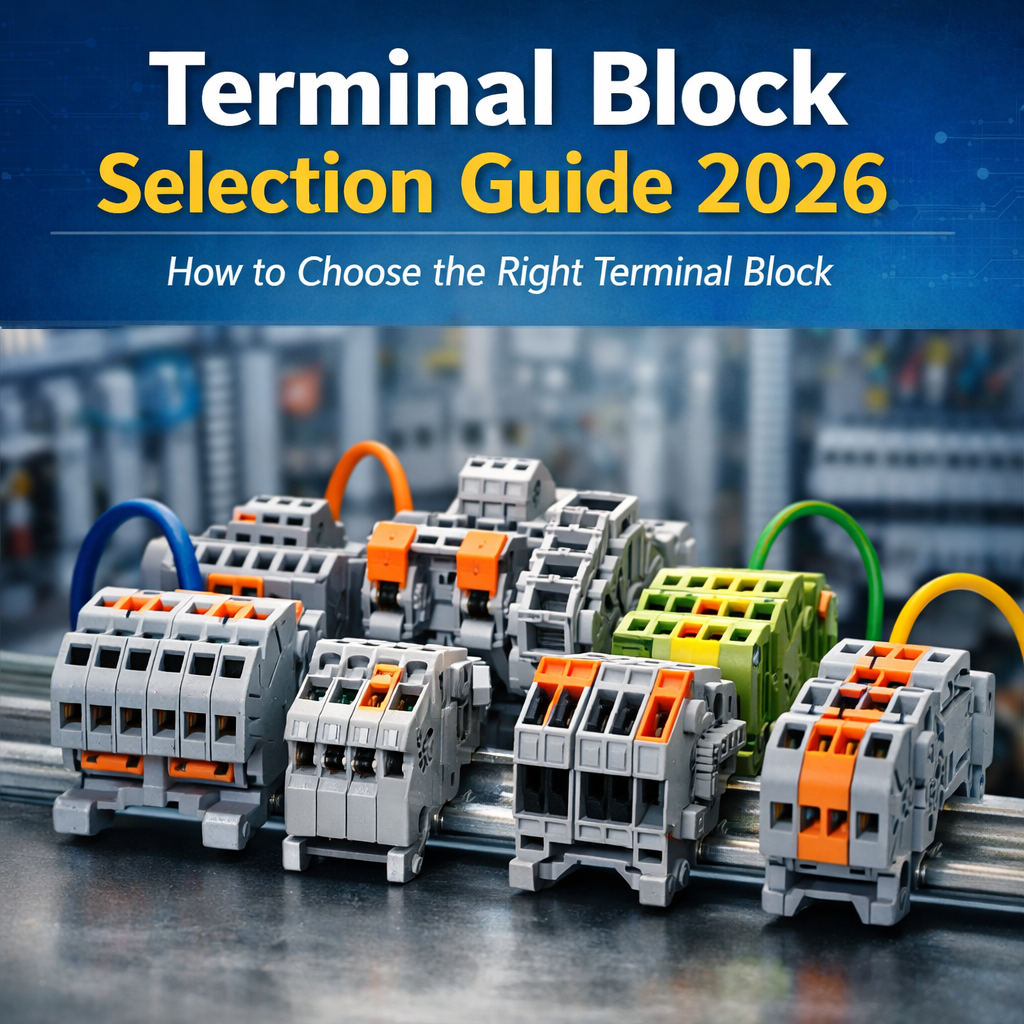
Terminal Block Selection Guide 2026 – How to Choose the Right Terminal Block
Introduction: Selecting the right DIN rail terminal block can be challenging for engineers and panel builders. With countless types, ratings, and standards to consider, choosing incorrectly may lead to overheated connections, loose wires, or even safety hazards. This guide addresses those pain points by explaining how to choose the right terminal block based on electrical requirements, mechanical design, environmental conditions, and industry standards. Our aim is to improve your understanding of terminal blocks and boost your project’s reliability – while also enhancing our site’s SEO visibility for all things terminal blocks.
TL;DR:
– Match Electrical Ratings: Ensure the terminal block’s current and voltage ratings exceed your system’s requirements (ideally by ~150% for current). This prevents overheating and maintains safety margins.
– Connection Type Matters: Decide between screw vs spring clamp terminal blocks (or push-in) based on application. Spring/push-in types enable faster, tool-free wiring and resist vibration, whereas screw clamps handle larger wires and require periodic tightening.
– Consider Design & Environment: Choose appropriate form factor (feed-through, multi-level, etc.) and mounting style (DIN rail, panel mount) that fits your panel space. Use high-quality insulation materials (e.g. UL94 V-0 polyamide) and ensure the block’s temperature and environmental specs suit your operating conditions.
– Verify Standards Compliance: Select terminal blocks that meet safety and compliance standards (UL 1059, IEC 60947-7-1, etc.) to ensure proper creepage/clearance distances and reliable performance under regulations. Certified blocks (UL, CE, IEC) have been tested for electrical and fire safety, giving you peace of mind.
Electrical Ratings and Wire Capacity (Current, Voltage & Size)
When starting a terminal block selection process, first nail down the electrical requirements. The terminal block current and voltage rating must comfortably handle your application’s needs. It’s recommended to choose a block rated well above the normal operating levels – for example, at least 150% of the maximum expected current. This overhead prevents the connector from running hot under peak load. Operating a terminal at its limit can cause excessive heat rise and eventual failure, so oversizing is a key safety margin.
Voltage rating is equally important. The block’s voltage rating is determined by its design (pitch/spacing and insulation) and dielectric strength of the housing. Always ensure the block’s rating exceeds your system’s maximum voltage, including any transient surges. For instance, a 600 V-rated terminal block is generally safe for a 480 V AC system. Exceeding the rated voltage risks arcing or breakdown of insulation. Voltage ratings also tie into creepage and clearance requirements – the physical spacing between conductive parts. Higher-voltage terminal blocks will have larger spacings to prevent flashover (per IEC and UL standards).
Don’t forget about wire size and conductor compatibility. Every terminal block has a specified wire gauge range it can accept. Verify that your conductors (whether AWG or mm²) fall within this range. If you use too large a wire, it won’t fit; too small and it may not clamp securely. Also consider the conductor type: stranded vs solid. Many screw-clamp terminals work well with stranded wires (providing a secure clamping surface), while push-in terminal blocks often require either solid conductors or ferruled stranded wires for optimal connection. Using the recommended wire type ensures good contact and minimizes issues like wire strand breakage or poor continuity.
Lastly, consider the number of circuits or poles needed – this affects how many terminal points and possibly the size of terminal block assembly required. Multi-circuit assemblies should still meet the same rating per pole.
Key Takeaways:
– Choose a terminal block with electrical ratings above your operational load – aim for ~150% of max current and a higher voltage class for safety.
– Ensure the block supports your wire gauge and type (e.g. use ferrules for fine-stranded wire in push-in connectors). Proper fit prevents loose connections.
– Account for surges and transient conditions – extra headroom in ratings helps handle inrush currents or overvoltage events without failure.
Learn more about our high-current terminal blocks and their electrical specifications.
Connection Mechanisms: Screw vs. Spring vs. Push-In Clamps
The next major consideration is the terminal’s connection mechanism or clamping style. The two prevalent categories are screw clamp terminals and spring clamp terminals – with push-in terminal blocks being a popular spring variation. Each has its pros and cons, so selecting the right one depends on your project’s priorities (e.g. ease of wiring, maintenance, vibration resistance).
Screw-clamp terminal blocks use a screw (and often a metal cage or plate) to secure the wire. They have a long track record and are known for handling large wire sizes and high currents well. When you tighten the screw onto the conductor, it creates a solid electrical contact with a large surface area, which is beneficial for high-current applications. However, screws require tools (a screwdriver) and add time to installation. There’s also a maintenance aspect: screws can loosen over time due to vibration or thermal cycling, so critical installations may require periodic re-tightening to maintain the specified torque and clamping force. Failing to tighten to the recommended torque can lead to a loose connection that overheats. That said, screw terminals remain highly versatile and are widely used, especially where tradition and familiarity are valued.
Spring-clamp terminals (also called tension clamp or push-in if they allow direct insertion) use a spring mechanism to hold the wire. Push-in terminal block advantages include very quick installation – you simply push the stripped wire in to connect (for release, a lever or tool might be used). No screwing means no tool is needed, which can cut wiring time by up to 50% and reduce labor costs. Spring clamps exert a consistent pressure on the wire, so they are self-adjusting and resist loosening. In high-vibration environments (e.g. automotive, machinery), spring terminals tend to maintain connectivity better since there’s no screw that can back out. Another benefit is minimal maintenance – once inserted, the spring keeps tension, and you don’t have to periodically check tightness.
Push-in styles are essentially a subset of spring clamps that allow direct insertion of solid wires or ferruled stranded wires without even opening a lever (the spring inside yields to the wire and then grips it). These are very popular in modern control panels because they speed up assembly. They can handle a wide range of wire sizes too, often from small signal wires up to a decent gauge. One limitation is that inserting larger, very flexible stranded wires might require ferrules or an opener tool to depress the spring. Also, extremely high-current lines might still favor screw clamps or bolt connectors due to larger contact mass.
| Feature / Criteria | Screw Clamp Terminal Block | Spring Clamp Terminal Block | Push-In Terminal Block |
|---|---|---|---|
| Installation time | Slow – requires screwdriver and torque control | Fast – tool-assisted spring opening | Very fast – direct wire insertion |
| Tool requirement | Required (screwdriver) | Minimal (release tool or lever) | Not required (for solid / ferruled wires) |
| Vibration resistance | Medium – may loosen over time | High – constant spring pressure | High – spring-loaded, vibration-proof |
| Maintenance needs | Periodic re-tightening recommended | Maintenance-free | Maintenance-free |
| Wire size range | Wide – suitable for large cross-section conductors | Medium to wide | Medium (best with solid or ferruled wires) |
| Conductor types | Solid & stranded (bare or ferruled) | Solid & stranded | Solid or stranded with ferrules |
| Connection reliability | High (if correctly torqued) | Very high | Very high |
| Risk of installation error | Medium – over/under-torque possible | Low | Very low |
| Typical applications | Power circuits, high-current lines | Control panels, machinery, vibration environments | High-density control wiring, fast panel assembly |
| Panel wiring efficiency | Moderate | High | Very high |
| Typical user preference | Traditional panel builders | Industrial automation engineers | Mass production / modern control cabinets |
In summary, screw vs spring clamp terminal blocks is not about which is “better” overall, but which is better for your needs. For example, if you prioritize quick installation and vibration-proof connections, spring or push-in terminals are ideal. If you have very large conductors or want the tried-and-true method, screw terminals might be preferable. Many manufacturers (WAGO, Weidmüller, Phoenix Contact, etc.) now offer extensive spring-clamp terminal lines due to their popularity in speeding up panel wiring.
Regardless of type, always follow the manufacturer’s guidance on wire preparation (strip length, ferrules, etc.) and proper insertion technique. And remember to consider if the terminal block offers features like dual wire entry (some clamps can hold two wires in one terminal for jumpering), or if they require any special tools for release.
Key Takeaways:
– Screw terminals provide robust connections for larger wires and high currents, but need tools to install and can loosen under vibration (requiring maintenance checks).
– Spring clamp terminals (including push-in types) enable faster, tool-free wiring and maintain tension automatically, making them vibration-resistant and low-maintenance.
– Choose the connection style based on your application: use spring/push-in for quick assembly and moderate currents, and screw clamps for very heavy-duty wires or if industry standards/traditions lean that way.
Learn more about spring-clamp connection technology in our terminal block product line.
Design & Mounting: Feed-Through, Multi-Level, and Form Factor Considerations
Terminal blocks come in various designs and form factors. It’s important to select a style that fits both the physical mounting type you need and your panel’s space constraints. The most common format for industrial applications is the DIN rail terminal block, which clips onto a standard 35 mm metal rail in control cabinets. DIN rail mounting makes it easy to add, remove, or reposition terminals on the rail, and it’s a widely adopted system for modular panel wiring. Ensure you choose terminal blocks compatible with the rail type (e.g. top-hat TH35 rail) if going this route. Some terminal blocks are panel-mount or PCB-mount instead, which would be used in different scenarios (e.g. a barrier strip bolted to a chassis, or a PCB terminal block soldered onto a circuit board).
Terminal block mounting types on DIN rail can include top-entry or side-entry for the wires, depending on how you want to arrange wiring inside the enclosure (side-entry low-profile blocks might save vertical space, while top-entry can be easier to access from above). Also consider marking and accessories: most DIN rail blocks have marker strip slots, test probe holes, and available accessories like end stops, separators, jumpers for commoning connections, etc. These can greatly ease wiring and troubleshooting in complex panels.
Another design aspect is whether you need feed-through terminal block types or specialized blocks. A basic feed-through terminal simply connects one wire to another through the block (with one input and one output contact per pole). However, there are multi-functional terminals like:
– Grounding terminal blocks: which connect to a DIN rail (ground bus) to provide earth connection. They are usually green-yellow and have a metal foot that contacts the rail.
– Fuse terminal blocks: include a fuse holder to protect circuits.
– Disconnect (knife) terminals: have a built-in switch or knife disconnect to isolate circuits for testing.
Make sure to pick the right type if your design calls for these additional functionalities.
If space is at a premium, consider multi-level terminal blocks. These stack two or three independent terminal levels in one block, effectively doubling or tripling the number of connections in the same footprint. A multi-level terminal block selection makes sense for high-density wiring like in PLC interfaces, where many signals need to be routed and panel space is limited. Just be mindful that multi-level designs might have slightly lower current ratings (due to compact size and potential heat buildup) and can be trickier to wire (the lower level might be harder to reach). Also, labeling multi-level terminals clearly is important to avoid confusion.
For high-current or multi-conductor connections, “double-level” or “triple-level” might not be feasible, and instead you might use dedicated high-current single-level blocks or even bolt-type terminal blocks for very large cables.
In terms of form factor, ensure the block’s pitch (distance between adjacent terminals) accommodates your wire and any required tools. Standard DIN rail terminals often come in 5mm, 6mm, 8mm widths for different wire gauges. The overall size must fit your enclosure without crowding. Also confirm how the wiring will be routed: some terminals offer angled entry vs straight, which can help organize wiring paths.
Key Takeaways:
– Match the mounting style to your project – DIN rail terminals are ideal for modular panel setups, while PCB or chassis-mount may suit other uses. Verify the block fits your rail or panel cutout as needed.
– Use feed-through terminals for simple wire-to-wire connections, and consider specialized blocks (ground, fuse, disconnect) if needed. For dense designs, multi-level blocks can save space by stacking connections.
– Ensure the terminal block’s physical size, wiring orientation, and accessories (markers, jumpers) align with your panel layout and make wiring/maintenance convenient.
Learn more about DIN rail mounting systems and terminal block types in our catalog.
Materials and Environmental Specifications
Environmental conditions and material quality play a critical role in terminal block performance over time. Harsh environments or high operating temperatures demand that you select a terminal block built to withstand those stresses.
Start with the insulation material: Most DIN rail terminal blocks use molded plastic housings, commonly polyamide 6.6 (PA66, a type of nylon) because of its good electrical insulation, mechanical strength, and heat resistance. When comparing terminal block insulation material options, look at their flammability ratings and temperature range. High-quality blocks use flame-retardant materials that meet UL94 V-0 or similar standards – meaning they resist ignition and self-extinguish quickly if they do catch fire. Avoid cheap blocks with inferior plastics that might warp or ignite under overload. Also, if you require halogen-free materials for environmental or safety reasons (smoke toxicity), ensure the product is labeled accordingly.
Temperature rating is crucial if your equipment faces extreme heat or cold. Standard terminal blocks might be rated for -40°C to +105°C, for example. If your enclosure runs hot or you’re near engines/furnaces, verify that the block can handle the ambient and any self-heating from current load. As a rule, the operating temperature of the end system needs to be considered – use a high-temperature-rated terminal block if the situation demands. Conversely, in very cold conditions, plastics can become brittle; make sure the low-end temperature spec is acceptable.
Consider any chemical or environmental exposures as well. In corrosive atmospheres (offshore, marine, chemical plants), you may want terminal blocks with corrosion-resistant metal parts (e.g. tin-plated copper or stainless steel screws) and UV-resistant housings if used outdoors. Some blocks are specifically built for such environments (and may carry an IP rating if they provide any sealing – though typical open-style terminal blocks are not fully sealed). If moisture or dust is present, you might need additional protections like using an enclosure or choosing terminal blocks that come with covers or are “finger-safe” with IP20 touch-safe design.
Mechanical durability is another factor: the plastic housing should be tough enough to handle the insertion force of wires and any vibration without cracking. Also look at the torque and clamping force specs for screw terminals – a well-designed block will specify a tightening torque that ensures optimal contact without stripping threads or damaging the housing.
In summary, terminal block temperature and environmental specs must align with your application’s conditions for reliable long-term operation. Using a block outside of its intended environment can lead to premature failures (cracked housing, loose contacts due to thermal expansion/contraction, etc.).
Key Takeaways:
– Use high-quality insulating materials – e.g. PA66 with UL94 V-0 flame rating – to ensure fire safety and stability. Avoid cheap plastics that can melt or burn easily.
– Check the temperature rating of the terminal block. For hot environments or high-current applications, choose a high-temp rated block that can handle the heat. Similarly, ensure low-temperature performance if needed.
– Account for environmental factors: humidity, dust, vibration, chemicals. Select blocks with corrosion-resistant contacts and consider protective covers or enclosures if the setting is harsh.
Learn more about terminal block materials and how they perform in different environments.
Safety Standards and Compliance (UL, IEC, etc.)
Safety and compliance standards exist to guarantee that terminal blocks can be used safely in electrical installations. When choosing a terminal block, verifying its adherence to these standards is essential – especially in regulated industries or projects that will be inspected/certified. Two of the most important standards to look for are IEC 60947-7-1 and UL 1059, along with any relevant national standards or certifications (like CSA C22.2 No. 158 in Canada, or CE marking in Europe).
IEC 60947-7-1 is the International Electrotechnical Commission’s standard for low-voltage terminal blocks (primarily for industrial copper conductors, typically up to 1000 V). Terminal blocks tested to IEC 60947-7-1 have to meet requirements for mechanical strength (e.g. pull-out tests for wires, tightening torque tests), electrical performance (current carrying without excessive temperature rise), and dielectric properties (insulation resistance, power-frequency withstand voltage, etc.). They also must maintain specified creepage and clearance distances between conductors based on the working voltage and pollution degree. Essentially, an IEC-compliant terminal block has proven it can operate safely under a range of normal and fault conditions.
UL 1059 is the Standard for Terminal Blocks used in the United States (Underwriters Laboratories). UL 1059-certified terminal blocks are UL Recognized Components for use in equipment. This standard covers things like the maximum voltage (generally 1500 V or less) and current ratings, the flammability of materials, and the spacing (clearance/creepage) required for safety. For example, UL 1059 defines minimum spacing distances that must be maintained at certain voltage levels to prevent arc hazards. It also includes testing for things like short-circuit conditions and temperature rise at rated current. Using a UL terminal block certification is often mandatory if you are building a UL-listed panel or device – it ensures the terminals won’t be the weak link in the safety chain. As a practical tip, look for the “UR” (UL Recognized) mark on the product or check UL’s database for the component file number.
In Europe, the CE marking on a terminal block indicates conformity to the EU Low Voltage Directive and other applicable directives. This usually means the block meets EN standards (which for terminal blocks, EN 60947-7-1 is harmonized with IEC). Additionally, industry-specific standards might apply (for instance, railway or marine approvals, ATEX for explosive atmospheres, etc., if relevant to your project). Check if you need those certifications.
Another aspect of safety is creepage and clearance requirements – even if you’re not intimately familiar with the standard numbers, ensure the datasheet provides the creepage distance (along surfaces) and clearance (through air) for the terminal block, and that those values are sufficient for your operating voltage. For instance, a block might specify a creepage of ≥5 mm and clearance ≥5 mm for a 600 V rating in Pollution Degree 2 environment. High pollution or humidity environments require larger creepage distances to avoid tracking. These requirements are defined in standards like IEC 60664-1 and incorporated into UL/IEC terminal block standards. In short, compliance standards ensure that issues like spacing, insulating material quality, and circuit integrity are accounted for in the design.
Also consider insulation resistance and dielectric strength specs which are often given on datasheets. A good terminal block will have high insulation resistance (in the hundreds of MΩ) and be able to withstand a high voltage dielectric test (e.g. 2 kV AC for 1 minute) without breakdown – these metrics come from standards testing and are important for safety in high-voltage applications.
Key Takeaways:
– Use certified terminal blocks that clearly indicate compliance with UL, IEC, or other required standards. This ensures the block has passed rigorous safety tests (for fire, shock, etc.) and is approved for use in your target market.
– Standards enforce critical parameters like creepage/clearance distances, proper current and voltage handling, and flame resistance. Don’t use untested, generic terminals in critical projects – the risk isn’t worth it.
– Always review the manufacturer’s datasheet for safety specs: look at voltage ratings, test voltage, creepage/clearance, temperature rise data, and certification logos. These give confidence that the terminal block will perform safely under real-world conditions.
Learn more about international terminal block standards and certification requirements.
Brand Comparison: WAGO vs. Weidmüller vs. TE Connectivity
When selecting terminal blocks, you may notice certain leading brands dominating the market. Three well-known names are WAGO, Weidmüller, and TE Connectivity (TE), each with their own product specialties and innovations. How do they compare, and what should you consider regarding brand when choosing a terminal block?
WAGO – A German manufacturer famed for pioneering spring pressure connection technology. WAGO introduced the first popular spring clamp terminal blocks (their “CAGE CLAMP” design) and continues to focus on push-in and lever-operated connectors. The advantage of WAGO’s terminals is generally in ease of use and reliability in vibration-prone environments. For example, WAGO’s TOPJOB® S series DIN rail blocks are push-in type and widely used for industrial control, and they also offer lever-actuated connectors for fast field wiring. If your priority is cutting wiring time and maintenance, WAGO’s spring terminals set industry benchmarks. Their brand is often associated with high build quality and extensive testing, albeit sometimes at a higher price point. WAGO terminals are common in building automation, machinery, and anywhere technicians appreciate tool-free wiring.
Weidmüller – Another German leader in connectivity, Weidmüller provides a broad portfolio including both traditional screw clamp terminals and newer push-in types (e.g. the Weidmüller Klippon® line). Weidmüller is known for precision engineering and offers a huge variety of terminal block styles and accessories. They excel in features like test-disconnect terminals, fuse terminals, pluggable terminal systems, and more. If you need a specific kind of terminal (say a three-level sensor terminal with test point and disconnect), chances are Weidmüller has it. The quality is top-tier, and they often design for global compliance (their products typically carry UL, IEC, Ex ratings, etc.). In terms of comparison, Weidmüller’s screw terminals are often considered a gold standard for reliability (with strong clamping force and robust screws), while their newer push-in terminals incorporate clever touches like integrated push-buttons for release. They might be the brand of choice if your application demands a very specific terminal solution or if you have existing designs standardizing on them.
TE Connectivity (formerly Tyco Electronics) – TE is a global giant in electrical components, and their terminal block offerings are also extensive. They produce DIN rail terminals (including the BUCHANAN brand series) covering screw, spring, and push-in types. TE’s feed-through terminal block designs often focus on compact size and integration into OEM products. They might not be as famous for terminals as WAGO or Weidmüller in the panel wiring realm, but they offer reliable solutions often favored in equipment where the terminal blocks are part of a larger assembly (like interface modules, power supplies, etc.). TE Connectivity’s strengths include material science and mass production – their terminals will meet specs and often are very cost-competitive for the performance. For example, TE’s Entrelec (formerly ABB) terminal blocks are used in many control panels and known for good quality. TE also provides a lot of PCB-mounted terminal blocks and pluggable connectors (useful if you need a pluggable wiring solution).
| Brand | Core Technology | Key Strengths | Typical Products | Best Use Scenarios |
|---|---|---|---|---|
| WAGO |
Spring pressure connection (CAGE CLAMP, Push-in, Lever) |
Tool-free wiring Excellent vibration resistance Fast installation, low maintenance |
TOPJOB S DIN rail terminal blocks Lever-actuated connectors |
Building automation, machinery, vibration-prone environments, fast panel wiring projects |
| Weidmuller |
Screw clamp & Push-in terminals (Klippon system) |
Extremely broad product range Precision engineering Rich accessories & test functions |
Screw terminals, push-in terminals, test-disconnect, fuse, pluggable terminals |
Complex control panels, sensor wiring, applications needing special terminal functions |
| TE Connectivity |
Screw, spring & push-in terminals (BUCHANAN, ENTRELEC) |
Strong material science Compact designs Cost-effective for OEM production |
DIN rail terminals, PCB terminal blocks, pluggable connectors |
OEM equipment, power supplies, interface modules, integrated assemblies |
When it comes to Brand Comparison: WAGO vs Weidmüller vs TE, the truth is all three companies make excellent terminal blocks. The decision may come down to: availability, price, specific product features, and personal or industry preference. Some control panel builders prefer to stick with one brand ecosystem for ease of accessories and consistent markings. Others might choose based on a unique feature (for instance, WAGO’s lever-actuated blocks for tool-less rewiring, or Weidmüller’s extensive range of sensor/actuator terminals).
It’s also worth considering compatibility – many terminal blocks from different brands can intermix on the same DIN rail, but accessories like bridging combs or marker strips might not be cross-compatible. Staying within one brand for a project can simplify assembly (all parts fit nicely together with uniform height, common accessories, etc.).
Of course, brand reputation can be an indicator of quality. All three of these brands have proven reliability and compliance. If you choose any of them, you can be confident the basic performance will be as advertised. The differences are nuanced: WAGO often for spring connections, Weidmüller for breadth of lineup, TE for value and integration.
Finally, don’t overlook other brands like Phoenix Contact, ABB/Entrelec, Allen-Bradley, etc., which also produce high-quality terminal blocks. The key is to ensure whichever brand you pick, the terminal block meets your required criteria (ratings, size, type, certs). Many lesser-known manufacturers also offer good terminals, but always verify specs and certifications. If you’re considering cost-saving with off-brand terminals, weigh the risk: critical systems benefit from proven brands where you have technical support and trust in consistency.
Key Takeaways:
– WAGO is renowned for spring clamp terminals and tool-free connection innovation – great for fast, reliable wiring without maintenance.
– Weidmüller offers a comprehensive range, with excellence in both screw and push-in technology, and many specialized terminal block types for diverse applications.
– TE Connectivity provides solid, globally-used terminal blocks (screw and push-in) with a focus on value and integration into OEM equipment. All three brands are reputable; base your choice on the specific features you need, availability, and compatibility with your project.
Conclusion & Call to Action
Choosing the right terminal block in 2026 comes down to understanding your project’s requirements and matching them with the appropriate product. By considering electrical ratings, connection style, design form factor, materials, and compliance standards, you can confidently select a terminal block that will deliver safe and reliable service for years to come. As technology evolves (and standards update), staying informed on the latest terminal block selection criteria will ensure your designs are both innovative and compliant.
In summary, always prioritize safety and compatibility when making your selection. A well-chosen terminal block simplifies wiring, minimizes maintenance, and upholds the integrity of your electrical system. Conversely, a poor choice can result in downtime or hazards. Use this guide as a starting point, and don’t hesitate to consult manufacturer datasheets or application engineers for any unique concerns.
At CDGKZ, we understand the critical role terminal blocks play in your projects. Our CDGKZ DIN rail terminal block series is engineered to meet stringent IEC and UL standards, offering options in screw, push-in, and multi-level designs to suit any application. We combine high-quality materials (flame-resistant insulators, copper alloy contacts) with precision manufacturing to ensure every connection is secure.
Ready to find the ideal terminal block solution? We invite you to explore our product range or reach out to our technical team for personalized assistance. Whether you’re upgrading a control panel or designing a new system, CDGKZ is here to support you with reliable products and expertise. Contact us today for a quote, samples, or any questions – and build your next project with confidence in every connection.
