
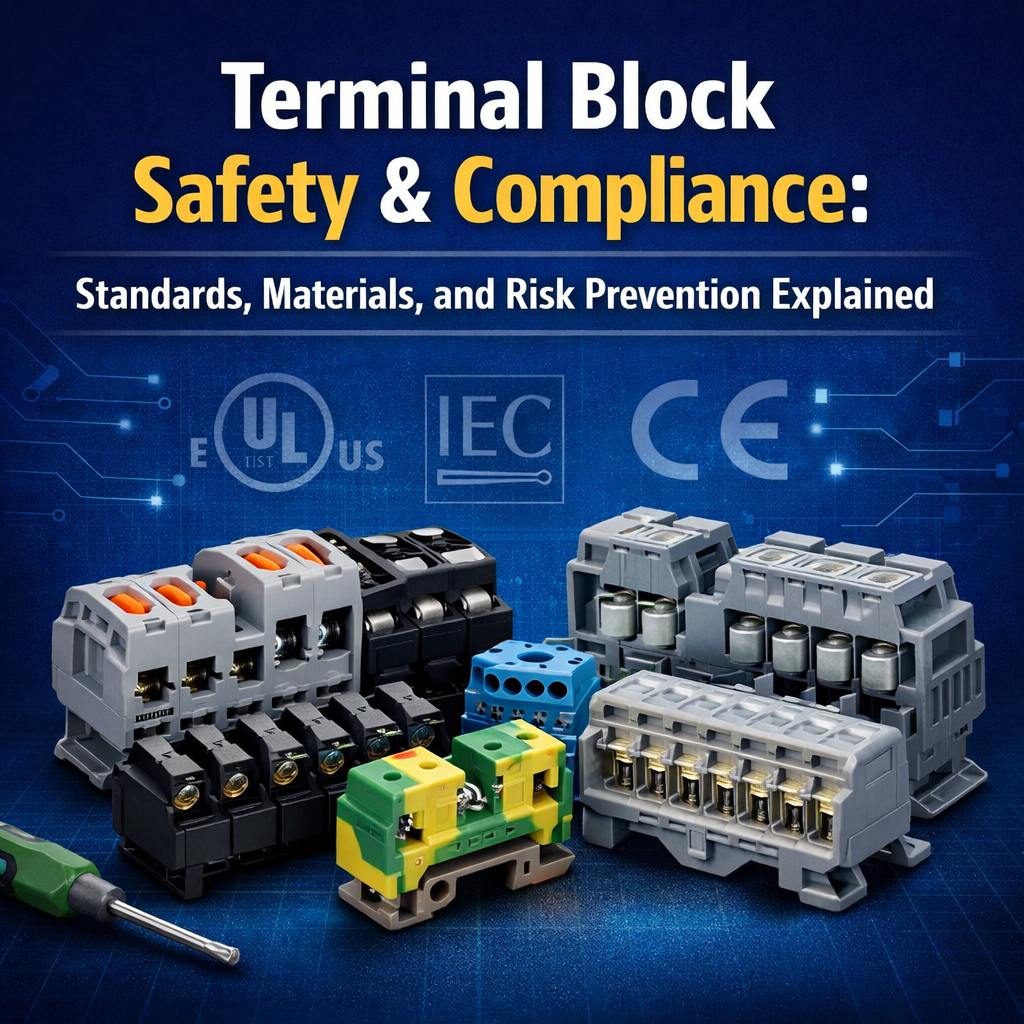
Terminal Block Safety & Compliance: Standards, Materials, and Risk Prevention Explained
Introduction: Terminal blocks are critical components in electrical systems, but not all are created equal. Choosing a low-cost connector without proper certifications can lead to overheating, electrical fires, or equipment failure. This article addresses the pain points of engineers and project managers by exploring terminal block safety and compliance—helping you determine which products are truly safe, compliant, and built for long-term use (not just cheap upfront).

TL;DR:
– Compliance Standards: Always use terminal blocks that meet relevant safety standards (e.g. IEC 60947-7-1, UL 1059, CE). Certified blocks ensure proper insulation, creepage distances, and overall safety.
– Materials & Fire Safety: Opt for flame-retardant terminal block materials like UL94 V-0 rated PA66 (nylon) housings. High-quality insulation resists fire, passes glow-wire tests, and prevents short circuits.
– Preventing Failures: Avoid loose connection terminal block hazards by tightening screws to the correct torque. Use proper wire sizes and don’t overload terminals – this prevents overheating risks, arcing, and insulation failure.
– Application-Specific Needs: Select blocks suited for your environment (industrial control panels, high-voltage systems, or harsh environments). Each use case may require specialized safety features or regulatory compliance.
| Safety Factor | What to Check | Why It Matters |
|---|---|---|
| Certification | IEC / UL / CE | Legal & safety compliance |
| Housing material | UL94 V-0 PA66 | Fire prevention |
| Connection quality | Torque / spring clamp | Prevent overheating |
| Application rating | Voltage / current | Avoid overload failures |
Standards & Regulations

Global and industry standards define what makes a safe, compliant terminal block. Adhering to these standards ensures the product has been rigorously tested for safety and reliability. Three key references are:
IEC 60947-7-1: An international standard for industrial low-voltage terminal blocks (for copper conductors, typically up to 1000 V). Terminal blocks compliant with IEC 60947-7-1 have proven mechanical strength, insulation quality, and thermal performance under standardized tests.
UL 1059: The U.S. Standard for Terminal Blocks, which sets safety requirements for terminals used in electrical equipment. UL 1059 covers criteria like minimum creepage/clearance distances and safe current ratings. Using UL 1059-certified terminal blocks ensures they are approved for use in UL-listed control panels and devices.
CE Mark (EU): Terminal blocks sold in Europe should carry the CE mark, indicating compliance with EU directives such as the Low Voltage Directive. In practice, CE-marked terminal blocks conform to relevant EN standards (often identical to IEC 60947-7-1) and come with a Declaration of Conformity. CE compliance assures the product meets essential safety requirements for the European market.
The table below compares the most important global terminal block safety standards and their scope.
| Standard | Region | Scope |
|---|---|---|
| IEC 60947-7-1 | International (IEC) | Industrial low-voltage terminal blocks for copper conductors. Defines requirements for mechanical strength, electrical performance, temperature rise limits, insulation properties, creepage and clearance distances, and thermal aging tests to ensure terminal block safety. |
| UL 1059 | United States (UL) | Safety standard for terminal blocks used in electrical equipment and control panels. Covers current and voltage ratings, clearance and creepage spacing, fire resistance, abnormal condition testing, and requirements for UL-listed end-product assemblies. |
| CE Marking (EU Directives) | Europe (CE) | Mandatory conformity marking indicating compliance with EU directives such as the Low Voltage Directive (LVD). Terminal blocks must meet applicable EN standards, often harmonized with IEC 60947-7-1, to satisfy essential safety requirements for the European market. |
| *Compliance with these standards enables terminal blocks to be used safely across global markets. | ||
Using compliant terminal blocks builds trust and reduces liability. A UL or IEC certification on a product shows it was independently tested for electrical terminal block safety. Always check for certification logos (e.g. UL Recognized, CE) and documentation to verify that a terminal block meets the necessary safety standards.
Key Takeaways:
– Use Certified Blocks: Select terminal blocks with recognized certifications (UL, IEC, etc.) for proven safety and compliance.
– Standards Cover Essentials: Regulations enforce proper voltage ratings, insulation distances, and fire resistance – critical factors for safe operation.
– Documentation Matters: Verify compliance via the manufacturer’s certificate or markings (UL file number, CE mark) to ensure authenticity.
Learn more: Terminal Block CDGKZ Certifications – UL, CE, RoHS & IEC Explained
Fire Safety & Insulation
Choosing the right material is crucial for terminal block safety. High-quality blocks use flame-retardant plastics that resist ignition and self-extinguish if overheated. Polyamide 6.6 (PA66) is a common housing material known for its strength and fire resistance when formulated to LernUL94 V-0 standards. A UL94 V-0 terminal block housing will self-extinguish within 10 seconds after a flame is removed and won’t drip flaming plastic. By contrast, lower-rated materials (like UL94 V-2) can burn longer and even drip flaming particles, increasing fire risk. Using a flame-retardant terminal block material (UL94 V-0 rated PA66, often with halogen-free additives) ensures the connector won’t fuel a fire in fault conditions.
Fire safety tests like the glow-wire test further ensure the plastic can withstand extreme heat. In IEC compliance testing, a hot glow wire (e.g. 750 °C or higher) is applied to the terminal block; a glow-wire tested terminal block will not catch fire or will self-extinguish quickly. This simulates scenarios like an overheated conductor touching the housing. Along with fire resistance, good insulation design (adequate creepage/clearance distances per standards) prevents short circuits and arcing between terminals. Quality materials and design features (sufficient insulation thickness and spacing) prevents shorts and maintains safety even under electrical stress.
| Material Type | Typical UL94 Rating | Flame Retardancy | Thermal Stability | Typical Applications |
|---|---|---|---|---|
| PA66 (Flame Retardant Grade) | UL94 V-0 | Self-extinguishing within 10 seconds, no flaming drips | High (continuous use ~105–120 °C) | Industrial terminal blocks, control panels, automation systems, UL / IEC compliant applications |
| PA66 (Standard Grade) | UL94 V-2 | Burns longer, may drip flaming particles | Medium | Low-cost terminal blocks, light-duty equipment, non-critical electrical assemblies |
| PBT (Flame Retardant Grade) | UL94 V-0 / V-1 | Good flame resistance, slightly lower than PA66 | Medium–High | Compact terminal blocks, PCB terminal connectors, space-limited enclosures |
| ABS (Generic Plastic) | UL94 HB | Flammable, does not self-extinguish | Low | Consumer electronics, non-industrial connectors (not recommended for terminal block safety) |
| Phenolic (Thermoset Plastic) | UL94 V-0 | Excellent flame resistance, brittle material | High heat resistance | High-temperature terminal blocks, legacy industrial designs |
Key Takeaways:
– Flame-Retardant Housing: Always choose terminal blocks with UL94 V-0 rated insulating bodies for maximum fire safety.
– Tested for Fire & Heat: Features like glow-wire certified materials and high CTI (comparative tracking index) ensure the block can withstand overload heat without igniting or failing.
– Robust Insulation: Proper design (sufficient insulation thickness and spacing) prevents shorts and maintains safety even under electrical stress.
Learn more:Understanding UL94 V-0 and Flame Retardant Materials
Common Safety Risks
| Risk | Root Cause | Prevention |
|---|---|---|
| Overheating | Loose screw, overload | Correct torque, rated current |
| Fire | Non V-0 housing | UL94 V-0 PA66 |
| Arcing | Exposed strands | Proper stripping & insulation |
| Corrosion | Humidity, salt | Tin-plated conductors |
Even with certified components, improper use or poor installation can create hazards. Here are the most common safety risks with terminal blocks and how to mitigate them:
- Overheating & Fire: Loose or improper connections are a top cause of terminal block failures. A loose screw clamp increases resistance, leading to heat buildup. Such loose connection terminal block hazards can result in melted insulation or fire. Overloading a terminal (passing more current than its rating) similarly causes overheating. Vibration can also gradually loosen connections in industrial settings. To prevent these issues, tighten all connections to the specified torque and use blocks with appropriate current ratings (never exceed the rated amperage). This avoids hot spots and potential electrical fires.
- Short Circuits & Arcing: If conductors are not properly insulated or spaced, short circuits can occur. Exposed wire strands or conductive debris bridging between terminals will cause arcing and potentially catastrophic failure. Deteriorated insulation can also cause short circuits. To mitigate this, ensure wires are fully inserted and no bare metal is exposed outside the terminal. Maintain required clearance between adjacent terminals (per the design or using divider plates). Many modern safe terminal blocks include barriers and covers as short circuit prevention features to stop accidental contact between terminals.
- Environmental Factors: Harsh conditions can accelerate failures. Moisture or corrosive chemicals can corrode contacts, increasing resistance or causing intermittent connections. Extreme temperatures can cause plastic parts to become brittle or deform. To address these risks, choose terminal blocks rated for your environment (e.g. corrosion-resistant metal alloys, high-temperature plastics, or sealed/IP-rated terminals). Also consider using protective enclosures or regular maintenance (inspections and cleaning) in environments prone to vibration, dust, or moisture.
Key Takeaways:
– Tight Connections Only: Most overheating issues trace back to loose connections or overloads—use correct ratings and keep terminals tight to avoid heat build-up.
– Prevent Accidental Shorts: Use proper insulation practices and any safety accessories (end covers, separator plates) to ensure no unintended contact between live parts.
– Mind the Environment: In high-vibration or corrosive environments, use specially designed terminal blocks and check connections periodically to prevent gradual failures.
Learn more: Preventing Terminal Block Failures: Tips & Solutions
Applications & Use Cases
Safety and compliance considerations often depend on the application. Different industries and environments have specific requirements:
- Control Panels & Industrial Systems: In factory control panels and automation systems, dozens of terminals are used to interconnect equipment. Here, terminal blocks for control panel safety should use UL/IEC certified terminal blocks for industrial use. Such blocks are designed for continuous operation and will maintain secure connections even under vibration and heat. Industrial automation terminal block compliance gives engineers confidence that the connections won’t fail unexpectedly during production.
- High Voltage & Power Applications: In power distribution, renewable energy (solar PV), and other high-voltage setups, terminal blocks must handle elevated voltages and currents safely. Terminal blocks for high voltage applications have larger insulation barriers and higher creepage distances to prevent tracking at voltages up to 1000 V or more. Always verify the voltage and current ratings of a terminal block against your application’s requirements. Using an underspecified connector in a high-voltage scenario can lead to dielectric breakdown or overheating, so only use blocks explicitly rated for those conditions (often carrying both IEC and UL markings for high-voltage use).
- Harsh or Extreme Environments: Outdoor installations, marine applications, and railway systems impose extra stresses on electrical connectors. Safe terminal blocks for harsh environments feature rugged construction: corrosion-resistant contacts (to handle moisture or salt air), UV-stable and heat-resistant plastics for extreme temperatures, and often vibration-proof designs. For example, railway signal terminals must endure constant vibration and shock. Many terminal blocks are specifically built and certified for such conditions. When working in harsh environments, choose products with appropriate IP ratings and environmental specifications. This ensures long-term safety and prevents failures like corrosion-related loosening or insulation cracking.
Key Takeaways:
– Match the Spec: Always select terminal blocks rated for the highest voltage, current, and environmental stress of your application (don’t assume a general-purpose block will cover a unique high-voltage or outdoor need).
– Industry Standards: Different sectors may require specific certifications (e.g. marine approvals, railway fire and vibration standards). Using blocks that meet these ensures compliance and durability in those settings.
– Plan for Conditions: Consider where the terminal will be used (factory floor, control cabinet, solar farm, etc.) and choose accordingly – this proactive approach avoids safety issues and costly retrofits later on.
Learn more: Terminal Block Selection Guide by Industry
FAQ
Q1: Which safety standards should a terminal block comply with?
A: Key safety standards for terminal blocks include IEC 60947-7-1 (international standard for industrial low-voltage terminal blocks) and UL 1059 (the UL standard for terminal blocks used in the US). In practice, a high-quality terminal block will often comply with both, meaning it has been tested for clearances, creepage, heat resistance, and other safety aspects in line with these standards. Additionally, look for the CE mark for use in Europe (indicating compliance with the Low Voltage Directive and related EN standards). Always check the product documentation for a list of standards and certifications it meets.
Q2: What does a UL94 V-0 rating mean for terminal block materials?
A: UL94 is a flammability rating for plastics. V-0 is the most flame-retardant category in the UL94 vertical burn test. If a terminal block housing is rated UL94 V-0, it means that when the plastic is exposed to flame, it will extinguish itself within 10 seconds after the flame is removed and will not drip flaming particles. This is crucial for fire safety. In simple terms, a V-0 rated terminal block material resists catching fire and will not contribute to spreading a fire if there’s an overload or spark. Many industrial terminal blocks use polyamide (PA66) with a V-0 rating, sometimes enhanced with additives to meet this standard. Always prefer V-0 materials for better safety, especially in high-density electrical panels.
Q3: How can I prevent terminal blocks from overheating or failing?
A: Preventing terminal block overheating or failure comes down to proper selection and installation. Always use the block within its rated current and voltage (do not overload it), and ensure every wire connection is tight. Loose connections create high resistance, leading to heat and arcing – so tighten screws to the recommended torque or ensure spring clamps fully engage. Also choose quality terminal blocks made from flame-retardant, heat-resistant materials, and periodically inspect connections (especially in high-vibration or high-heat environments) to catch any loosening or damage early.
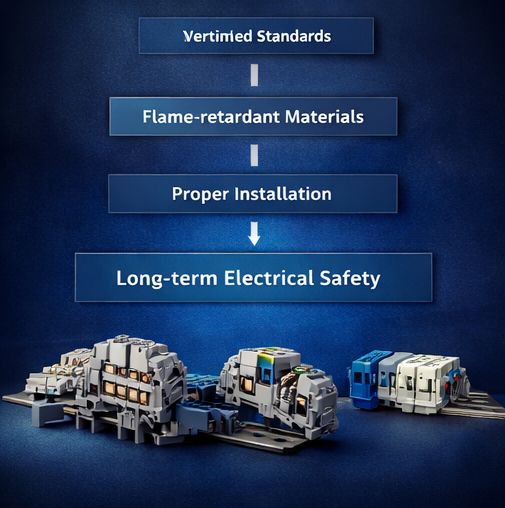
Conclusion: Safety and compliance are essential when selecting terminal blocks. Understanding standards, using flame-retardant materials, and avoiding common pitfalls will keep your electrical projects reliable and safe. As a manufacturer, CDGKZ prioritizes these principles – our terminal blocks meet UL 1059, carry CE markings, and use UL94 V-0 insulating materials for maximum safety. Ultimately, choosing the right terminal block (and using it correctly) protects your equipment and personnel from hazards. Contact us to learn more about our certified terminal block CDGKZ solutions or to get expert guidance on selecting the best connectors for your needs.
