
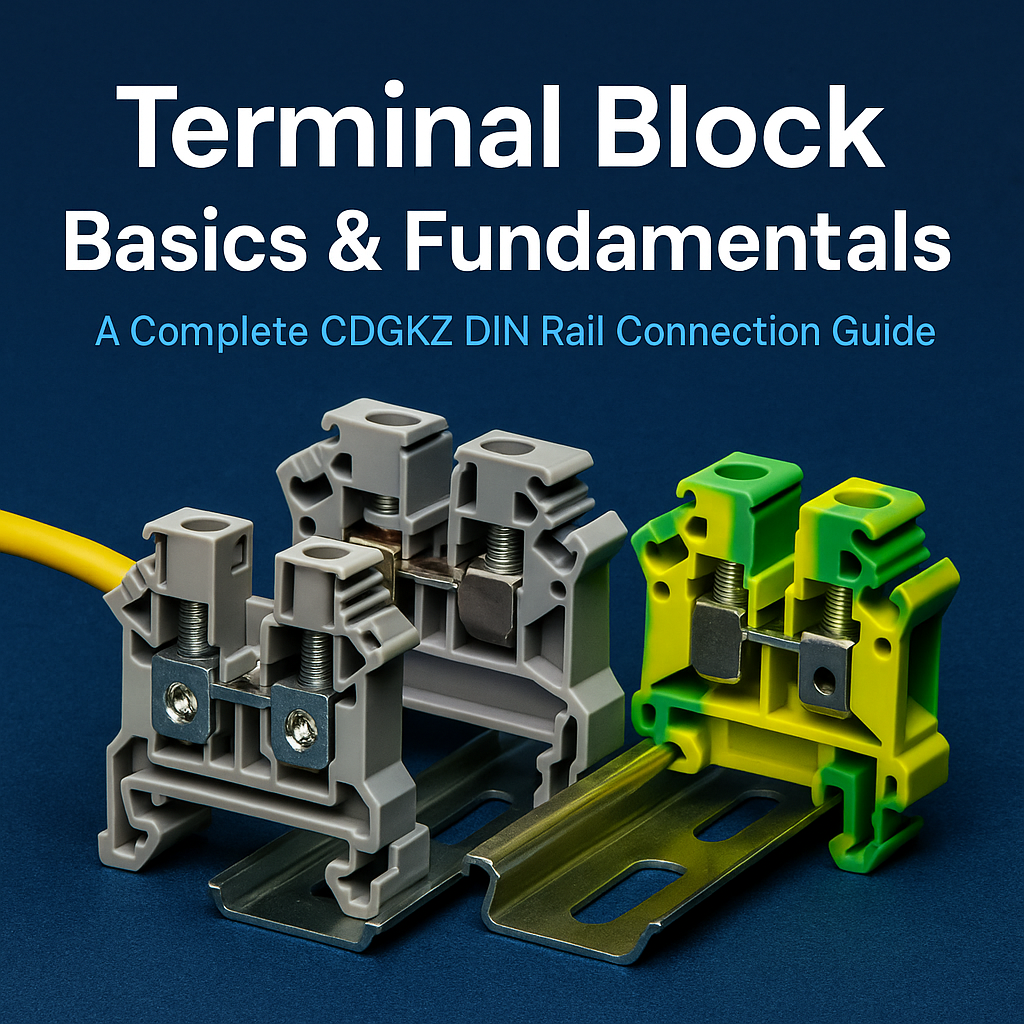
Terminal Block Basics & Fundamentals: A CDGKZ DIN Rail Guide
In industrial control panels, terminal blocks (also called terminal strips or connection blocks) are modular, insulated connectors that secure and distribute electrical wires. Each block contains an insulating body and a metal clamp (commonly a screw or spring mechanism) to grip a stripped conductor. This design eliminates splicing: wires enter one side of the block and exit the other (feed-through), or multi-level blocks can support two or more circuits in the same footprint. When installed on a standard DIN rail (e.g. 35mm “Top-hat” rail), the blocks clip onto the metal rail for support and grounding. Wiring is straightforward: strip the conductor, insert it into the terminal, and tighten the screw or clamp until it is secure. [Suggested diagram: Terminal block structure showing its housing and screw clamp] (Diagram alt: “Cross-sectional diagram of a DIN-rail terminal block showing the insulating body and metal clamping screw that secures the conductor.”)
Key Takeaways:
– Terminal blocks are insulated connection hubs (terminal strips) used to organize multiple wires in control panels.
– Each block has an insulating housing and a clamp (screw or spring) to secure conductors, forming a single-wire circuit.
– Blocks mount on standard DIN rails, providing mechanical support and a common ground bus.
– Wires connect by stripping insulation and fastening under the clamp; blocks can be single feed-through or multi-level to save space.
Internal link suggestion: Explore our DIN-rail terminal block products (CDGKZ).
Types of Terminal Blocks and Connection Styles
Terminal blocks come in many types and configurations. A feed-through terminal block (single-level) provides a straight path for one wire. Multi-level blocks stack two or more circuits vertically in one housing (dual, triple, etc.) to save rail space. Specialized blocks include ground (PE) terminal blocks, which are colored green/yellow and dedicated to earthing. Other variants incorporate fuses or disconnects for circuit protection.
Connection method is another key distinction. Screw-terminal blocks use a metal clamp tightened by a screw to secure the wire. Some screw blocks have spring-loaded clamps for vibration resistance. In contrast, push-in (plug-in) terminal blocks allow tool-less wiring: you simply insert the bare conductor into a spring-cage slot, and the built-in spring grips it. Each style has trade-offs: screw blocks are simple and robust, while push-in types enable faster installation. Selecting the right terminal block depends on the current rating, number of circuits, and ease of use required in your application.
| Connection Type | Working Principle | Advantages | Limitations | Typical Applications |
|---|---|---|---|---|
| Screw Clamp Terminal | Tighten screw to compress metal clamp onto wire | High contact force; stable at high current; very common | Requires torque control; may loosen under vibration if misused | Power distribution, motor wiring, MCC panels |
| Spring-Cage Terminal | Spring exerts pressure on inserted conductor | Strong vibration resistance; consistent clamping force | Requires tool to open spring; slower than push-in | Railways, HVAC units, vibrating machinery |
| Push-in Terminal | Insert conductor directly into spring mechanism | Very fast wiring; tool-less for rigid or ferruled wires | Requires ferrules for best performance; slightly higher cost | PLC wiring, OEM panels, high-volume assembly |
Key Takeaways:
– Blocks are single-level (feed-through) or multi-level (stacked) to accommodate one or multiple circuits.
– Ground (PE) blocks provide a secure earth connection (green/yellow color).
– Screw-clamp terminals use a tightening screw, spring-cage blocks use a spring mechanism, and push-in (plug-in) blocks allow direct insertion.
– Choice of type depends on current/voltage needs and whether you need tool-free wiring or highest contact force.
Internal link suggestion: Browse CDGKZ terminal block catalog for various styles.
DIN Rail Mounting and Wiring Tips
One major advantage of DIN-rail terminal blocks is easy installation. Mounting is straightforward: clip the block onto a standard DIN rail (usually 35mm TS35), where it locks into place. On CDGKZ DIN rails, the blocks snap on quickly for modular assembly. Once mounted, wire each conductor by stripping about 8–10mm of insulation, inserting the bare wire into the terminal, and tightening the clamp screw or spring clamp. Always turn off power before wiring and tighten each screw to the specified torque – a loose screw can overheat the block. If using push-in or spring-cage blocks, depress the spring (or lever) and insert the wire until it clicks. At the ends of terminal block rows, install end plates or end stops to prevent blocks from sliding. For neat wiring, use jumper bridges (comb bars) to distribute common signals and label each block with markers. [Suggested diagram: DIN rail with terminal blocks and end stops] (Diagram alt: “Illustration of a DIN rail with several terminal blocks clipped on and an end-plate to prevent sliding.”)
| Component | Material Type | Properties | Why It Matters |
|---|---|---|---|
| Terminal Housing | PA66 (Nylon) / PC FR (V-0) | Flame-retardant, good creepage distance | Meets UL94 V-0; suitable for industrial control panels |
| Metal Conductor | Copper alloy (Tin or Nickel plated) | High conductivity, corrosion resistance | Lower temperature rise; long-term stable connections |
| Spring Mechanism | Stainless steel (e.g., 304 / 301) | High elasticity, anti-fatigue | Ensures long-term clamping force in spring/push-in types |
| Screws | Carbon steel / Zinc-plated steel | High mechanical strength | Prevents thread damage and maintains torque performance |
Key Takeaways:
– Terminal blocks clip onto standard DIN rails for quick mounting (no tools needed for the rail itself).
– To wire: turn off power, strip the conductor, insert it into the block, and tighten the screw or clamp firmly.
– Use end-clamps to lock end blocks, and organize wiring with jumper bars and labels. Proper torque and wire preparation ensure a safe connection.
Internal link suggestion: Learn about DIN rail accessories at CDGKZ.
Standards, Ratings, and Materials
| Installation Step | Requirement / Best Practice | Standard / Guideline |
|---|---|---|
| Strip Length | 8-12 mm depending on model | IEC 60204-1 |
| Screw Torque | 0.4-1.2 Nm (according to block’s current rating) | Manufacturer spec / UL |
| End Clamp Installation | Use at both ends of each block row | Prevents sliding and loosening |
| Wire Ferrules | Recommended for multi-strand flexible conductors | Improves contact reliability |
| Labeling | Use printed markers / tags for each terminal point | IEC 61439 |
| Jumper Bars / Bridges | Match jumper rating with terminal current rating | Follow manufacturer data |
Industrial terminal blocks must meet strict safety standards. CDGKZ terminal blocks comply with IEC 60947-7-1 (copper conductor blocks) and IEC 60947-7-2 (protective earth blocks), as well as UL 1059 for North America. These standards define limits on voltage, current, temperature rise, and insulation (for example, a maximum 30 K rise under UL 1059 testing). Housings are made of flame-retardant plastic (typically UL94 V-0 rated) to prevent fire spread. Conductive parts are usually copper alloys with corrosion-resistant plating. Terminal blocks have specified voltage and current ratings (often printed or color-coded on the block); always select a block rated for at least the system’s voltage and conductor size. Compliance with UL/IEC ensures your wiring is safe and code-compliant.
Key Takeaways:
– DIN-rail terminal blocks follow UL 1059 and IEC 60947-7 standards for voltage, current, creepage, and temperature ratings.
– Insulating materials are UL-rated flame-retardant plastics, and metal parts (copper alloys) are corrosion-resistant.
– Always verify a block’s voltage/current ratings match your application to ensure safe operation.
Internal link suggestion: See CDGKZ’s UL/IEC-certified terminal blocks.
| Parameter | Typical Value | Standard Requirement | Notes |
|---|---|---|---|
| Rated Voltage | 400–800 V | IEC 60947-7-1 | Must match system voltage category |
| Rated Current | 10–150 A | UL 1059 / UL 486E | Depends on conductor size and clamp design |
| Temperature Rise | ≤ 30 K | UL 1059 | Measured at rated current under test conditions |
| Wire Size Range | 0.5–35 mm² | IEC 60947-1 | Larger ranges for power and high-current blocks |
| Dielectric Strength | 2.5–3 kV | UL / IEC dielectric tests | Tested between adjacent conductive parts |
| Flammability Rating | UL94 V-0 | Required for industrial panels | CDGKZ uses PA66 / PC flame-retardant materials |
Applications in Industrial Wiring
Terminal blocks are ubiquitous in industrial control systems. They act as the wiring hubs inside control panels and equipment. For example, they let PLCs, relays, sensors, and power supplies be interconnected without soldering or splicing. DIN-rail blocks organize connections in applications like telecommunications, building automation, HVAC, lighting control, and machinery. A single multi-level block might distribute a sensor signal to multiple destinations, or a power distribution block might split a main supply to several branch circuits. Ground (PE) blocks tie all chassis grounds together safely. Because terminal blocks group connections neatly, technicians can service one circuit without disturbing others. CDGKZ terminal blocks are found in panels worldwide, delivering reliable connections for signals and power across diverse industries.
Key Takeaways:
– Terminal blocks serve as the connection points for devices in control panels (PLCs, relays, motors, etc.).
– They are used in many industries (telecom, HVAC, automation, lighting, vehicles, etc.) to organize wiring and distribute signals or power.
– Multi-level and power distribution blocks help handle high-current and multi-circuit needs, while ground blocks centralize earthing.
Internal link suggestion: Explore terminal block applications with CDGKZ.
| Industry / Application | Recommended Terminal Block Type | Reason |
|---|---|---|
| Control Panel / PLC I/O | Push-in / Spring-cage DIN rail terminal blocks | Fast wiring, high density, easy troubleshooting |
| Motor Control Center (MCC) | Screw-type, high-current feed-through blocks | High load current, reliable torque-locked connections |
| Energy Storage / PV Systems | High-current feed-through (e.g., 150 A and above) | Handles large cross-section conductors and high DC currents |
| Railway / Transportation | Spring-cage terminals | Excellent vibration resistance and long-term stability |
| HVAC / Building Automation | Push-in terminals | Quick installation, frequent wiring changes |
| Power Distribution Panels | Large-capacity screw clamp terminals | Robust mechanical performance at high current levels |
FAQ
Q: What is a DIN rail terminal block?
A: A DIN rail terminal block is an insulated connector mounted on a standardized metal rail (DIN rail) inside control panels. It provides secure connection points for wiring multiple electrical circuits without splicing. The block holds each wire under a screw or spring clamp, organizing the wiring and allowing easy maintenance.
Q: How do I connect wires to a screw terminal vs a push-in terminal?
A: For a screw terminal, strip the wire end, insert it into the terminal slot, and tighten the screw to clamp the wire. The screw applies pressure on a metal clamp that grips the conductor. For a push-in (spring) terminal, strip the wire, push it into the slot against the spring mechanism, and the spring will hold it. Push-in blocks usually lock the wire automatically without tools, making installation faster.
Q: Why are UL/IEC standards important for terminal blocks?
A: UL (e.g. UL 1059) and IEC (e.g. IEC 60947-7-1) standards ensure terminal blocks meet safety and performance requirements for voltage, current, insulation, and temperature. Compliance guarantees the block can safely carry rated loads and withstand tests (like dielectric and temperature-rise tests). Using UL/IEC-certified blocks (like CDGKZ blocks) helps meet electrical codes and ensures reliable, safe industrial wiring.
Conclusion & CTA
Understanding terminal block fundamentals is essential for safe, organized industrial wiring. CDGKZ DIN rail terminal blocks combine rugged materials with compliance to UL/IEC standards, ensuring reliable wire termination in any control panel. Whether you need feed-through, multi-level, or high-current blocks, our CDGKZ products deliver quality and peace of mind. Visit cdgkz-relay.com to explore our terminal block catalog, or contact our engineering team for help specifying the right block for your application.
