
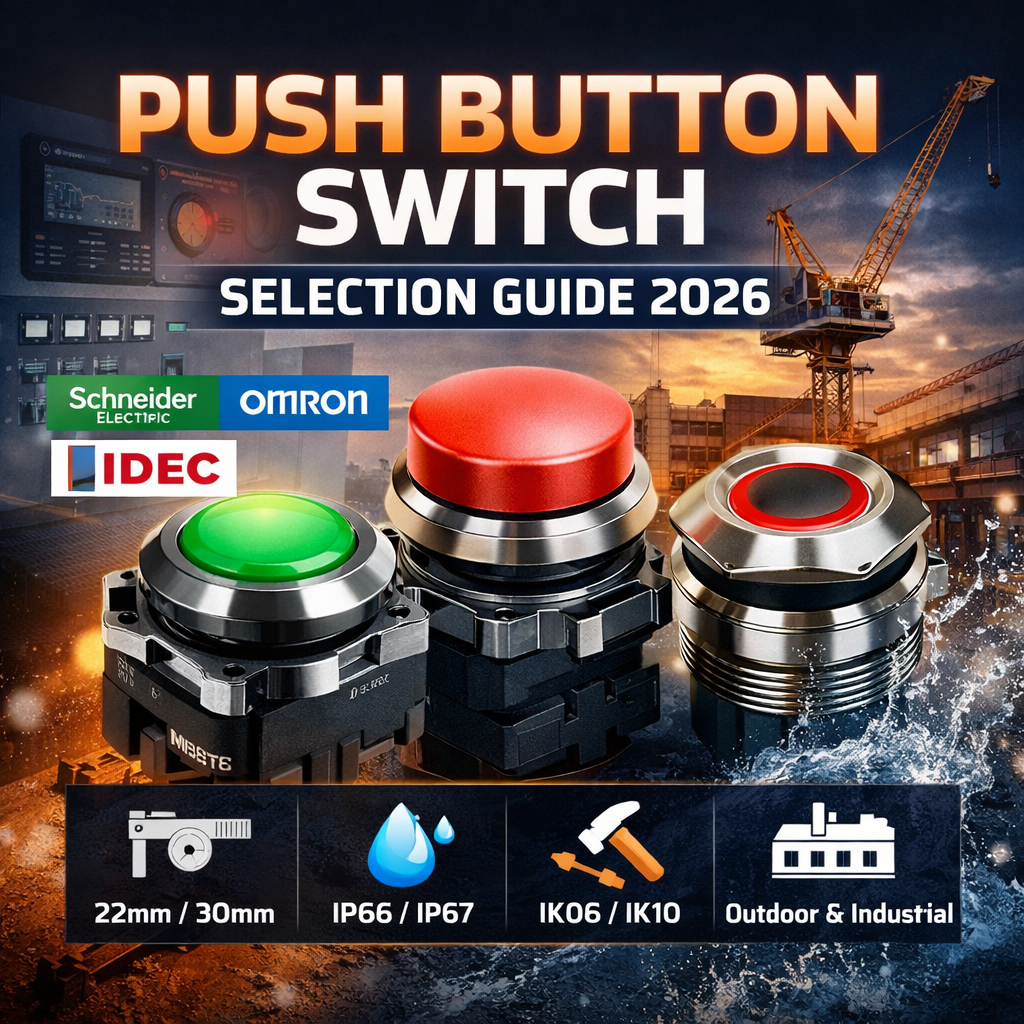
Push Button Switch Selection Guide 2026 – How to Choose the Right Push Button

Push Button Switch Selection Guide 2026 – How to Choose the Right Push Button

Selecting the right push‑button switch for industrial applications in 2026 can be daunting. Engineers and buyers must navigate brand choices, mechanical specifications, environmental ratings and compliance requirements. A misfit switch could mean poor ergonomics, electrical failure or safety violations. This guide helps you make sense of the options, comparing Schneider, Omron and IDEC (Izumi) lines while explaining mounting diameters, head sizes, actuation force, and protection ratings like IP65, IP67 and IK. Whether you need a momentary pilot button or a rugged emergency stop, this resource equips you to specify with confidence.

TL;DR

  • Start with the application: Determine whether you need a momentary pilot switch, a latching selector, or a specialized E‑stop. Synonyms include control pushbutton, selector switch, pilot switch, emergency stop, momentary push‑button and latching push‑button. Each has unique actuating force, mechanical endurance and compliance considerations.

  • Choose the mounting diameter: Standard sizes are 22 mm and 30 mm; the panel cut‑out must match the switch family. Head diameter and actuation force must also suit the operator’s ergonomics.

  • Compare brands: Schneider’s Harmony series, Omron’s A22/30 and IDEC’s HW/AY lines differ in style, availability, illumination options and price. Consider global certifications (IEC, UL, CSA) and cross‑compatibility with your control panel.

  • Check environmental ratings: IP65 means dust‑tight and water jet resistant; IP67 adds temporary immersion. IK ratings indicate impact resistance (IK08 to IK10 withstand 5 – 20 J shocks).

  • Don’t forget compliance: Ensure your push button meets relevant standards (IEC 60947‑5‑1 for control‑circuit devices) and certifications like UL 508 and UL 1054 for North Americaul.comcweup.com. For harsh environments, confirm that components carry CE and RoHS marks

Understanding Push Button Types & Functions

Before choosing a push button, clarify the function and mechanism. Momentary push‑buttons (often called pilot switches or control pushbuttons) return to their original position when released, making them suitable for start/stop control. Latching buttons stay in the actuated state until pressed again, often used for mode selection or manual reset. Selector switches rotate between positions rather than being pressed, offering two, three or more stable states. Emergency stop buttons (E‑stops) use a large mushroom head and latching mechanism; ISO 13850 defines their functional requirements and mandates that actuating the button immediately stops hazardous movements.

When describing buttons, manufacturers often use synonyms such as push button switch, pilot light, selector switch, actuator, operator or push buttom (common search misspelling). Industrial catalogues also differentiate between illuminated and non‑illuminated versions, with LEDs or incandescent lamps integrated into the actuator. Illumination adds visibility and signalling but may require separate supply voltages and increases mounting depth.

Key Takeaways:

  • Define the action: momentary (spring return), latching (stay put), rotary selector or emergency stop.

  • Synonyms like pilot switch, selector switch and push buttom represent similar devices; ensure search terms reflect your needs.

  • Consider illumination, color coding and special functions (key‑lock, maintained action) early in the specification.

Internal link suggestion: Learn more about emergency stop standards and safety relays.

Brand Comparison: Schneider vs Omron vs IDEC

Three major brands dominate industrial push‑button switches: Schneider Electric, Omron and IDEC. Each offers multiple series targeting different price points and applications.

  • Schneider Electric (Harmony XB4/XB5). The Harmony line features metal (XB4) and plastic (XB5) bezels, standard 22 mm or 30 mm mounting diameters, and modular contact blocks that clip onto the actuator. Harmony units offer robust IP66 and IK08 protection, optional illumination, and modular contacts (NO/NC). They comply with IEC 60947‑5‑1 and UL 508, making them globally accepted. Schneider provides high customization, including flush heads, extended heads, key‑release and potentiometer modules.

  • Omron (A22/A30). Omron’s A22 series uses 22 mm mounting holes and offers momentary and latching push‑buttons, selector switches and key switches. The A30 series expands to 30 mm for larger heads. Omron emphasises ergonomic design with bright illumination and short travel. Many A22 buttons provide IP65 or IP66 protection and are certified to UL 508 and CSA C22.2 No.14 (harmonised with UL 508). Omron also offers plug‑in contact blocks for quick wiring.

  • IDEC (Izumi) (HW/YW/ALFA). IDEC’s HW series supports 22 mm mounting and offers flush or extended operators, pilot lights and illuminated push‑buttons. The ALFA 22 and ALFA 30 lines provide heavy‑duty anti‑vandal models. IDEC emphasises compact bodies with mounting depths under 45 mm, which is beneficial in shallow control panels. Many IDEC switches meet IP65 or IP67 and IK08 standards for harsh environments.

When comparing brands, examine the availability of spare contact blocks, mount depth, illumination options, mechanical endurance (e.g., 1 million operations for momentary buttons), and price. Schneider often commands a premium but offers wide international support; Omron provides a balance of quality and cost; IDEC is known for reliability in compact designs. Ensure cross‑compatibility of contact blocks and certification marks when mixing brands in one panel.

Brand Comparison: Schneider Harmony vs Omron vs IDEC (Izumi)

Use this matrix to compare common industrial push buttom switch families by mounting size, protection ratings, and functional options for control panel selection.

Table comparing Schneider Harmony, Omron A22/A30 and IDEC push button switch series by material, mounting size and protection ratings.
Brand / Series Bezel / Body Material Mounting Size Typical Protection Optional Functions Selection Notes (2026)
Schneider Electric
Harmony XB4 / XB5
XB4: Metal bezel
XB5: Plastic bezel
Common: 22 mm
Also seen: 30 mm (depending on configuration)
Often around IP66
Typical impact: IK08
Illumination (LED), modular NO/NC contacts, flush/extended heads, selector switches, key-release/key-switch operators, potentiometer modules Premium ecosystem + wide global support. Strong choice when you need broad options, standardisation across projects, and easy spare parts availability.
Omron
A22 / A30
Typically plastic body/bezel (varies by model); modular contact blocks A22: 22 mm
A30: 30 mm
Many models: IP65–IP66
IK varies by model (often mid-range)
Momentary/latching, illuminated types, short travel designs, selector/key switch variants, quick wiring contact blocks (model dependent) Balanced cost vs performance. Good for high-volume panels where reliable sourcing, clear illumination options and ergonomic operation matter.
IDEC (Izumi)
HW / ALFA
HW: compact industrial construction
ALFA: heavy-duty / anti-vandal options (often metal-body)
HW: 22 mm
ALFA 22 / ALFA 30: 22 mm / 30 mm
Many models: IP65–IP67
Harsh-duty models: up to IK08 (and higher for anti-vandal lines)
Flush/extended operators, pilot lights, illuminated push buttons, anti-vandal versions, compact bodies suitable for shallow panels Strong for compact panel depth needs (often <45 mm mounting depth on certain lines). Great for tight enclosures and rugged applications with sealing requirements.
Buyer checklist: Verify IP/IK ratings apply to the fully assembled operator + gasket + contact block, check contact block availability (spares), mounting depth, illumination options, and certifications (IEC/UL/CSA) before mixing brands in one panel.

Key Takeaways:

  • Schneider, Omron and IDEC offer 22 mm and 30 mm series with different bezels, contact blocks and modularity.

  • Harmony XB4/XB5 emphasises modularity and global certification; Omron A22/A30 focuses on ergonomics and cost; IDEC HW/ALFA provides compact yet robust options.

  • Always verify that contact blocks and LED modules are compatible across the chosen brand and that UL/IEC markings are present.

Internal link suggestion: See our in‑depth review of Schneider Harmony XB4 vs XB5.

Mechanical Specifications: Mounting Diameter, Cut‑out & Actuation

Mounting diameter defines the size of the hole drilled in the control panel. Two standard families dominate: 22 mm (often 22.3 mm or 22.5 mm cut‑out) and 30 mm (often 30.5 mm cut‑out). The choice depends on space, operator visibility and industry tradition. North American systems historically favoured 30 mm devices, while IEC‑based systems use 22 mm; modern panels adopt both, but mixing sizes complicates panel design. Panel cut‑out tolerances typically allow ±0.1 mm; proper punching or drilling prevents misalignment and ensures the sealing gasket compresses uniformly.

Mounting depth is the clearance behind the panel required for the operator and contact block. Shallow enclosures, such as those used in compact machinery or console panels, may require low‑profile switches. Some IDEC and Omron models offer mount depths under 45 mm, while illuminated versions with transformer modules may exceed 60 mm. Always measure available space and check manufacturer data sheets.

Head diameter and actuation force affect ergonomics. Larger heads provide easier actuation and improved visibility; smaller heads permit denser mounting. Standard head diameters range from 24 mm to 40 mm; emergency stop heads reach 40–60 mm for quick identification. Actuation force varies between 1–4 N (0.1–0.4 kgf) for momentary buttons and 2–8 N for latching or sealed buttons. Too high a force may cause operator fatigue; too low a force risks accidental activation.

Panel cut‑out for square or rectangular buttons (e.g., 16 mm or 24 mm square) requires careful alignment; gaskets and anti‑rotation notches must be correctly oriented. Always follow the manufacturer’s drilling template; mis‑aligned holes compromise IP sealing.

Key Takeaways:

  • Standard mounting diameters are 22 mm (22.3/22.5 mm cut‑out) and 30 mm (30.5 mm cut‑out). Choose based on panel space and existing components.

  • Check mounting depth; illuminated and transformer models may require deeper enclosures.

  • Consider head diameter and actuation force for ergonomics; E‑stop heads are larger for visibility.

Internal link suggestion: Learn how to design operator panels with 22 mm and 30 mm hardware.

Environmental & Safety Ratings: IP65, IP67 and IK

Industrial environments demand protection against dust, water, chemicals and impacts. The Ingress Protection (IP) rating system (IEC 60529) uses two digits: the first for solids and the second for liquids. An IP65 rating means a device is dust‑tight and can withstand water jets. IP66 withstands stronger jets, and IP67 allows temporary immersion. When selecting a push button for wash‑down areas, outdoor panels or maritime equipment, choose IP66 or IP67. For indoor control cabinets, IP54 or IP55 may suffice. Note that the rating applies to the assembled operator and contact block when correctly installed with gaskets and sealing rings.

The IK rating (IEC 62262) quantifies impact resistance. IK08 devices withstand 5 joules (approx. 1.7 kg mass dropped from 300 mm), IK09 withstand 10 J, and IK10 withstand 20 J. Anti‑vandal buttons made of stainless steel or aluminium often achieve IP67 and IK10 ratings, suitable for outdoor kiosks, elevators and public transport. Plastic bezel buttons usually offer IK05–IK07. Consider IK rating when equipment may be struck by tools, kicked or vandalised.

Beyond IP and IK, IEC 60947‑5‑1 sets performance and testing requirements for control circuit devices, including mechanical endurance and short‑circuit capacityscc-ccn.ca. UL 508 covers industrial control equipment up to 1 500 V and includes temperature, overload and dielectric withstand tests. UL 1054 specifies construction and testing for snap‑action switches. Ensuring compliance with these standards guarantees reliability and safety across markets.

IP & IK Ratings Comparison for Push Button Switch Selection

Quick reference for dust/water ingress protection (IP) and mechanical impact resistance (IK) in industrial environments.

Table comparing IP65, IP66 and IP67 dust/water protection with IK08–IK10 impact resistance levels.
IP (IEC 60529) Ingress protection against dust & water
IP Rating Dust Protection (1st digit) Water Protection (2nd digit) Typical Use Cases
IP65 6 = Dust-tight (no dust ingress) 5 = Water jets (no harmful ingress) Factory control cabinets, dusty workshops, general splash zones
IP66 6 = Dust-tight 6 = Powerful water jets (higher pressure) Washdown environments, outdoor panels with frequent cleaning
IP67 6 = Dust-tight 7 = Temporary immersion (time/depth specified by test) Outdoor/marine equipment, heavy rain exposure, washdown + immersion risk
IK (IEC 62262) Impact resistance (energy in joules)
IK Rating Impact Energy Practical Meaning Typical Use Cases
IK08 5 J Resists moderate knocks and tool bumps General industrial panels, factory floor equipment
IK09 10 J Higher resistance to accidental impacts Public-facing equipment, mobile machinery housings
IK10 20 J Maximum impact resistance (anti-vandal level) Outdoor kiosks, elevators, public transport, harsh industrial abuse zones
Selection tip: Pair higher IP (sealing) with higher IK (impact) for outdoor or washdown applications. For control cabinets, IP65 with a reasonable IK level is often sufficient—ensure correct installation with gaskets/sealing rings for the rated protection.

Key Takeaways:

  • IP65 is dust‑tight and resists water jets; IP67 allows temporary immersion.

  • IK ratings measure impact resistance; IK08–IK10 correspond to 5 – 20 J energy.

  • Ensure your selected push button is certified to IEC 60947‑5‑1, UL 508 and relevant national standards for safety and legal compliance.

Internal link suggestion: Explore our guide to IP ratings and environmental sealing.

Application Scenarios & Harsh Environments

Understanding the application environment is essential for proper switch selection. In outdoor installations such as marine equipment or crane controls, choose metal‑body, IP67/IK10 rated anti‑vandal switches. Stainless steel bodies resist corrosion, and high IK ratings ensure survival against knocks. Washdown zones in food processing or pharmaceutical plants need sealed IP66/IP67 plastic or metal switches; materials should resist detergents and CIP (clean‑in‑place) chemicals. For control cabinets in factories, IP65 plastic buttons with standard bezels suffice; choose flush heads if space is limited.

Hazardous areas (e.g., oil & gas) require explosion‑proof enclosures; specialized push buttons (Ex‑rated) comply with IEC 60079 standards and are outside the scope of this general guide. High‑ambient temperatures may necessitate heat‑resistant plastics or metal bezels; check the rated operating temperature (commonly −25 °C to +70 °C). High‑vibration environments such as mobile machinery should use spring‑clamp terminals and secure contact blocks; some manufacturers offer anti‑vibration accessories.

Selecting the correct color and legend aids operator recognition. IEC 60204‑1 recommends red for emergency stop, yellow for abnormal conditions, green for start, white for general functions, blue for mandatory conditions and black for stop. Illuminated push buttons may integrate multicolor LEDs for status indication.

For safety circuits, ensure that the push button integrates with reliable contact blocks and meets functional safety requirements (e.g., SIL or PL ratings). When using emergency stops, confirm they comply with ISO 13850 and are wired to appropriate safety relays.

Application Scenarios × Selection Matrix (Push Button Switches)

Use this quick matrix to match your environment with the recommended push button switch type and target ratings (IP/IK), materials, and key notes.

Diagram showing recommended push button switch types and ratings for outdoor, washdown, control cabinet and hazardous area applications.
Environment Recommended Switch Type Target IP / IK Body / Bezel Material Key Spec Notes
Outdoor / Marine / Cranes
Outdoor · Splash · Corrosion
Anti-vandal, sealed, panel-mount push button (often metal-body). Prefer stainless steel for high corrosion resistance. IP67 (or higher)
IK10 recommended
Stainless steel / anodized metal bezel; UV-resistant seals Choose robust actuation + gasket sealing. Verify operating temperature (e.g., −25 °C to +70 °C) and cable gland/connector sealing.
Washdown Zones
Food · Pharma · CIP chemicals
Fully sealed push button (plastic or metal) with chemical-resistant gasket. Consider flush head to reduce residue. IP66 / IP67
IK08–IK10 depending on risk
High-grade plastic (chemical resistant) or stainless steel Ensure detergent/CIP compatibility; prefer smooth surfaces. For frequent cleaning, prioritize sealing design + durable legend marking.
Factory Control Cabinet
Panels · General industrial
Standard 22 mm or 30 mm pilot device push button (plastic bezel commonly used). Flush head if space is limited. IP65 typical
IK07–IK08 optional
Plastic bezel / metal optional Focus on correct panel cutout size, mounting depth, and reliable contact blocks. Match actuation force to operator comfort and duty cycle.
Hazardous Area (Oil & Gas)
Explosive atmospheres
Ex-rated push buttons in explosion-proof enclosures. Selection depends on zone/classification. IP/IK depends on enclosure design
Ex protection is the priority
Certified explosion-proof enclosure (metal) Must comply with hazardous area standards (e.g., IEC 60079 / ATEX / UL Class/Div). Outside scope of general guide—use certified solutions only.
Fast rule: Outdoor & washdown → prioritize sealing (IP); public/heavy duty areas → prioritize impact (IK); control cabinets → prioritize mounting size, depth, and contact reliability.
Safety reminder: Emergency stop buttons should follow ISO 13850 and be wired into appropriate safety relays / safety circuits.

Key Takeaways:

  • Outdoor and harsh environments demand metal or reinforced plastic switches with IP67/IK10 ratings.

  • Washdown zones require sealed, chemical‑resistant buttons; control cabinets can use IP65.

  • Color coding and compliance with IEC 60204‑1 and ISO 13850 aid operator safety and recognisability.

Internal link suggestion: Read about selecting sensors and switches for hygienic environments.

Frequently Asked Questions

Why choose a 22 mm versus 30 mm push button?

Answer: The 22 mm size is standard in IEC‑centric markets and allows a more compact panel layout. 30 mm buttons provide a larger actuator surface, improving ergonomics and allowing gloved operation. Choice depends on panel space, operator preference and existing hardware. Ensure panel cut‑out and mounting hardware match the selected size.

What is the difference between IP65 and IP67 for push buttons?

Answer: An IP65 push button is dust‑tight and withstands water jets, making it suitable for general industrial environments and light washdown. IP67 adds protection against temporary immersion, ideal for equipment exposed to splashes or submersion (e.g., food processing, marine). Higher numbers indicate better protection; always verify both digits.

Do I need UL certification for my push buttons?

Answer: If your equipment will be used in the US or Canada, or you need compliance with North American codes (e.g., NFPA 70), you should select buttons certified to UL 508 for industrial control equipment or UL 1054 for snap‑action devices. These standards ensure the devices have been tested for temperature rise, overload, endurance and dielectric withstand. Many global manufacturers offer dual certification (IEC and UL/CSA). Always consult local regulations.

Conclusion & Call‑to‑Action

Selecting the right push button switch in 2026 involves more than aesthetics. You must consider the type of action (momentary, latching or selector), mounting diameter (22 mm vs 30 mm), mechanical specifications (panel cut‑out, head size, actuation force), environmental protection (IP65, IP67) and impact resistance (IK ratings). This guide has compared major brands like Schneider, Omron and IDEC, highlighted compliance with IEC 60947‑5‑1, UL 508 and UL 1054, and explained why you need IP and IK ratings for harsh environment. Understanding these factors ensures that your control panels are safe, reliable and compliant.

Ready to choose? Start by listing your application requirements (indoor/outdoor, washdown, operator ergonomics). Use the tables and charts suggested in this guide to compare products. Consider our recommended CDGKZ push button series, which offers 22 mm and 30 mm models with IP67/IK10 protection and dual certifications. Contact our sales team or browse our online configurator to build your perfect control panel. Selecting the right push button today will keep your machinery running smoothly tomorrow.

Leave a Comment

Your email address will not be published. Required fields are marked *

Scroll to Top