
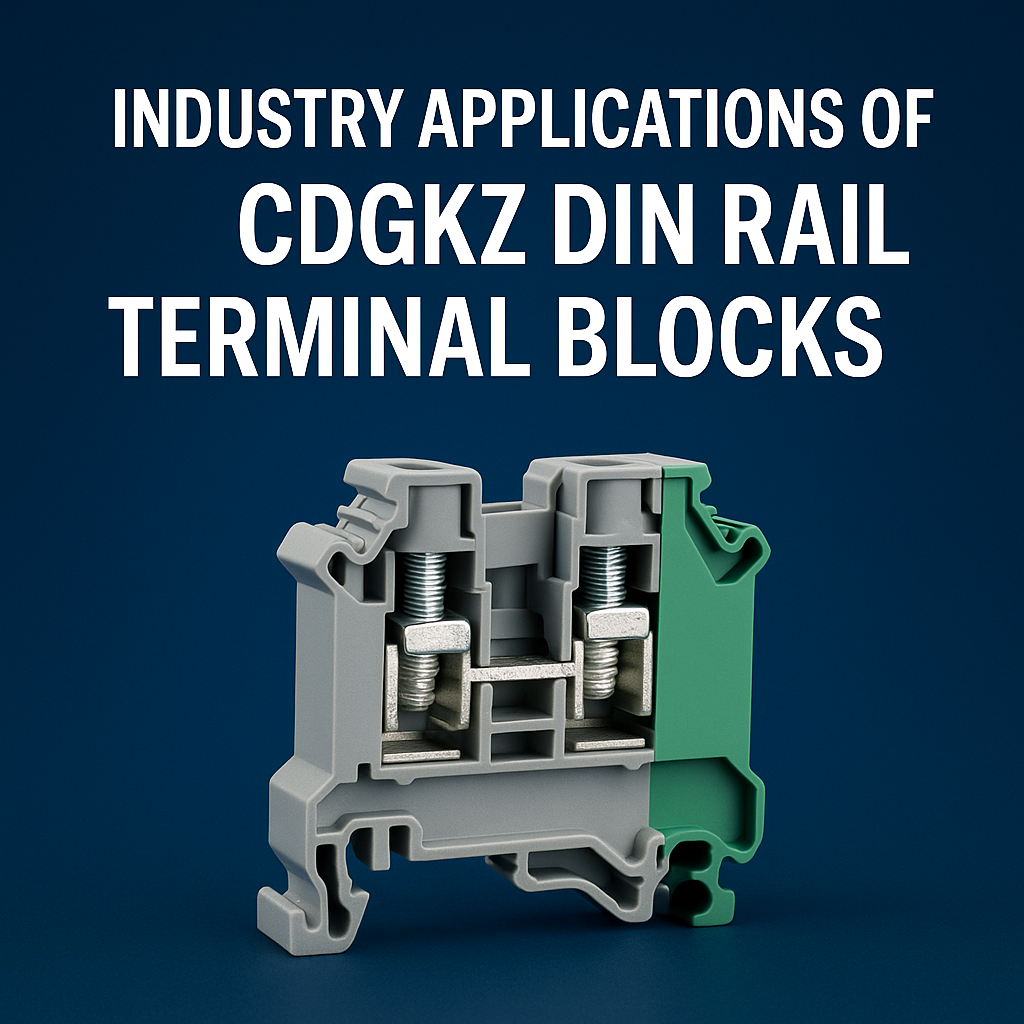
Industry Applications of CDGKZ DIN Rail Terminal Blocks
Engineers and integrators rely on reliable electrical connections in manufacturing, power, and building systems. DIN rail terminal blocks organize wiring for these systems, but with so many configurations, choosing the right connector can be complex. This guide covers terminal block basics and fundamentals — answering “Where are terminal blocks used?” — and highlights CDGKZ DIN rail terminal block applications in control panels, factory automation, HVAC, and renewable energy systems, showing how these connectors ensure safe, efficient power distribution.
TL;DR:
– DIN rail terminal blocks are standard in electrical control cabinets and automation panels, connecting equipment in telecom, building management, HVAC, power supplies, lighting, and control systems.
– They simplify industrial wiring by bundling signals and power, enabling secure connections for PLCs, motors, sensors and actuators.
– In power and renewable systems, terminal blocks safely distribute high-current power (e.g. PV arrays, battery storage) and often include fuses or disconnects.
– Specialized blocks support harsh environments: automotive, rail, marine and aerospace applications rely on vibration-resistant, corrosion-proof connectors.
– Overall, CDGKZ DIN rail terminal blocks improve wiring efficiency, safety and maintenance across diverse sectors.
Industrial Control Panels and Factory Automation
In manufacturing and automation, DIN rail terminal blocks serve as the backbone of control panels. They join field device wiring (sensors, actuators, motors) to PLCs, drives and relays in control cabinets. By providing a clear interface, terminal blocks let engineers organize complex wiring and distribute power safely. For example, screw-clamp or spring-cage blocks hold conductors firmly under each rail, while barrier or fuse terminal blocks isolate circuits and protect against overloads. This modular wiring approach makes assembly and maintenance easier: circuits can be traced and swapped without rewiring entire harnesses. DIN rail blocks are used in factory automation lines, conveyor systems, and CNC machinery to streamline signal and power distribution. The compact, snap-on CDGKZ DIN rail terminal blocks allow quick installation in tight control racks. In short, they ensure reliable connections in control systems and automate wiring harnesses across industrial machines.

Key Takeaways:
– Terminal blocks organize wiring in industrial control panels, simplifying complex automation circuits.
– They provide reliable, labeled connection points for signals and power (e.g. from sensors and motors).
– Modular DIN rail blocks support fast maintenance and future expansion of factory systems.
Learn more about CDGKZ terminal block solutions for industrial automation.
Power Distribution and Renewable Energy Systems
Terminal blocks are essential in power distribution panels and renewable energy installations. In main switchboards and distribution cabinets, heavy-duty DIN rail terminal blocks connect branch circuits, busbars, and ground lines. They often include fused or disconnecting models for overload protection. In renewable energy systems, terminal blocks handle high-current DC wiring safely: for example, PV combiner boxes and inverter panels use DIN rail connectors to combine solar panel outputs, while battery energy storage racks rely on robust terminal blocks for long-term DC power distribution. These blocks must meet high voltage ratings (often up to 600–1500V for solar arrays) and UL/IEC standards for energy systems. By securely joining conductors, terminal blocks prevent loose connections that could cause arcing or faults under heavy loads. CDGKZ high-current terminal blocks feature large copper paths and parallel contacts to evenly share current, reducing heat buildup in EV chargers and battery systems. Whether in a data center power panel or a wind turbine, DIN rail terminal blocks ensure safe, efficient power wiring in energy systems.
Key Takeaways:
– DIN rail blocks distribute high current safely in power panels and switchgear.
– They support renewable setups (solar, wind, battery storage) by joining PV strings and battery feeders.
– Modular design (e.g. pluggable or multilevel blocks) allows easy addition of circuits as systems grow.
Learn more about CDGKZ terminal block solutions for power distribution and renewable energy.
Building Automation, HVAC and Instrumentation
Building and HVAC systems use terminal blocks to interconnect controls, sensors and power in management panels. In commercial buildings, terminal blocks tie together HVAC controls, lighting circuits, security sensors, and fire/alarm signals in central control cabinets. For instance, building management systems (BMS) monitor and control heating, ventilation, air conditioning, and lighting — all wired via DIN rail blocks to ensure organized, accessible wiring. In HVAC equipment (furnaces, chillers), terminal blocks allow technicians to hook up power, thermostats, fans and sensors reliably. These blocks must endure fluctuating temperatures and moisture; CDGKZ marine-grade and industrial blocks use corrosion-resistant materials and sealed designs for durability. Terminal blocks also support instrumentation in buildings (e.g. lab equipment or process sensors) by providing multi-circuit connection points. For example, multi-level or multi-channel blocks can group I/O connections for temperature, pressure and flow sensors. In smart building infrastructure, DIN rail terminal blocks help bridge traditional low-voltage wiring with modern data/communication interfaces. Overall, in HVAC and building automation, terminal blocks create neat, labeled junctions for every cable, boosting safety and simplifying troubleshooting.
Key Takeaways:
– Terminal blocks connect HVAC controls, sensors, and actuators in central BMS and panelboards.
– They maintain secure wiring under varying environmental conditions, essential for reliable building systems.
– Multi-circuit and push-in block designs speed up wiring in instrumentation and smart building installations.
Learn more about CDGKZ terminal blocks for building automation and HVAC systems.
Transportation, Automotive, Marine and Aerospace
Dynamic transportation and heavy-duty sectors demand terminal blocks built for harsh conditions. In automotive and rail vehicles, terminal blocks are used for power distribution and signal systems. For example, DIN rail and chassis-mount blocks integrate into EV charging stations, locomotive control cabinets, and onboard electronics. In rail vehicles, Phoenix Contact notes that “function terminals can be found in almost every rail vehicle,” used for signal conditioning, circuit protection and diagnostics. These blocks often support high vibration and wide temperature ranges. In aerospace, terminal blocks are commonplace in aircraft electrical systems – they replace wire nuts and splices by securely clamping wires in instrument and power panels. Marine vessels similarly use marine-grade terminal blocks (sealed and corrosion-resistant) in engine rooms and navigation systems. CDGKZ’s rugged terminal blocks meet automotive (IATF) and railway (IRIS) standards for electrical connectors, ensuring reliable connections aboard trains, ships and aircraft. By using spring-clamp or bolt-type terminals, these blocks maintain contact under shock and vibration, making them ideal for transportation and defense applications.
Key Takeaways:
– Heavy-duty terminal blocks are used in cars, trains, ships and planes to handle power and signal wiring.
– They are built for extreme conditions (vibration, salt spray, temperature) with robust clamp or bolt connections.
– Specialized certifications (marine-grade, aerospace quality) ensure performance in transportation and defense environments.
Learn more about rugged CDGKZ terminal block solutions for transportation and aerospace.
FAQs
Q: What is a DIN rail terminal block? A DIN rail terminal block is an insulated electrical connector mounted on a metal DIN rail inside control panels. It securely joins wires and equipment, creating a junction point for power and signals. These modules (sometimes called terminal strips or connector blocks) support modular wiring layouts and allow circuits to be reconfigured without soldering. High-quality blocks use screw or spring clamps to hold conductors and may include built-in fuses or test points for added safety.
Q: Where are terminal blocks commonly used? Terminal blocks are used in nearly every electrical system that requires neat, organized wiring. You’ll find them in industrial control panels, factory automation equipment, and machine tools; in building systems like HVAC, lighting and fire alarm panels; in renewable energy installations (solar inverters, battery racks); and in transportation (trains, ships, aircraft). Essentially, any multi-circuit wiring application – from smart buildings to telecom racks – uses DIN rail terminal blocks to ensure safe connections. For example, they are standard in building management systems and motor control centers.
Q: Why use CDGKZ terminal blocks? CDGKZ DIN rail terminal blocks are engineered for efficiency and durability. They offer space-saving designs (including multi-level blocks), robust clamp mechanisms that resist vibration, and high-quality insulating materials. In critical applications, CDGKZ models include fuse holders and grounding terminals for extra protection. By using branded CDGKZ blocks, installers benefit from consistent parts, clear labeling, and compatibility with international rail standards. This means easier installation, safer circuits, and confidence that the blocks will perform over the long term, even in demanding environments.
Conclusion and Next Steps
From factory automation to renewable energy, DIN rail terminal blocks are fundamental for organized, safe wiring. CDGKZ’s range of compact, modular terminal blocks supports every industry use case – whether it’s control panels, power distribution, HVAC, or specialized vehicles. By choosing the right terminal connector (screw, spring-clamp, fuse holder, etc.), you boost installation speed and system reliability. Explore CDGKZ’s catalog or contact our technical specialists to specify the ideal terminal block solution for your application. Reliable electrical connections start with quality terminal blocks – request a quote or sample to see how CDGKZ can optimize your wiring.
