
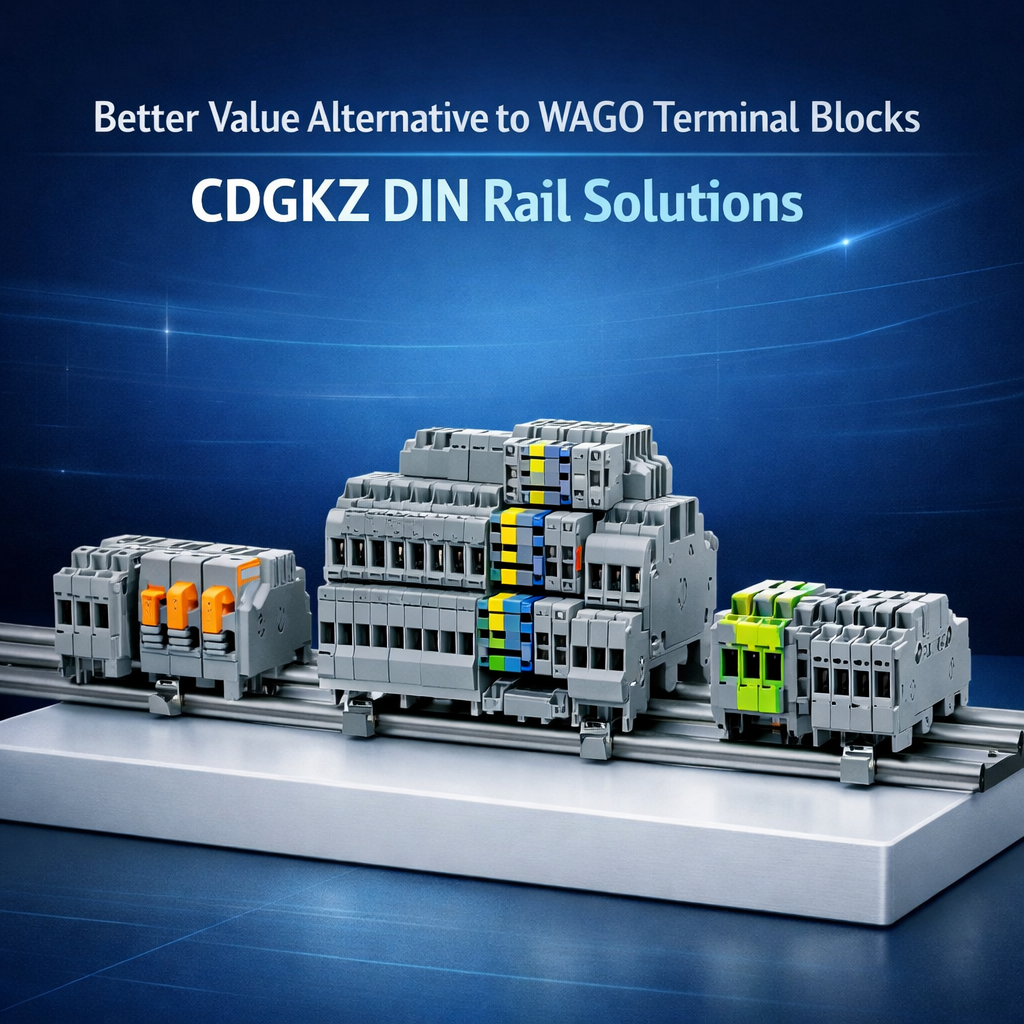
Better Value Alternative to WAGO Terminal Blocks CDGKZ DIN Rail Solutions
If you’re comparing brands because WAGO pricing and lead times strain your panel budget, you’re not alone. Many builders want a cheaper alternative to WAGO terminal blocks that still passes audits, holds up in vibration, and matches common DIN-rail layouts. This deep-research guide explains what “compatible” really means and how cost-effective terminal blocks vs WAGO can be sourced without compromising safety margins or certification readiness.
TL;DR
Most buyers searching “WAGO terminal block alternative” are actually trying to solve three problems: compliance risk, field reliability, and total cost (parts + wiring time + rework). WAGO’s rail-mount families emphasize push-in / spring pressure connection benefits like maintenance-free operation and vibration-proof performance when correctly installed.
For a practical purchasing decision, use these shortcuts:
- If you need DIN rail terminal blocks compatible with WAGO, define compatibility as mounting on DIN 35 rail, matching conductor ranges, and meeting the same IEC/UL acceptance path—not “all accessories and jumpers interchange.” WAGO itself highlights system features like jumpers and marking systems, which are often proprietary by brand family.
- If you’re evaluating an equivalent to WAGO terminal blocks, the fastest credibility check is documentation: IEC test basis, UL scope relevance, material flammability ratings, and traceable QC. Standards such as IEC 60947-7-1 and UL 1059 define what counts as “safe terminal block behavior” under mechanical, thermal, and dielectric stress.
- CDGKZ positions itself as a low cost WAGO alternative terminal blocks source via factory scale and OEM workflows, including sampling, testing, and customized production steps. CDGKZ also markets “30%+ lower cost vs Western brands” and an ISO-oriented automated facility.
- For junction-box splicing (not DIN-rail blocks), people also search WAGO 221 2273 alternative terminal blocks. Those are a different category than control-cabinet terminal strips, so the right “alternative” depends on whether you’re wiring inside a panel or splicing in the field.
Key Takeaways
– “Compatible” usually means rail + rating + compliance path—not universal accessory interchange.
– Use IEC/UL documentation as your fastest filter for “equivalent” claims.
– CDGKZ’s core pitch is factory-direct economics plus OEM customization steps.
Learn more about CDGKZ DIN rail terminal block selection by current, voltage, and wire size.
What “equivalent to WAGO terminal blocks” really means
Engineers often type “equivalent to WAGO terminal blocks” or “WAGO compatible terminal blocks” when they actually mean: “Can I keep the same cabinet layout and still pass reliability and compliance checks?” Start by separating three layers of equivalence:
First is mechanical equivalence: rail fit (DIN 35/NS 35 style mounting), block width, and wiring direction. WAGO’s rail-mount systems emphasize specific actuation variants (lever/push-button/operating slot) and support multi-deck formats for dense wiring.
Second is electrical equivalence: conductor range, voltage/current class, surge performance, insulation coordination mindset, and temperature rise margins. WAGO highlights universal connection for common conductor types with push-in termination for solid/stranded/ferruled conductors in its TOPJOB S family.
Third is system equivalence: markers, jumpers, test points, and accessory logistics. Even world-class systems can be “compatible” on the rail but not cross-compatible in bridges/labeling. Phoenix Contact explicitly markets its own standardized bridging/marking/testing ecosystem within its system—meaning accessory interoperability is usually inside a family, not across brands.
Compatibility Checklist (Mechanical / Electrical / System)
| Category | Key Checkpoints | Why It Matters |
|---|---|---|
| Mechanical Fit |
DIN rail compatibility (IEC/EN 60715) Width & pitch alignment Mounting stability Wire entry direction |
Ensures seamless installation without modifying panels or layouts. |
| Electrical Ratings |
Rated voltage & current Insulation material (PA66, UL94 V-0) Temperature resistance Contact reliability |
Prevents overheating, failures, and ensures long-term operational safety. |
| System Compatibility |
Cross-connection bridges End stops & markers Labeling system compatibility Accessories ecosystem |
Maintains system consistency and reduces redesign or accessory mismatch costs. |
Key Takeaways
– “Equivalent” should be defined in three layers: mechanical, electrical, and system ecosystem.
– Rail fit alone does not guarantee accessory/jumper interchange across brands.
– Use WAGO’s published actuation + conductor-type approach as a benchmark list when writing your replacement spec.
Standards and certifications that decide whether a “replacement” is acceptable
A WAGO replacement terminal blocks strategy becomes low-risk only when you align your alternative with the standards your customers, inspectors, or panel certifications care about. Two key benchmarks commonly referenced for terminal blocks are IEC 60947-7-1 and UL 1059.
The International Electrotechnical Commission defines IEC 60947-7-1 for terminal blocks intended to connect round copper conductors, within specified conductor cross sections, and within low-voltage circuit limits (up to 1,000 VAC or 1,500 VDC depending on context). This is the “language” many global projects expect when reviewing insulation, temperature rise, mechanical endurance, and connection integrity.
For North American acceptance paths, Underwriters Laboratories publishes UL 1059, which covers terminal blocks rated 1500 V or less and includes protective conductor terminal blocks used to connect conductors to supports such as mounting rails. UL 1059 also frames terminal blocks as intended to permanently support and insulate wire terminations where lack of insulation/support could create fire or shock risk—important language for compliance justification.
CDGKZ’s own compliance content positions its terminal blocks as designed around UL/IEC frameworks and global requirements (as a vendor claim), which is useful for marketing—but for engineering sign-off, you still want traceable documents: test reports, declarations, and (where applicable) UL file references.
Compatibility Checklist (Mechanical / Electrical / System)
| Category | Key Checkpoints | Why It Matters |
|---|---|---|
| Mechanical Fit |
DIN rail compatibility (IEC/EN 60715) Width & pitch alignment Mounting stability Wire entry direction |
Ensures seamless installation without modifying panels or layouts. |
| Electrical Ratings |
Rated voltage & current Insulation material (PA66, UL94 V-0) Temperature resistance Contact reliability |
Prevents overheating, failures, and ensures long-term operational safety. |
| System Compatibility |
Cross-connection bridges End stops & markers Labeling system compatibility Accessories ecosystem |
Maintains system consistency and reduces redesign or accessory mismatch costs. |
Key Takeaways
– IEC 60947-7-1 and UL 1059 are high-signal references when evaluating a WAGO alternative.
– UL 1059 explicitly addresses mounting-rail use and protective conductor terminal blocks.
– Treat “certification-ready” as a documentation package, not a slogan—request traceable evidence.
Learn more about certification documents to request (IEC reports, UL scope, CE/RoHS declarations).
Why CDGKZ can be a factory direct terminal blocks alternative to WAGO
If your goal is a factory direct terminal blocks alternative to WAGO, then cost structure matters as much as product features. CDGKZ’s primary positioning is that it runs an integrated manufacturing model (R&D → sampling → production → QC → packaging → shipment) and offers customized/OEM workflows, which can reduce sourcing friction for panel builders and brand owners.
From a conversion perspective, that directly supports multiple long-tail intents in your keyword list:
- budget replacement for WAGO terminal blocks and low cost WAGO alternative terminal blocks: CDGKZ explicitly markets “30%+ lower cost vs Western brands” as part of its value proposition.
- OEM terminal blocks alternative to WAGO and private label terminal block manufacturer alternative to WAGO: CDGKZ describes a one-stop customized service flow including preliminary design, sample fabrication and testing, multiple quality checks, and customized packaging/labeling—exactly what OEM/private-label buyers care about.
- high quality terminal blocks alternative to WAGO: “Quality” must be translated into process and proof. CDGKZ claims ISO-oriented process control and quality certification coverage; use this as a starting point, then insist on the underlying test/inspection artifacts for your specific part numbers and ratings.
In other words: CDGKZ is trying to win on cost-effective terminal blocks vs WAGO while still speaking the compliance language buyers expect.
Key Takeaways
– CDGKZ’s differentiation is factory-direct economics plus OEM customization steps, not just “generic compatibility.”
– Use the “30%+ lower cost” claim as a commercial hook—but validate with your own BOM + documentation review.
– Quality claims convert better when tied to QC workflow and cert-ready paperwork.
Selecting the right alternative to WAGO DIN rail terminal blocks and splicing connectors
Searchers often mix two needs in one query: cabinet terminal strip building and field splicing. If your customer wants an alternative to WAGO DIN rail terminal blocks, they are typically designing control panels: feed-through blocks, ground/PE blocks, multi-level blocks, disconnect/test functions, and standardized marking/jumper workflows. WAGO’s TOPJOB S positioning highlights multi-deck through blocks, potential distribution, and coordinated jumpers/marking solutions.
But if the user asks WAGO 221 2273 alternative terminal blocks, they usually mean small splicing connectors used in junction boxes or lighting. WAGO describes the 221 series as lever-actuated splicing connectors covering broad conductor types and sizes; the 221 series is also presented as rated up to 32 A / 450 V (depending on variant/approvals context) and designed for tool-free operation.
For the 2273 series, WAGO’s product description frames it as a PUSH WIRE splicing connector for solid conductors up to 2.5 mm², with an ambient temperature limit noted (T60).
So the right mapping is:
- For panels: look for push-in terminal block alternative to WAGO or spring clamp terminal blocks alternative to WAGO if speed + vibration resistance matter (a benefit emphasized by multiple connection-technology vendors, including WAGO’s spring pressure messaging).
- For modularity: ask whether plug-in terminal blocks equivalent to WAGO are required, because pluggable modules change maintenance workflows and inventory strategy. WAGO explicitly mentions pluggable modules as a retrofit-friendly option in its system narrative.
Key Takeaways
– Split requirements into “panel terminal strips” vs “junction-box splicing connectors” before choosing an alternative.
– Push-in / spring clamp designs are often chosen for wiring speed and vibration resistance narratives.
– Pluggable modules are a workflow decision—verify need before specifying “plug-in equivalent” parts.
FAQ
Which documents should I request when buying a reliable WAGO alternative terminal block manufacturer?
Ask for a part-number-specific datasheet, a clear statement of applicable IEC/UL scope, and traceable compliance evidence (e.g., test reports or listing/recognition references). Standards define the acceptance logic, but your audit will hinge on what the supplier can document for your exact SKU.
Are DIN rail terminal blocks compatible with WAGO by default?
They may be rail-mount compatible, but that does not guarantee system accessory interchange (jumpers/markers/test plugs). Treat “DIN rail terminal blocks compatible with WAGO” as a spec-writing exercise: define rail, ratings, conductor range, and accessory requirements explicitly.
How do I position CDGKZ as an industrial terminal block supplier better than WAGO without over-claiming?
Use a “value” framing: factory-direct cost structure + OEM service + documentation readiness. CDGKZ markets lower cost vs Western brands and an OEM-oriented workflow; your strongest claim is “better cost-performance for matched requirements,” supported by your own test/inspection results.
Key Takeaways
– The best FAQ answers reference documents and definitions, not opinions.
– “Compatibility” must be scoped (rail vs accessories vs approvals).
– “Better than” claims convert safely when phrased as “better value for matched requirements.”
Conclusion and CTA
A strong WAGO terminal block alternative is not chosen by price alone—it’s chosen by how confidently you can defend it under inspection, how consistently it performs in the field, and how much it reduces total installed cost. WAGO’s own narratives emphasize spring-pressure benefits such as maintenance-free and vibration-proof connections in demanding environments, and its TOPJOB S system messaging highlights coordinated jumpers/marking and broad application coverage.
If your project needs WAGO replacement terminal blocks with lower BOM cost, CDGKZ’s positioning aligns with the needs behind keywords like factory direct terminal blocks alternative to WAGO, budget replacement for WAGO terminal blocks, and OEM terminal blocks alternative to WAGO—especially because it markets an OEM workflow (design → sample → testing → QC → customized packaging) and “30%+ lower cost vs Western brands.”
For best conversion and lowest engineering risk, offer (or request) two things in the same conversation:
1) a spec-matched proposal (rail type, wire range, voltage/current class, functions like PE and multi-level); and 2) a documentation pack aligned to IEC/UL expectations. That’s how you credibly sell high quality terminal blocks alternative to WAGO while still delivering a cost-effective terminal blocks vs WAGO story.
CTA: If you want a quote-ready cross-reference, request CDGKZ’s catalog + sample set for the CDGKZ DIN rail terminal block families (push-in and screw options) and specify your target wire sizes, rail type, and certification markets upfront.
Key Takeaways
– The winning alternative is “spec + documents + supply chain,” not “cheapest part.”
– CDGKZ’s conversion angle is OEM capability plus factory-direct cost claims.
– Position “better than WAGO” as “better value for matched requirements,” backed by evidence.
