
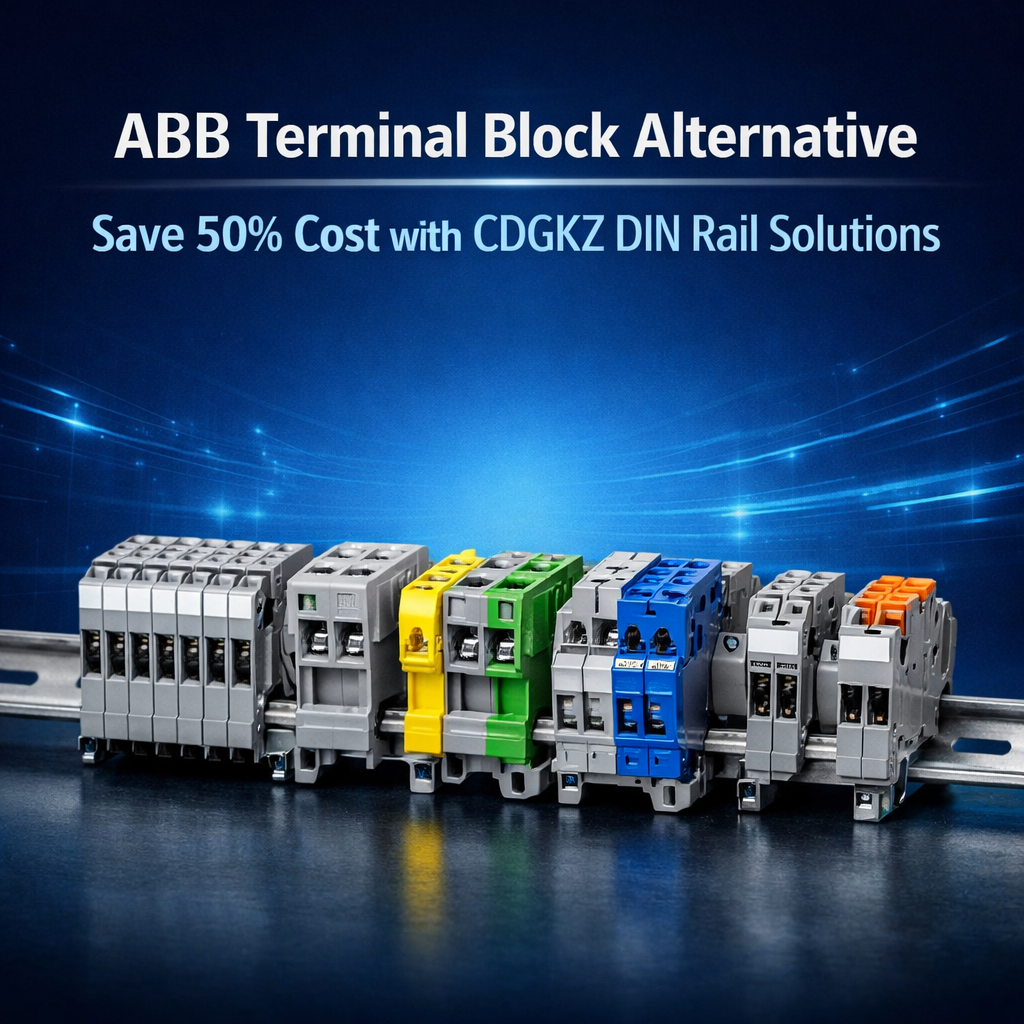
ABB Terminal Block Alternative: Save 50% Cost with CDGKZ DIN Rail Solutions
Buyers switch brands for the same reasons every year: brand pricing keeps rising, project timelines get tighter, and panel builders cannot afford rework from loose connections or heat issues. A credible ABB replacement must be “standards-first”: fit standardized DIN rails and prove electrical/mechanical performance through recognized tests. That’s exactly how you should position CDGKZ DIN rail terminal block solutions—cost-focused, compliance-ready, and panel-builder friendly.
ABB Terminal Block Alternative, ABB Terminal Block Replacement, ABB Compatible Terminal Blocks, ABB DIN Rail Terminal Block Alternative, Cost-Effective ABB Terminal Block Replacement, ABB Terminal Block Cheaper Alternative, Low Cost ABB Terminal Block Equivalent, Save 50% Cost ABB Terminal Block Alternative, Affordable ABB Terminal Blocks Replacement, Best Price ABB Terminal Block Substitute, High Quality ABB Terminal Block Alternative, Industrial Grade ABB Terminal Block Replacement, ABB Terminal Block Equivalent with UL Certification, IEC Standard ABB Terminal Block Alternative, Reliable ABB Terminal Block Substitute, ABB Terminal Block Alternative for Control Panels, ABB Terminal Block Replacement for Industrial Automation, OEM Alternative to ABB Terminal Blocks, DIN Rail Terminal Block ABB Alternative Supplier, Bulk Supply ABB Terminal Block Alternative.
TL;DR
If you want the article to convert, you need to prove three things: the alternative is truly compatible, truly compliant, and truly lowers total cost. “ABB-compatible” should be framed around standardized mounting and standardized terminal-block performance testing—especially for industrial copper conductors in low-voltage switchgear/controlgear assemblies.
A strong “ABB Terminal Block Replacement” pitch should anchor on two globally recognized baselines: IEC terminal-block requirements and UL terminal-block safety evaluation (when selling into North America or UL-built panels). This is why phrases like “ABB Terminal Block Equivalent with UL Certification” and “IEC Standard ABB Terminal Block Alternative” convert—they pre-answer the compliance objection.
Position “CDGKZ DIN rail terminal block” around measurable proof points: temperature-rise control, mechanical integrity of the clamp, insulation/dielectric robustness, and correct spacings—because these are the failure modes that cause downtime, hot spots, or inspection delays.
Cost messaging converts best when you explain where savings come from: fewer distribution layers and a factory-direct/OEM supply model, while still meeting the same standards. You can safely use “Save 50% Cost ABB Terminal Block Alternative” as a search-intent phrase, but you should tie it to a transparent cost model rather than an absolute promise.
Key Takeaways – Conversion = standards + proof + cost model (not “cheap”).
– Use IEC/UL language to reduce buyer risk and shorten decision time.
– Explain savings through channel structure, not vague discounts.
Learn more about “How to choose DIN-rail terminal blocks (wire range, torque, approvals)”
Why buyers actively search for an ABB alternative
The demand behind “ABB Terminal Block Alternative” is not just price sensitivity; it is project risk management. In control panels and industrial automation cabinets, terminal blocks are a high-count BOM item. When you multiply “per-terminal” cost across hundreds or thousands of points, procurement naturally looks for a “Cost-Effective ABB Terminal Block Replacement” that does not introduce compliance or reliability risk.
A credible alternative also benefits from industry standardization. Most panel ecosystems assume standardized rail mounting and standard test methods for terminal-block performance. For example, standardized mounting rail requirements support compatible mounting across suppliers, which is one reason “ABB DIN Rail Terminal Block Alternative” searches convert well: the buyer expects a drop-in mechanical fit and known accessory pattern (end stops, jumpers, markers).
In many organizations, total cost is bigger than purchase price. Buyers want to avoid downtime and rework caused by loose terminations or heat rise at contact points. That is why your message should connect “High Quality ABB Terminal Block Alternative” to measurable outcomes: stable contact resistance, reduced maintenance touchpoints, safer operation, and smoother inspections.
Why Buyers Move from ABB to Alternatives
The decision is not sudden. Buyers move through a clear path — from cost pressure to delivery challenges — before choosing a better alternative.
Price Pressure
High brand pricing creates strong cost pressure in large-volume projects.
Compliance Risk
Alternatives must meet IEC / UL standards and ensure compatibility.
Reliability Risk
Buyers evaluate stability, durability, and long-term performance.
Lead Time / Service
Long lead times and slow response push buyers to seek alternatives.
Move to a Better Alternative
Lower cost, reliable quality, faster delivery, and flexible support.
Switching is not about replacing a brand — it’s about reducing total project risk.
Key Takeaways – Search intent is “lower cost with no compliance risk,” not only “cheaper.”
– DIN-rail standardization makes brand switching realistic when specs match.
– Reliability messaging should be tied to testable performance, especially temperature rise.
Learn more about “Control panel wiring best practices and terminal block selection checklist”
Standards and compatibility for ABB-compatible terminal blocks
To make “ABB Compatible Terminal Blocks” believable, define compatibility in standards language: standardized mounting plus standardized terminal-block requirements. On mounting, DIN rail mechanical compatibility is anchored in the mounting-rail standard that defines dimensional/functional requirements for compatible mounting of switchgear/controlgear and accessories on certain rail types. This is the hidden backbone that allows blocks from different vendors to snap onto the same rail profile when designed correctly.
On terminal-block performance, the core global reference is the terminal-block standard for copper conductors used in industrial or similar environments, intended to be fixed to a support and provide electrical/mechanical connection between conductors. Public descriptions of the scope also reference typical rated voltage limits (up to 1,000 V AC and 1,500 V DC, depending on edition) and wide conductor cross-section coverage for copper conductors—exactly the language engineers want when approving “IEC Standard ABB Terminal Block Alternative.”
If your customers ship into North America or build UL-evaluated panels, you also need to speak UL terminal-block language. UL’s terminal block standard describes terminal blocks intended to support and insulate wire terminations/joints from each other and from the mounting surface when lacking such support introduces risk (fire, shock, injury). That matters for the keyword “ABB Terminal Block Equivalent with UL Certification,” because it addresses inspection and safety objections up front.
ABB Terminal Block → CDGKZ Compatibility Matrix
Engineering comparison of ABB-style terminal blocks and CDGKZ DIN rail solutions for direct replacement compatibility.
| Parameter | ABB Terminal Block | CDGKZ Terminal Block | Compatibility |
|---|---|---|---|
| Wire Range | 0.2 – 4 mm² / 0.2 – 6 mm² | 0.2 – 4 mm² / 0.2 – 6 mm² | Fully Compatible |
| Rated Current | 24A – 41A | 24A – 41A | Equivalent |
| Rated Voltage | 800V – 1000V | 800V – 1000V | Equivalent |
| Mounting Width | 3.5 mm / 5.2 mm / 6.2 mm | 3.5 mm / 5.2 mm / 6.2 mm | Same Footprint |
| Terminal Type | Screw / Spring Clamp | Screw / Push-in | Compatible Options |
| Accessories | End plates, jumpers, markers | End plates, jumpers, markers | Interchangeable |
CDGKZ terminal blocks are designed for seamless DIN rail integration with ABB-style systems, ensuring minimal redesign and fast replacement.
Key Takeaways – “ABB-compatible” should be defined as standards-led fit + standards-led performance.
– IEC language reduces engineering friction for global projects; UL language reduces UL/inspection friction in North America.
– Compatibility tables convert better than generic claims—because they are checkable.
Learn more about “DIN rail sizes (TH35-7.5 vs TH35-15) and cabinet layout tips”
Quality proof points that let you claim “better,” not just “cheaper”
A “Reliable ABB Terminal Block Substitute” claim becomes credible when you show which tests matter and why they prevent real failures. One of the most persuasive engineering proof points is temperature rise under load. Industry quality-test descriptions explicitly link temperature-rise testing to IEC terminal-block requirements and UL terminal-block evaluation. The logic is simple and compelling: temperature rise is driven by Joule heating; excessive rise indicates higher contact resistance, which is a reliability and safety risk.
Next, show selection parameters and rating discipline. Engineering selection guides highlight the need to match application needs (wire size range, current/voltage ratings, pitch/spacing, approvals) rather than “overbuying a brand.” When you connect this to “Industrial Grade ABB Terminal Block Replacement,” you frame CDGKZ as a disciplined engineering choice: choose the correct block type and rating, and then verify documentation and test evidence.
Finally, address the buyer’s hidden fear: spacing/insulation errors that threaten approvals. Technical notes on terminal blocks and UL recognition emphasize the importance of adequate spacing for OEM applications and the role of UL recognition marking in inspection contexts. This lets you convert skeptical procurement teams: CDGKZ can be pitched as “low cost,” but your quality story must focus on design for spacing, insulation, and inspection acceptance.
Temperature Rise Test of a Terminal Block
This diagram explains how current passing through a terminal block creates heat, and why lower contact resistance helps reduce temperature rise in electrical connections.
Current
Electrical current flows through the conductor and terminal contact point during operation.
Contact Resistance
The contact interface creates resistance. Poorer contact means higher resistance and more energy loss.
Temperature Rise
Higher resistance causes more heating, which increases terminal temperature during the test.
Test Principle
Under load current, heat generation is closely related to resistance at the contact point. As current passes through the terminal, poor electrical contact creates extra resistance, and that resistance turns electrical energy into heat.
Key Relationship
Better contact quality improves conductivity and reduces temperature rise, helping the terminal block remain stable and reliable.
Higher Contact Resistance
- More energy loss at the contact point
- Higher local heating
- Greater temperature rise during testing
- Higher risk of long-term instability
Lower Contact Resistance
- More efficient current transfer
- Lower heat generation
- Reduced temperature rise
- Better long-term connection reliability
Why this matters: In terminal block testing, lower contact resistance helps control heat buildup under rated current, which is critical for safety, reliability, and long service life.
Key Takeaways – Temperature rise is a concrete, standards-linked “quality” indicator that engineers trust.
– A quality claim converts when it’s tied to selection discipline (wire range, ratings, approvals).
– Spacing/insulation credibility matters for OEM/UL contexts; address it directly.
Cost model for CDGKZ: how “cheaper” can still be “better”
To sell “ABB Terminal Block Cheaper Alternative” without sounding unsafe, explain the cost model professionally. A common driver is channel structure. Pricing and distribution analyses describe how margin can be added in layers (manufacturer-to-distributor and distributor-to-customer), and those layers can materially change the end price even when products meet similar functional requirements. This is why “OEM Alternative to ABB Terminal Blocks” performs so well: OEM/factory-direct sourcing can reduce stacked margins.
The second driver is standardization. When terminal blocks are designed around standardized DIN-rail mounting and tested against the same terminal-block requirements, the buyer’s switching cost drops. That motivates procurement to negotiate aggressively and seek “Best Price ABB Terminal Block Substitute,” especially for high-volume panel programs where terminal blocks are frequent line items.
The third driver is total cost of ownership: reliable, compliant rail-mount terminal blocks (also called rail-mounted terminal blocks, DIN-rail mounted terminal blocks, or rail-mount terminal strips) can reduce maintenance touch time and downtime. Industry positioning for DIN-rail terminal blocks explicitly connects reliable connection solutions with streamlined maintenance and minimized downtime—translation: buyer value is not only “cheaper,” it is “lower lifetime cost.”
Use “Save 50% Cost ABB Terminal Block Alternative” as a search-intent headline paired with a transparent disclaimer: savings depend on volumes, specs, and channel. This keeps the claim aggressive while staying professional and believable.
Why Terminal Block End Pricing Increases
This waterfall chart shows how distribution layers can increase terminal block pricing — and where factory-direct sourcing helps buyers save cost.
How Pricing Builds Up
End pricing often increases step by step: first the brand price, then distributor margin, and then additional cost for stockholding, support, and service response.
Where Factory Direct Saves
By reducing unnecessary distribution layers, factory-direct sourcing can lower total purchase cost while still supporting compatibility, quality, and delivery planning.
Key takeaway: Factory-direct terminal block sourcing is not only about a lower unit price. It can also reduce the accumulated cost added by channel markup, local inventory burden, and service premiums.
Key Takeaways – Make “cheaper” credible by describing channel margins and OEM/factory-direct structure.
– Standardization reduces switching risk and enables competitive sourcing.
– Tie price to TCO: reliability and maintenance matter in automation cabinets.
FAQ
What makes a DIN Rail Terminal Block ABB Alternative Supplier “drop-in compatible”?
Drop-in compatibility should be documented as (1) rail fit based on standardized mounting-rail requirements and (2) matching functional specs (wire range, rated current/voltage, accessories) plus validation testing. Referencing DIN-rail mounting standards and terminal-block performance requirements makes this definition defensible to engineers and auditors.
What certifications matter for ABB Terminal Block Replacement for Industrial Automation?
Globally, engineers commonly anchor on IEC terminal-block requirements; for North America, UL terminal-block evaluation is frequently expected, especially when equipment or panels are built to UL-related frameworks. The UL terminal block scope emphasizes safety protection (support/insulation of terminations) as the core purpose.
How can I verify “High Quality ABB Terminal Block Alternative” claims before bulk purchase?
Ask for evidence aligned to real failure modes: temperature-rise test results (contact resistance/heat), mechanical clamp integrity, dielectric/insulation verification, and correct markings/approval documentation. Temperature-rise testing is explicitly discussed by major terminal-block manufacturers as a key verification linked to IEC and UL evaluation expectations.
Key Takeaways – FAQ answers should point back to standards and tests, not marketing language.
– UL/IEC framing reduces buyer objections and speeds engineering sign-off.
– Sample qualification + documentation is the safest route to bulk conversion.
Conclusion and CTA
If your audience is searching “ABB Terminal Block Alternative for Control Panels” or “ABB Terminal Block Replacement for Industrial Automation,” your best conversion strategy is to sell risk reduction—not just a lower unit price. Anchor your message in recognized baselines: standardized DIN-rail mounting and terminal-block requirements for industrial copper conductors, plus UL terminal-block safety evaluation language where applicable. That framing makes “Low Cost ABB Terminal Block Equivalent” sound professional, because it becomes “lower cost, proven by the same rulebook.”
To position CDGKZ DIN rail terminal block as the superior option, lead with a simple offer: a cross-reference table, sample kit, drawings, and compliance documentation package—then a volume quote with lead time. That is how you convert “Bulk Supply ABB Terminal Block Alternative” searches into RFQs: reduce uncertainty, make qualification easy, and show the cost model clearly.
CTA:
Request a quote and free sample set for your ABB replacement project. Share your wire range, current/voltage, block type (feed-through/ground/fuse/disconnect/double-level), and monthly volume—CDGKZ will return a cross-reference, recommended equivalents, and a cost-down proposal within one business day (factory-direct, OEM supported).
