
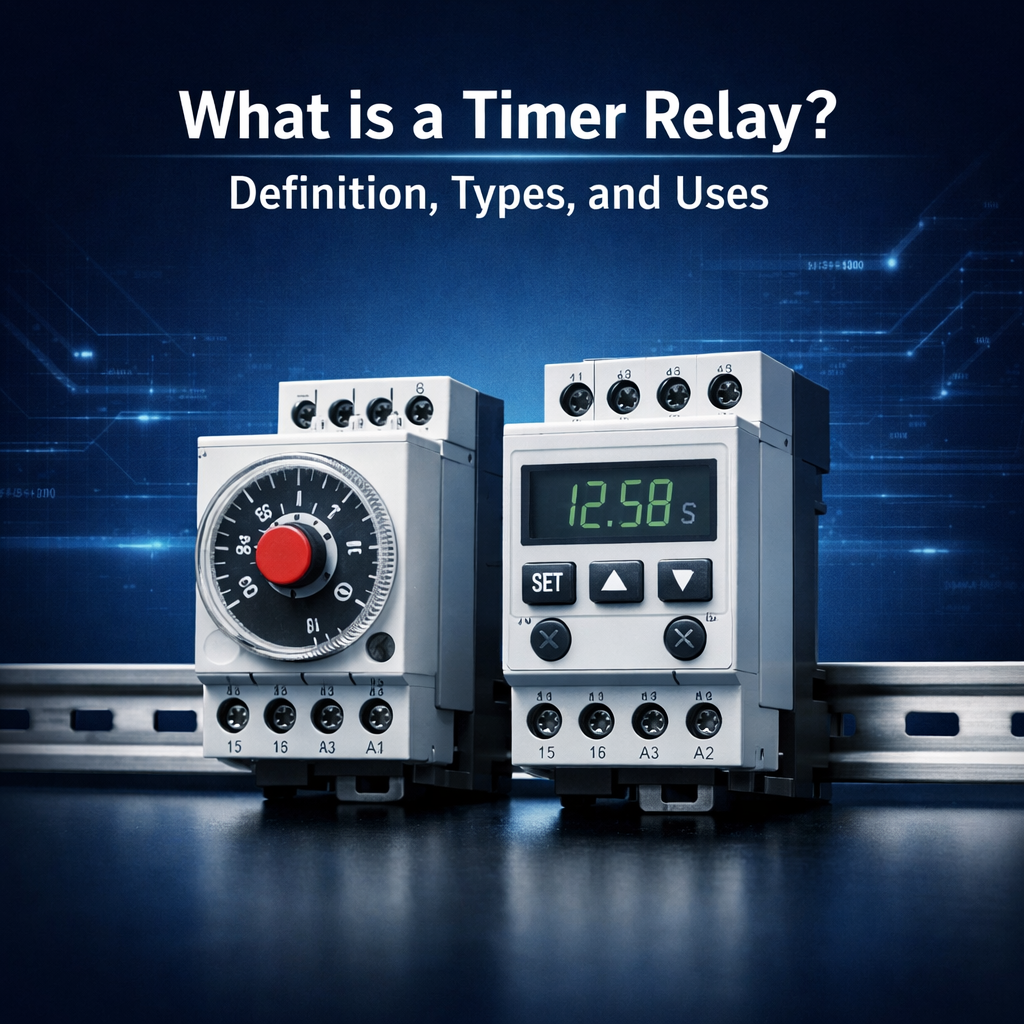
What is a Timer Relay Definition, Types, and Uses
When selecting timers, procurement and engineering teams often face a dilemma: they need stability and reliability (long-term operation, anti-interference, traceable standards) while keeping costs under control (delivery time, customization, alternative compatibility). This article explains the practical value of Timer Relay and CDGKZ Timer Relay through “standards + key selection points + application scenarios”.
TL;DR
Timer relays (also called time relays, time delay relays, timing relays, or industrial timer relays) insert a controlled delay into a control circuit so machines start/stop in a safe, repeatable sequence.
- A timer relay combines an output relay (contacts) with a timing/control circuit so contacts change state after a preset interval.
- The most common timing functions are on-delay, off-delay, interval/one-shot, cycle/flasher, and star-delta; multi-function units combine several modes.
- Many popular “panel standards” revolve around function + voltage + contact rating + mounting (DIN rail / panel / plug-in socket), not brand logo—this is why “equivalent/alternative” sourcing is feasible.
- For compliance-driven markets, the dedicated time-relay standard is IEC 61812-1, and many control-circuit devices are covered under broader low-voltage switchgear/controlgear families such as IEC 60947-5-1.
Key Takeaways
- Timer relays are best understood by timing logic first, brand second.
- Multi-function timer relays reduce SKUs and simplify spares strategy.
Definition and working principle
A timer relay is a control relay with a built-in time delay: instead of switching contacts immediately when it is energized, it waits for a preset interval and then changes the output contacts (NO/NC). Distributors often define it as a combination of an electromechanical output relay and a control circuit that opens/closes contacts before or after a chosen timed interval.
Practically, timer relays act as “sequence engines” in hardwired panels: the input signal starts the timing mechanism, the device counts time, and the output changes state once the set time is reached. This simple control concept is why timer relays remain common even when PLCs exist—especially in cost-sensitive, single-function delay tasks where a dedicated device reduces programming and troubleshooting time.
In standards terms, the specialized standard IEC 61812-1 explicitly applies to time relays and coupling relays for industrial applications such as control, automation, signaling, and industrial equipment. That matters for buyers because it frames what “normal” testing and requirements look like when you’re comparing models or evaluating a factory-direct alternative.
Key Takeaways
- A timer relay’s “value” is deterministic control sequencing with minimal circuit complexity.
- For specification language, IE C 61812-1 is the most relevant anchor standard for time relays.
Types of timer relays
Most timer relays in industrial panels are selected in two layers: (1) timing function, (2) implementation & form factor (analog/digital, DIN rail, plug-in, etc.). Functionally, the “core five” are widely documented across manufacturers and technical guides: on-delay (delay-on make), off-delay (delay-on break), interval/one-shot, cycle/flasher, and star-delta.
On real products, you will also see function sets marketed as “10 functions” or “multi-function,” where a single unit supports multiple modes and wide-ranging time settings. For example, Schneider Electric lists Harmony time delay relays with multiple functions, wide time ranges (e.g., 0.1 s to 100 h depending on model), and DIN-rail-friendly narrow modules (e.g., 17.5 mm width on certain units).
Implementation-wise, analog timer relays typically use dial knobs/potentiometers for time setting, while digital/electronic timers use switches/displays/indicators to make configuration and status clearer. Manufacturer documentation commonly highlights run/power indicators and multi-mode selection as practical advantages of electronic timer designs.
Timer Relay Timing Functions at a Glance
Comparison table of timer relay functions and typical industrial applications.
| Timing Function | Abbreviation | Description | When Output Changes | Typical Industrial Applications |
|---|---|---|---|---|
| On-Delay Timer | TON | Output activates after a preset delay when power is applied. | Turns ON after the set time delay. | Motor start sequencing, conveyors, control panels, automation systems. |
| Off-Delay Timer | TOFF | Output remains active for a preset time after the input signal is removed. | Turns OFF after the set time delay. | Cooling fans, lighting control, HVAC systems, safety shutdown circuits. |
| Interval Timer | IT | Output activates immediately and remains on for a preset duration. | Turns ON instantly and OFF after the set time. | Alarm systems, lubrication equipment, dosing machines, pulse control. |
| Cycle Timer (Repeat Cycle) | CT | Output alternates between ON and OFF continuously at preset intervals. | Repeats ON/OFF switching cyclically. | Flashing lights, packaging lines, irrigation systems, automated production. |
| Star-Delta Timer | SD | Controls automatic switching from star to delta during motor startup. | Switches from STAR to DELTA after the preset delay. | Motor starters, compressors, pumps, fans, heavy industrial machinery. |
Key Takeaways
- Buyers should map the needed logic first (on-delay/off-delay/interval/cycle/star-delta), then match specs.
- Multi-function timer relays reduce inventory and simplify substitution rules in maintenance.
Link to “DIN-rail mounting vs panel-mount vs plug-in socket: how to choose for control cabinets.”
Uses in industrial control panels
Timer relays show up wherever “wait, then act” logic protects equipment or improves process stability. Typical industrial automation uses include sequencing conveyors (staggered starts), delaying fan start/stop in HVAC, coordinating actuators/solenoids, and preventing short cycling or immediate restarts after stop events.
They also appear in building and general control scenarios that are easy to visualize. Omron provides simple illustrations: a car ceiling light that remains on for several seconds after a door closes (classic off-delay behavior) and a fountain that repeatedly turns on/off at set intervals (cycle/flicker behavior).
In motor control, star-delta timing is a common pattern: the timer controls the transition between star and delta connection to reduce inrush current and mechanical stress during starting. Many guides list star-delta alongside the other core timing modes because it’s a frequent “panel-builder” requirement.
Timer Relay Application Map
Diagram mapping common industrial applications to recommended timer relay functions.
Key Takeaways
- Timer relays reduce mechanical/electrical stress by enforcing safe start/stop sequences.
- The same timing functions (on-delay, off-delay, cycle) explain most real-world applications.
Link to “Control panel relay sockets & fast replacement strategy (plug-in timers and bases).”
How to choose a timer relay
A practical selection workflow is consistent across brands and is well suited for “equivalent/alternative” procurement. A CDGKZ industry guide summarizes selection around factors like choosing the required timing function, matching supply voltage, selecting contact configuration/ratings, confirming timing range & accuracy, choosing mounting style (DIN rail / panel / plug-in), and checking environmental protection needs.
From a buyer’s risk-control perspective, two areas deserve “documented proof”: ratings and standards/compliance. On ratings, vendor product pages often highlight: time setting range, number of functions, mounting method (DIN rail), module width, and output contact rating. For example, Schneider’s Harmony modular timers list multi-function capability and DIN-rail mounting in their product descriptions.
On standards, IEC 61812-1 is the dedicated time relay standard (requirements & tests). For broader control-circuit devices and switching elements, IEC 60947-5-1 applies to control circuit devices intended for controlling/signalling/interlocking in switchgear and controlgear (up to specified voltage limits). In practice, some commercial timer relay listings explicitly reference IEC 61812-1 conformity and provide accuracy statements tied to it.
If you sell into CE-marked markets, it’s also typical to align with EU safety/EMC framework: the European Commission describes the Low Voltage Directive (LVD) and EMC Directive goals at a high level. (Model-level documents like Declarations of Conformity and test reports still matter most in procurement.)
Key Takeaways
- If you want a “Schneider Timer Relay Alternative” or “Omron Timer Relay Equivalent,” match function + voltage + contacts + form factor first.
- Standards references (especially IEC 61812-1) help you audit “equivalent” claims objectively.
FAQ
Is “Timer Raley” different from “Timer Relay”?
In most industrial procurement searches, “Timer Raley” is simply a misspelling of “Timer Relay” (time relay / time delay relay). The device concept—delayed switching of contacts—is the same.
What’s the difference between on-delay and off-delay?
On-delay waits for the preset time after input is applied before switching output; off-delay switches immediately on input but holds the output for a preset time after the input is removed. These modes are standard across major timer families and guides.
What documents should I request from a supplier before buying in volume?
Request the model datasheet (ratings/time ranges/functions), wiring/terminal diagram, and any conformity statements (e.g., references to IEC 61812-1 testing or applicable directives for destination markets). Commercial listings sometimes disclose IEC 61812-1 conformity in specifications, and the IEC scope clarifies what the standard covers.
Key Takeaways
- FAQ language that mirrors real buyer searches (“Timer Raley,” “equivalent,” “documents”) improves conversion.
- For B2B orders, documentation quality is often as important as unit price.
Conclusion and CTA
A timer relay (time delay relay / timing relay) is one of the most cost-effective ways to implement dependable “delay logic” in hardwired industrial automation—especially for on-delay, off-delay, interval/one-shot, cycle/flasher, and star-delta use cases. Standards such as IEC 61812-1 provide a shared technical foundation for evaluating performance and building trust when you are sourcing alternatives or scaling procurement across regions.
For buyers who want an Affordable Timer Relay Solution without sacrificing reliability, CDGKZ positions itself as a factory-driven supplier with broad industrial control product lines and stated certification coverage (e.g., CE/UL/RoHS claims on its corporate messaging). CDGKZ also emphasizes one-stop capabilities from R&D to production—useful when you need OEM labeling, panel-standard customization, or an “equivalent” sourcing strategy for established brands.
CTA: If you’re specifying a Cost-Effective Timer Relay for Control Panels, preparing a Schneider Timer Relay Alternative shortlist, or validating an Omron Timer Relay Equivalent, request a quotation package that includes: target timing modes, supply voltage range, contact format (SPDT/DPDT), load type (AC-15/DC-13), mounting preference (DIN rail vs panel vs plug-in), and required compliance documents.
Key Takeaways
- A conversion-friendly timer relay page should connect “function → spec → compliance → quote.”
- “Factory direct + standards language + documentation” is what makes an alternative supplier credible.
