
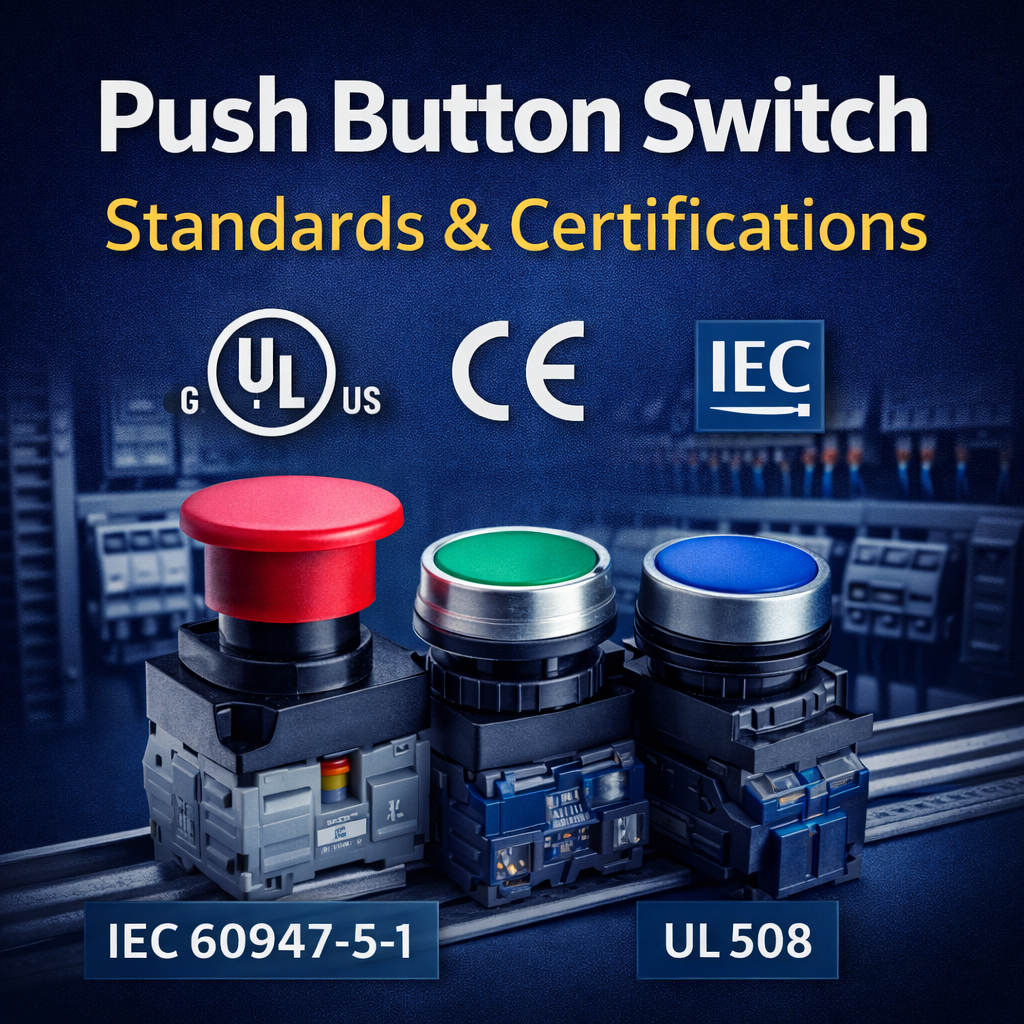
Push Button Switch Standards & Certifications: Safety & Compliance Guide

Push Button Switch Standards & Certifications: Safety & Compliance Guide

In machinery control panels, a single push‑button switch can mean the difference between a safe halt and an electrical hazard. Engineers, purchasers and compliance officers face a maze of international standards, certifications and environmental ratings when choosing switches. This guide demystifies those requirements and explains how selecting a CDGKZ PUSH BUTTOM SWITCH that meets IEC, UL, CE and RoHS standards protects both equipment and people. Whether you’re specifying a pilot pushbutton, an emergency stop device or a sealed IP65 unit, understanding standards is essential.

TL;DR

  • IEC 60947‑5‑1 / EN 60947‑5‑1 set design, performance and testing requirements for low‑voltage control‑circuit devices like push‑button switches and dictate rated voltages and mechanical endurance.

  • UL 508 covers industrial control equipment up to 1 500 V, including tests for temperature, overloads, dielectric strength and short‑circuit protection; UL 1054 sets specific construction and testing rules for snap‑action push‑buttons.

  • ISO 13850 defines functional requirements and design principles for emergency‑stop devices on machinery, ensuring that actuating the button stops dangerous movements.

  • CE marking & RoHS compliance are mandatory in the EU. The Low Voltage Directive requires protection against electrical hazards, while RoHS restricts hazardous substances like lead, mercury and phthalates in electrical devices.

  • Environmental ratings such as IP65/IP67 for dust/water ingress and IK ratings for impact resistance ensure buttons survive harsh conditions

Understanding Push Button Switch Standards

Standards exist to harmonise safety requirements across manufacturers and markets. Without them, a control pushbutton that functions in one jurisdiction might fail tests elsewhere. In the 2016 edition of IEC 60947‑5‑1, the standard covering electromechanical control‑circuit devices, rated voltages of up to 1 000 V AC or 600 V DC are specified. The standard lists mechanical endurance, material requirements and electromagnetic compatibility, clarifies screwless‑clamping units and adds new test tables. These technical revisions ensure modern push‑button switches meet reliability and safety expectations for both AC and DC systems.

North American standards take a slightly different approach. UL 508 – the industrial control equipment standard – governs devices intended to start, stop or protect motors up to 1 500 V and prescribes tests for temperature rise, overvoltage/undervoltage, endurance, calibration and dielectric withstand. UL 1054, meanwhile, covers snap‑action switches such as push‑buttons, focusing on construction, marking and test protocols. Understanding these standards is vital for export markets: equipment sold into the US often needs UL certification even if an IEC‑compliant version exists.

Even within Europe, there are differences between EN 60947‑5‑1 and the IEC document. The EN version harmonises national deviations and may include additional annexes or normative references. For example, EN 60947‑5‑1:2017 references European cross‑harmonised documents and may be linked to other directives such as EMC and Safety of Machinery. When ordering push buttons for EU projects, ensure the documentation cites the EN edition.

Key takeaways:

  • Standards harmonise safety and performance requirements across regions.

  • IEC 60947‑5‑1 defines rated voltages, mechanical endurance and test methods for control‑circuit devices.

  • UL 508 and UL 1054 address construction, testing and marking of control devices in North America.

Internal link suggestion: Learn more about electrical contact ratings.

IEC 60947‑5‑1 and EN 60947‑5‑1 Explained

The IEC 60947‑5‑1 standard (2016 edition) forms the backbone of electromechanical push‑button design. It applies to devices used for controlling, signalling and interlocking in low‑voltage switchgear and controlgear. The standard covers aspects such as:

  • Device classification – momentary push‑buttons, selector switches, indicator lights and multi‑function devices.

  • Rated characteristics – operational currents and voltages for AC and DC circuits, conventional heating current and insulation voltage.

  • Performance requirements – mechanical endurance (number of operations), electrical endurance under rated load, and short‑circuit ratings.

  • Environmental conditions – mechanical shock, vibration, humidity and temperature limits.

  • Testing procedures – verifying the ability to withstand dielectric voltage, making and breaking capacity, insulation resistance and environmental sealing.

The 2016 revision introduced material requirements and tests for screwless‑type clamping units and added new tables and figures. This ensures that terminals provide reliable contact and that users can confidently choose push buttons with either screw‑clamp or spring‑clamp terminals. For EU compliance, EN 60947‑5‑1 replicates the IEC content but may add notes on coordination with EU directives and extra normative references. Both require the manufacturer to supply product information such as rated operational current, voltage and mechanical life.

Key takeaways:

  • IEC 60947‑5‑1 applies to control‑circuit devices up to 1 000 V AC or 600 V DC.

  • The 2016 edition added requirements for screwless terminals, EMC, and new test tables.

  • EN 60947‑5‑1 harmonises IEC content with European directives; always check the correct edition for your region.

Internal link suggestion: Explore our guide on selecting contactors and relays.

North American Certifications: UL 508 & UL 1054

For equipment used in Canada and the United States, certification is typically required under UL (Underwriters Laboratories). UL 508 covers industrial control devices rated 1 500 V or less for starting, stopping, regulating, controlling or protecting motors. Manufacturers seeking UL listing must submit samples for testing. The standard includes:

  • Temperature and overload tests – verifying that the device doesn’t overheat under rated loads.

  • Overvoltage and undervoltage tests – ensuring safe operation in abnormal supply conditions.

  • Endurance tests – simulating thousands of mechanical operations to confirm durability.

  • Dielectric withstand and short‑circuit tests – verifying insulation integrity and that the device can safely interrupt fault currents.

UL 1054, in contrast, covers snap‑action switches like push‑button actuators used in appliances and control circuitscweup.com. It defines requirements for construction (insulating materials, contact spacing), marking (ratings, manufacturer information) and testing (mechanical endurance, temperature rise, dielectric strength). While UL 1054 primarily addresses household and light industrial devices, the requirements still influence industrial pilot push buttons.

North American jurisdictions often require UL certification to comply with local codes, such as the National Electrical Code (NFPA 70). In Canada, CSA C22.2 is harmonised with UL 508 and thus recognition from UL or CSA is usually necessary for equipment to be legally installed. When specifying control panels for North American customers, ensure the push buttons carry UL/CSA marks.

UL 508 Testing Process (Typical Workflow for Industrial Control Equipment)

A simplified flowchart showing how UL 508 evaluation typically verifies safety and durability for control devices used in industrial panels (e.g., pilot devices and push-button operators within an assembly).

Flowchart illustrating UL 508 testing process including temperature, overload and dielectric withstand tests.
Step 1
Sample Submission & Construction Review
Confirm materials, spacing/creepage concepts, markings, ratings, and documentation for the device/assembly.
Step 2
Temperature Rise (Heating) Test
Verify the device does not overheat under rated load and specified duty conditions (thermal stability).
Step 3
Overload / Abnormal Operation Checks
Evaluate behavior under overload and certain abnormal supply conditions to confirm safe operation margins.
Step 4
Mechanical / Electrical Endurance
Simulate repeated operations (thousands of cycles) to validate durability of actuation, contacts, and mechanisms.
Step 5
Dielectric Withstand (Hi-Pot) / Insulation Integrity
Apply a specified test voltage to verify insulation strength and that there is no breakdown (safety isolation).
Step 6
Short-Circuit / Fault Condition Verification
Confirm the device/assembly can safely withstand or interrupt specified fault currents without creating hazards.
Step 7
Certification Decision & Marking
Results reviewed → listing/recognition decision → approved markings and ongoing compliance surveillance as required.
Tip: For North American industrial control panels, buyers often look for UL/CSA marks. Document the ratings and test evidence clearly to support procurement and inspection.

Key takeaways:

  • UL 508 covers industrial control equipment up to 1 500 V and prescribes tests for temperature rise, overloads and short‑circuit protection.

  • UL 1054 governs snap‑action switches, focusing on construction, marking and performance.

  • North American codes often demand UL/CSA certification for industrial push‑buttons.

Internal link suggestion: Check our tutorial on circuit breaker selection criteria.

Emergency Stop Buttons & ISO 13850

An emergency stop (E‑Stop) is a safety device designed to immediately halt a machine or process when there is an imminent risk. The standard ISO 13850:2015 specifies functional requirements and design principles for E‑stop functions. According to ISO, the E‑stop must be capable of stopping hazardous machine movements and preventing unexpected restartsiso.org. The standard emphasises that:

  • The E‑stop must be readily accessible and visible, with a red mushroom‑shaped actuator on a yellow background to aid recognition.

  • Actuating the stop must override all other functions and bring the machine to a safe state.

  • Resetting the E‑stop should not restart the machine automatically; separate action is required to re‑energise the system.

  • The E‑stop must be fail‑safe; if a component fails, it should not negate the stopping function.

ISO 13850 clarifies that emergency stops are supplementary protective measures and do not replace guards or interlocks. It applies to almost all machinery except when an E‑stop would not reduce risk (e.g., handheld machines). Many national regulations incorporate ISO 13850, making it de facto mandatory for industrial machines. When selecting an E‑stop push‑button, ensure it is compliant and, in many cases, check additional standards such as IEC 60204‑1 (Safety of machinery – electrical equipment).

Key takeaways:

  • ISO 13850 specifies functional requirements for emergency stop devices to immediately stop hazardous machinery.

  • E‑stops must be clearly visible, override all functions, and require manual reset before restart.

  • E‑stop buttons are supplementary protective devices and cannot replace guards.

CE Marking, RoHS & Conformity Assessment

To place push‑button switches on the European market, manufacturers must affix the CE mark. Under the Low Voltage Directive (LVD 2014/35/EU), electrical equipment within certain voltage limits must offer protection against hazards such as electric shock, fire, mechanical hazards, and non‑electrical dangers. Manufacturers demonstrate compliance by ensuring their products meet relevant standards (e.g., EN 60947‑5‑1) and by compiling a Declaration of Conformity.

In addition to the LVD, the RoHS Directive restricts the use of ten hazardous substances, including lead, mercury, cadmium, hexavalent chromium and certain phthalates. Compliance ensures that push‑button switches do not contain harmful substances above permitted levels, protecting both the environment and user health. Other directives may apply, such as the Machinery Directive (2006/42/EC) and the Electromagnetic Compatibility Directive (2014/30/EU).

The conformity process typically includes:

  1. Design and testing – ensuring the product meets harmonised standards (IEC/EN, UL, etc.).

  2. Technical documentation – assembling a file with design drawings, test reports and risk assessments.

  3. Declaration of Conformity – a legal document signed by the manufacturer or authorised representative declaring that the product meets all applicable directives.

  4. Affixing the CE mark – the symbol is placed visibly on the device housing or label.

Failure to comply can lead to fines, product recalls or bans on selling devices in the EUtuvsud.com. For companies exporting to multiple markets, dual certifications (e.g., CE and UL) streamline global distribution and emphasise quality.

Key takeaways:

  • CE marking under the Low Voltage Directive ensures protection against electrical hazards and is mandatory for EU market accesstuvsud.com.

  • RoHS limits hazardous substances like lead and mercury in electrical equipmentenvironment.ec.europa.eu.

  • A Declaration of Conformity and technical documentation are required to prove compliance.

Internal link suggestion: Learn how to prepare a RoHS technical file.

Environmental Ratings: IP65, IP67 and IK Ratings

A certified push‑button switch must survive the environment in which it operates. The Ingress Protection (IP) rating system (defined in IEC 60529) uses a two‑digit code to describe protection against dust and water. A rating of IP65 means the enclosure is dust‑tight and can withstand water jets. IP66 and IP67 offer progressively higher protection: IP66 resists powerful jets, while IP67 allows temporary immersion in water. These ratings are critical for industrial push buttons used outdoors, on food processing equipment or near splash zones.

Testing for IP65 involves subjecting devices to dust‑filled environments and water jets to verify no harmful ingress. For IP67, products must remain watertight after immersion at a specified depth and time. When specifying a push‑button, choose a rating that matches the environment – e.g., IP65 for dusty factories, IP67 for wash‑down zones.

The IK rating (IEC 62262) measures resistance to mechanical impacts. An IK08 enclosure withstands 5 joules of impact (equivalent to a 1.7 kg mass dropped from 300 mm), IK09 resists 10 joules and IK10 resists 20 joules. High IK ratings are important in public spaces or heavy industrial areas where push buttons may be kicked, bumped or hit by tools. When combined with IP ratings, IK ratings ensure that the switch continues to perform after mechanical abuse.

IP & IK Ratings for Industrial Push-Button Switches (Quick Comparison)

Visual guide for selecting push button switch harsh environment protection: dust, water jets/immersion, and mechanical impact resistance.

Chart comparing IP65/IP66/IP67 dust and water protection with IK08–IK10 impact resistance levels.
IP (IEC 60529) Dust + Water Ingress Protection
IP65
Dust-tight (6) · Water jets (5)
Dust
6/6
Water
5/9
IP66
Dust-tight (6) · Powerful water jets (6)
Dust
6/6
Water
6/9
IP67
Dust-tight (6) · Temporary immersion (7)
Dust
6/6
Water
7/9
Dust scale uses the first digit (0–6). Water scale uses the second digit (0–9). Bars are relative for quick comparison.
IK (IEC 62262) Impact Resistance (Joules)
IK08
5 J impact energy
Impact
5 J
IK09
10 J impact energy
Impact
10 J
IK10
20 J impact energy
Impact
20 J
Tip: Pair high IP + high IK for outdoor / wash-down / public-access buttons.

Key takeaways:

  • IP65 is dust‑tight and protected against water jets; IP67 provides temporary immersion protectionkeystonecompliance.comvikingmasek.com.

  • IK ratings indicate impact resistance; IK08, IK09 and IK10 withstand 5, 10 and 20 joules respectivelypolycase.com.

  • Selecting the right IP/IK rating ensures push buttons survive harsh environments.

Internal link suggestion: Discover our guide to IP67 connectors and cable glands.

Frequently Asked Questions

What is the difference between IEC 60947‑5‑1 and UL 508?

Answer: IEC 60947‑5‑1 is an international standard covering low‑voltage control‑circuit devices up to 1 000 V AC or 600 V DC and specifies performance tests, mechanical endurance and design requirements. UL 508, meanwhile, is a North American standard for industrial control equipment up to 1 500 V that mandates temperature, overload, endurance and short‑circuit testsul.com. Manufacturers often certify to both to access global markets.

Why is ISO 13850 important for emergency stop buttons?

Answer: ISO 13850 sets functional requirements for emergency stop buttons, ensuring that they reliably stop hazardous machine movements and cannot be reset without manual intervention. Compliance ensures that pressing an E‑stop overrides all functions and provides a clear and accessible emergency shutdown.

Do I need CE and RoHS compliance for push‑button switches?

Answer: Yes, if you sell or install push‑buttons in the European Economic Area. The Low Voltage Directive requires that electrical equipment within certain voltage limits protects users from electrical and mechanical hazards. The RoHS Directive restricts hazardous substances such as lead and mercury in electrical equipment. Compliance is demonstrated via a Declaration of Conformity and affixing the CE mark.


Conclusion & Call‑to‑Action

Choosing the right push button switch isn’t just about colour or feel; it’s about safety, reliability and legal compliance. The IEC 60947‑5‑1 and EN 60947‑5‑1 standards specify construction and performance requirements for control‑circuit devices. UL 508 and UL 1054 provide North American guidelines for industrial and snap‑action switches. ISO 13850 ensures that emergency stop buttons are fail‑safe and easy to use. EU directives such as the Low Voltage Directive and RoHS require CE marking and restrict hazardous substances. Environmental ratings like IP65, IP67 and IK08–IK10 guarantee that the switch will survive dust, water and impacts.

For engineers and buyers, this means specifying switches that meet multiple standards to serve global markets. It’s also wise to choose manufacturers who maintain third‑party certifications and provide clear documentation. Our CDGKZ PUSH BUTTOM SWITCH portfolio is designed to meet IEC, UL and CE requirements, with options for IP67 sealing and IK10 impact resistance. By selecting certified products, you reduce risk, comply with regulations and ensure long‑term reliability.

Ready to upgrade your control panel? Contact us to discuss the right push‑button switch for your application or explore our online catalogue to compare specifications. The safety of your equipment and team is worth the investment.

Leave a Comment

Your email address will not be published. Required fields are marked *

Scroll to Top